Three steps: watts, heat hours, flame hours
The whole calculation is three multiplications, and the split between heat and flame is the one people get wrong. Watts divided by 1,000 is kilowatts; kilowatts times the hours of heat a day is the heat energy of one day; the flame effect is about 20 W of LED light, so 0.020 kW times the hours of flame-only a day is the flame energy of one day; the two together times 365 days is the year's energy; the year's energy times the price is the year's money. The month is the year divided by 12, not the day times 30 — the two differ by a few cents, and the year-divided-by-12 figure is the one this page uses, so it agrees with the yearly total exactly:
heat energy per day (kWh) = watts ÷ 1,000 × hours of heat a day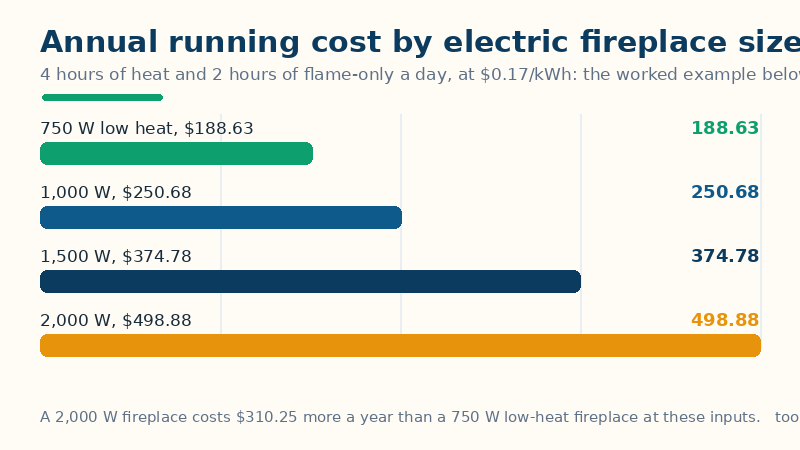
flame energy per day (kWh) = 0.020 kW × hours of flame-only a dayenergy per year (kWh) = energy per day × 365annual cost ($) = energy per year × electricity priceThe watts on the label are the heater's draw, and the heater does not draw them every hour the fire is on. Most electric fireplaces run 750 to 2,000 W when heating — 1,500 W is the standard, about 5,118 BTU an hour — with a low-heat setting of 750 W, while the flame effect alone draws only 10 to 30 W of LED light. What matters is the hours of each: four hours of heat is 6 kWh, while two hours of flames is 0.04 kWh — the heat is 150 times the flame — so the evening is priced by the heat hours, and the flame hours are nearly free. And like the radiator beside it on this page's family, a fireplace is usually seasonal — the yearly figure assumes every evening of the year, so a fireplace lit for the four cold months costs about a third of it.
Worked example: 1,500 W, 4 hours of heat and 2 hours of flame-only a day, $0.17/kWh
A 1,500 W electric fireplace at 4 hours of heat a day uses 1.5 × 4 = 6.00 kWh of heat a day, costing $1.02. The flame effect at 2 hours a day uses 0.02 × 2 = 0.04 kWh a day, costing $0.01. Together that is 6.0 kWh a day, costing $1.03. A month is 2,204.6 ÷ 12 = 183.7 kWh, costing $31.23. A year is 6.04 × 365 = 2,204.6 kWh, costing $374.78. The table above shows the same maths for the other fireplace sizes at 4 hours of heat and 2 hours of flames a day: a 750 W low-heat fireplace costs 12.8¢ an hour of heat and $188.63 a year in total, a 1,000 W fireplace costs 17.0¢ an hour of heat and $250.68 a year, and a 2,000 W large fireplace costs 34.0¢ an hour of heat and $498.88 a year. One hour of heat costs 25.5¢ at these settings and one hour of flame-only costs 0.3¢; the heat alone costs $372.30 a year and the flame alone $2.48. At 8 hours of heat a day the same fireplace costs $747.08 a year, and a four-month winter at this pace costs $124.93. Ten years of fireside evenings at this pace costs $3,747.82. Five published cross-checks reproduce exactly: wattcostcalc's 1,500 W electric fireplace at 4 hours a day and 17.5 cents costs $0.263 an hour, $1.05 a day, $31.50 a month and $383.25 a year — this page gives the same 6 kWh a day, $1.05 a day and $383.25 a year, while its $31.50 a month is the day times 30 and this page's year-divided-by-12 month is $31.94; and its 1-hour row of $7.88 a month and $95.81 a year is the same day-times-30 and day-times-365 maths against this page's $7.98 and $95.81. ElectriFlames' 1,500 W fireplace at 5 hours a day and 15 cents costs about $1.13 a day — this page gives the same 7.5 kWh a day and $1.13 a day — and their "roughly 23 cents" an hour is the whole-cent rounding of this page's 22.5¢. HomeGuide's table at 4 hours a day gives a 750 W fireplace $0.11 to $0.17 an hour and $13 to $20 a month — this page gives the same range as 10.5¢ to 16.5¢ an hour and $12.78 to $20.08 a month — and a 1,500 W fireplace $0.21 to $0.33 an hour and $26 to $40 a month — this page gives 21.0¢ to 33.0¢ an hour and $25.55 to $40.15 a month. Santanna Energy's 1,500 W fireplace at 4 hours a day and 18.34 cents costs $1.10 a day, $33.01 a month and $401.65 a year — this page gives the same $1.10 a day and $401.65 a year, while its $33.01 a month is the day times 30 against this page's $33.47; and its 1,000 W fireplace costs $0.73 a day and $22.01 a month — this page gives the same $0.73 a day, with the month $22.31. And HeaterGuides' 1,200 W fireplace at 4 hours a day and 14 cents costs $80.64 for a 120-day season — this page gives the same 4.8 kWh a day and $0.67 a day, while its 120-day season is four days shorter than this page's four-month winter of $81.76, the year divided by three.
How to read your result, and its limits
Four cautions keep the number honest. First, the flame watts are an assumption: this page uses 20 W for the flame effect, the middle of the 10 to 30 W band published guides give, and if your fireplace runs a fan with the flames the flame line is low — but even a 100 W flame effect is 1.7¢ an hour, so the flame is never the bill. Second, the heat is the bill: 6 kWh a day of heat against 0.04 kWh of flame — the flame is $2.48 of the $374.78 yearly total — so price the heat hours, not the flame hours. Third, the season is not the year: the yearly figure assumes the fire burns every evening of the year, but a four-month winter at this pace costs $124.93, not $374.78 — use the winter line for a fireplace lit in the cold months only. Fourth, the electricity price is the all-in rate: the total on the bill divided by the kilowatt-hours on the bill, including delivery charges. A 1,500 W fireplace on high heat costs the same as a 1,500 W space heater — 25.5¢ an hour at $0.17 — because 1,500 W is 1,500 W whatever the box looks like. For the heat pump that replaces the fire, the heat pump savings calculator prices the saving against resistance heat; and for the cost of running anything else in the house, the electricity cost calculator prices any appliance by watts and hours.
Common mistakes
- Pricing flame-only hours at heater watts. Two hours of flame-only is 0.04 kWh and $0.01, not 3 kWh and $0.51 — the flames are LED light, not the element. Price the heat hours and the flame hours separately.
- Running the heat all evening when the flames would do. Once the room is warm, the flames alone are 0.3¢ an hour — switch the heat off and keep the look. An evening of flames without heat is about a cent, not a dollar.
- Multiplying the daily cost by 30 for the month. Thirty days is not a twelfth of a year: the day times 30 gives $30.80 a month at the worked example's inputs, while the year divided by 12 gives $31.23. Use the year-divided-by-12 figure, which is the one that adds up.
- Pricing the whole year for a seasonal fireplace. Four hours of heat a day for a four-month winter is $124.93, not $374.78 — the yearly figure assumes the fire burns every evening of the year. Use the winter line for a fireplace lit in the cold months only.
- Adding the standing charge to every hour. The daily supply charge is payable whether the fireplace runs or not. Only the per-kWh rate belongs in the per-hour maths — the fixed charge is a separate line on the bill.
Frequently asked questions
How much does it cost to run an electric fireplace per hour?
A 1,500 W electric fireplace costs 25.5¢ an hour of heat at $0.17 per kWh, and about 0.3¢ an hour of flame-only. Four hours of heat and two hours of flames a day costs $1.03 a day, $31.23 a month and $374.78 a year — of which the flame is $2.48 a year.
How much does it cost to run an electric fireplace per month?
At the worked example's inputs — 1,500 W, 4 hours of heat and 2 hours of flame-only a day — the fireplace uses 183.7 kWh a month and costs $31.23 at $0.17 per kWh. The heat alone is $31.03 of that, and a four-month winter at this pace costs $124.93.
Does the flame-only mode cost anything?
Almost nothing: the flame effect is about 20 W of LED light, so two hours of flames a day is 0.04 kWh and about $0.01 a day — $2.48 a year. Published guides round the flame-only figure to about 1 to 2 cents an hour, which covers a larger flame effect or a fan running with it.
Is an electric fireplace cheaper to run than a space heater?
No, watt for watt: a 1,500 W fireplace on high heat and a 1,500 W space heater both use 1.5 kWh an hour — 25.5¢ at $0.17 per kWh. The fireplace adds the flame effect, which is the cheap part; the saving, if there is one, is heating one room with the fire instead of the whole house with central heat.