Gear litres set the size, the roll-top sets the allowance
A dry bag's litres are measured after it is closed — rolled down three or four times and clipped — which means a bag filled to the brim cannot be sealed at all. The honest calculation therefore has two steps: add up what must stay dry, then divide by the fill fraction. This page uses planning allowances for the first step — a change of clothes 5 litres, a towel 3 litres, a compressed sleeping bag 12 litres, food 1 litre a day, plus a flat 2 litres for phone, keys and wallet — and three-quarters for the second step, the fill fraction a roll-top closure leaves. The standard sizes makers sell are 5, 10, 15, 20, 30, 40, 55 and 65 litres, and the recommendation is the smallest standard size at or above the divided figure, so the bag closes with room to spare rather than exactly.
Gear litres = 2 (valuables) + 5 × changes of clothes + 3 × towels + 12 × sleeping bags + 1 × food days — Rated size needed = gear litres ÷ 0.75 — Buy the smallest standard size (5, 10, 15, 20, 30, 40, 55, 65 L) at or above that figure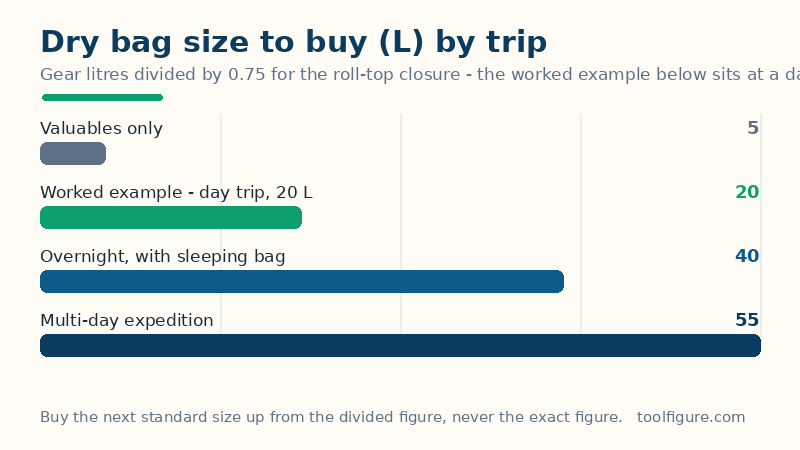
The allowances are planning figures, not maker measurements: a bulky fleece change packs larger than a summer change, and a sleeping bag's compressed volume depends on its fill and stuff sack. They are deliberately round so the arithmetic can be checked by hand, and the three-quarter divisor absorbs ordinary packing variation — a bag bought on this calculation has spare room by construction, not by luck. The size ladder in the guides agrees with the outputs: 5 litres for valuables, 10–20 litres for a day trip, 30–40 litres for an overnight trip with a sleeping bag, and 55–65 litres for multi-day expeditions.
Worked example: 1 change, 1 towel, 2 food days
A day tripper carrying one change of clothes, one towel and two days of snacks, plus phone, keys and wallet, should buy a 20 L dry bag. The working: gear litres = 2 (valuables) + 5 × 1 (clothes) + 3 × 1 (towel) + 12 × 0 (sleeping bags) + 1 × 2 (food days) = 2 + 5 + 3 + 0 + 2 = 12 litres. Rated size needed = 12 ÷ 0.75 = 16.0 litres. The smallest standard size at or above 16 litres is 20 litres, which filled to three-quarters holds 20 × 0.75 = 15.0 litres — 15.0 − 12.0 = 3.0 litres of spare room. The same arithmetic at other trip sizes:
| Trip | Gear litres | Rated size needed | Buy | Spare room |
|---|---|---|---|---|
| Valuables only | 2.0 L | 2.7 L | 5 L | 1.8 L |
| Day trip (worked example) | 12.0 L | 16.0 L | 20 L | 3.0 L |
| Overnight, with sleeping bag | 24.0 L | 32.0 L | 40 L | 6.0 L |
| Multi-day expedition | 37.0 L | 49.3 L | 55 L | 4.3 L |
Check the overnight row by hand: 2 + 5 + 3 + 12 + 2 = 24 litres, 24 ÷ 0.75 = 32.0 litres, and 32 is not a standard size, so the buy steps to 40 litres, which holds 40 × 0.75 = 30.0 litres at three-quarters — 30.0 − 24.0 = 6.0 litres of spare room. The multi-day row works the same way: 37 ÷ 0.75 = 49.3 litres, stepping to 55 litres, which holds 41.3 litres — 4.3 litres of spare room. The point stands in every row: the buy is always the next standard size up, never the exact divided figure, because the divided figure is a minimum, not a bag size.
How to read your result, and its limits
Three checks before trusting the size. First, the allowances are planning figures: if your change of clothes is a bulky fleece set or your sleeping bag compresses poorly, add a change's worth of litres and re-run — the divisor will carry the extra into the buy size. Second, check the hatch, not just the litres: a 20 L bag fits most recreational kayak hatches, while 40 L and up may not, and a bag that does not fit the hatch is the wrong bag whatever its litres. Third, one bag is not always the answer: above 65 litres of rated size this page says to split across two bags, and even below that, valuables in a small separate bag keep the phone reachable without opening the main bag — and limit what gets wet if one bag punctures.
Common mistakes
- Buying the exact gear litres. A 12-litre load in a 12-litre bag cannot be rolled shut — the bag's litres are measured after rolling, so the buy must exceed the load by the closure allowance.
- Counting gear that can get wet. Dry goods, water bottles and gear that tolerates a splash inflate the total and push the buy a whole standard size up for no benefit.
- One giant bag for every trip. A 55-litre bag on a day trip is half-empty, hard to roll and seal, and awkward to carry — the day-trip size and the expedition size are different bags.
- Trusting the litre label across brands. Makers measure slightly differently; the three-quarter rule and the next-size-up step are what make the recommendation robust to that variation.
Related tools: Kayak Size Calculator — Your kayak size from height and weight: length range, volume class and minimum capacity; Cooler Size Calculator — Your cooler size from group, days, drinks and food — the litres and quarts it must hold, the standard size to buy, and the ice inside it; Backpack Size Calculator — Your backpack size in two parts: frame size from torso length, and litres from trip length, packing style and season.
Frequently asked questions
What size dry bag do I need?
It follows what must stay dry: add 2 litres for valuables, 5 per change of clothes, 3 per towel, 12 per compressed sleeping bag and 1 per food day, then divide by 0.75 for the roll-top closure and round up to the next standard size. For example, 1 change, 1 towel and 2 food days is 12 litres of gear, needing 16 litres of rated size — buy 20 litres.
Why divide by 0.75 for a dry bag?
Because a roll-top bag is only filled to about three-quarters before the top is rolled down three or four times to seal. The litres printed on a bag are measured after rolling, so a bag filled to the brim cannot be closed — the divisor is the closure allowance, not padding.
What fits in a 20 litre dry bag?
A day trip's kit: phone, keys and wallet, a full change of clothes, a towel and a couple of days of snacks — 12 litres of gear, which needs 16 litres of rated size and buys a 20-litre bag with 3 litres of spare room.
Is one big dry bag or several small ones better?
Several small ones, for most trips: valuables in a 5-litre bag plus kit in a larger bag keeps the phone reachable without opening the main bag, and if one bag punctures only part of the kit gets wet. Above 65 litres of rated size, splitting across two bags is the only option this page recommends.
