Three steps: energy per load, loads a year, cost
The whole calculation is one multiplication with a correction for the cycling. Energy per load times the electricity price is the cost of one load; energy per load times the loads a week times 52 weeks is the year's energy; the year's energy times the price is the year's money. The correction that makes the answer honest is the energy per load itself — it is a measured figure, not the nameplate watts times the cycle length:
cost per load ($) = energy per load (kWh) × electricity price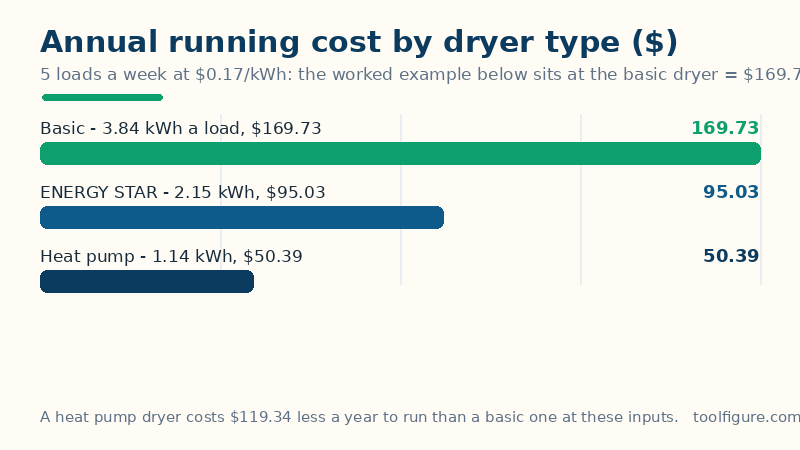
annual energy (kWh) = energy per load × loads a week × 52annual cost ($) = annual energy × electricity priceThe energy-per-load figures on this page are the Department of Energy's test figures for a standard 8.45 lb load: a basic dryer uses 3.84 kWh a load (2.20 lb of clothes dried per kWh), an ENERGY STAR dryer uses 2.15 kWh (3.93 lb/kWh) and a heat pump dryer uses 1.14 kWh (7.39 lb/kWh). The ENERGY STAR level becomes the federal minimum for new standard-size electric dryers from 1 March 2028, so the basic figure is already the old machine's number. The element in a standard dryer is rated around 5,600 W, but the Department of Energy's test sample averaged a 61-minute cycle with the element cycling on and off — which is why 5,600 W for an hour (5.6 kWh) is not the load's energy, and why the measured 3.84 kWh is the figure to price.
Worked example: 3.84 kWh a load, 5 loads a week, $0.17/kWh
A basic dryer uses 3.84 kWh per load, and a household dries 5 loads a week at $0.17 per kWh. One load costs 3.84 × $0.17 = $0.65. A week is 3.84 × 5 = 19.2 kWh, costing $3.26. A month is 998.4 ÷ 12 = 83.2 kWh, costing $14.14. A year is 3.84 × 5 × 52 = 998.4 kWh, costing $169.73. The table above shows the same maths for the other dryer types at the same 5 loads a week: an ENERGY STAR dryer at 2.15 kWh a load costs $0.37 a load and $95.03 a year — a $74.70 a year saving against the basic dryer — and a heat pump dryer at 1.14 kWh costs $0.19 a load and $50.39 a year, a $119.34 a year saving. At 7 loads a week the basic dryer costs $237.62 a year. Three published cross-checks reproduce exactly: a 4,400 W dryer running 54 minutes (0.9 hours) uses 3.96 kWh a load, which at 5 loads a week is 1,029.6 kWh a year and $178.12 at $0.173/kWh; a 3,000 W dryer for 45 minutes at $0.15/kWh costs $0.34 a load; and a 3,000 W dryer for an hour at $0.175/kWh costs $0.525 a load.
How to read your result, and its limits
Four cautions keep the number honest. First, the year is 52 weeks: 364 days, one day short of a calendar year, so a 365-day year adds about one load's cost — about $0.65 at the worked example's inputs. Second, this page prices electric dryers: a gas dryer burns gas for its heat and draws only a few hundred watts of electricity for the drum and controls, so its electric cost is small and its gas cost is a separate question — the water heater cost calculator shows how gas is priced per therm. Third, not every load is the standard load: heavy towels take longer and use more energy than a light load of delicates, a moisture sensor that stops when the clothes are dry uses less than a fixed timer, and a clogged lint filter or a long vent run adds minutes to every cycle. Fourth, the electricity price is the all-in rate: the total on the bill divided by the kilowatt-hours on the bill, including delivery charges. For the other half of the laundry, the washing machine cost calculator prices the wash — where the water heating, not the motor, is the cost; for the cost of running anything else in the house, the electricity cost calculator prices any appliance by watts and hours; and for the cheapest upgrade in the house, the LED bulb savings calculator prices the swap bulb by bulb.
Common mistakes
- Multiplying the nameplate watts by the cycle hours. A 5,600 W element for an hour is 5.6 kWh, which at $0.17/kWh is $0.95 a load and $247.52 a year at 5 loads a week — against the measured $0.65 a load and $169.73 a year. The element cycles off for much of the cycle, so the nameplate figure overstates the bill by nearly half.
- Comparing dryers on watts instead of kWh per load. Two dryers can carry the same 5,600 W rating and use very different energy per load, because one has a moisture sensor and a heat pump and the other does not. The kWh per load — 3.84, 2.15 or 1.14 — is the comparison; the watts are not.
- Forgetting the loads a week. The per-load cost is the interesting number, but the yearly cost is the budget number, and it scales directly with frequency: 3 loads a week is $101.84 a year, 5 is $169.73 and 7 is $237.62 at the worked example's inputs. Count the loads before quoting the year.
- Adding the standing charge to every load. The daily supply charge is payable whether the dryer runs or not. Only the per-kWh rate belongs in the per-load maths — the fixed charge is a separate line on the bill.
Frequently asked questions
How much does a clothes dryer cost to run per load?
A basic dryer at the Department of Energy's test figure of 3.84 kWh a load costs $0.65 a load at $0.17 per kWh. An ENERGY STAR dryer at 2.15 kWh costs $0.37 a load and a heat pump dryer at 1.14 kWh costs $0.19 a load at the same rate.
Why can't I just multiply the watts by the hours?
Because the heating element cycles: it is rated around 5,600 W while it is on, but it switches off for much of every cycle — the Department of Energy's test sample averaged a 61-minute cycle. Multiplying 5,600 W by an hour gives 5.6 kWh and $0.95 a load, against the measured 3.84 kWh and $0.65. The kWh per load is the number that matters.
How much does a clothes dryer cost to run per year?
At 5 loads a week and $0.17 per kWh, a basic dryer uses 998.4 kWh a year and costs $169.73. At 7 loads a week it costs $237.62 a year, and at 3 loads a week $101.84 — the yearly cost scales directly with how often the dryer runs.
Is a heat pump dryer worth it?
On running cost, yes by a clear margin: at 5 loads a week and $0.17/kWh a heat pump dryer costs $50.39 a year against $169.73 for a basic dryer, a $119.34 a year saving, and an ENERGY STAR dryer saves $74.70 a year. Whether it pays for itself depends on the price gap to the basic dryer — and heat pump dryers take longer per load and need no vent, which matters in a flat.