The IHF table, stated in full
Handball sizes are not a shop convention — they are the International Handball Federation's ball regulations, and the table below is the resin-ball table exactly as the IHF publishes it. Circumference is measured around the widest point of the inflated ball, and weight is verified after inflation, not before. The no-resin table follows underneath, because the same size number means a smaller, lighter ball when no resin is used, and buying the resin ball for a no-resin league — or the reverse — is the most common sizing mistake in the sport.
| IHF size | Circumference (resin) | Weight (resin) | Who plays it |
|---|---|---|---|
| 3 | 58–60 cm | 425–475 g | Men senior, boys 16+ |
| 2 | 54–56 cm | 325–375 g | Women senior, girls 14+, boys 12–16 |
| 1 | 50–52 cm | 290–330 g | Girls 8–14, boys 8–12 |
| 0 | 46–48 cm | 255–280 g | Children 8 and under, beginners |
| IHF size | Circumference (no resin) | Weight (no resin) |
|---|---|---|
| 3 | 55.5–57.5 cm | 400–425 g |
| 2 | 51.5–53.5 cm | 300–325 g |
| 1 | 49–51 cm | 290–315 g |
| 0 | 46–48 cm | 255–280 g |
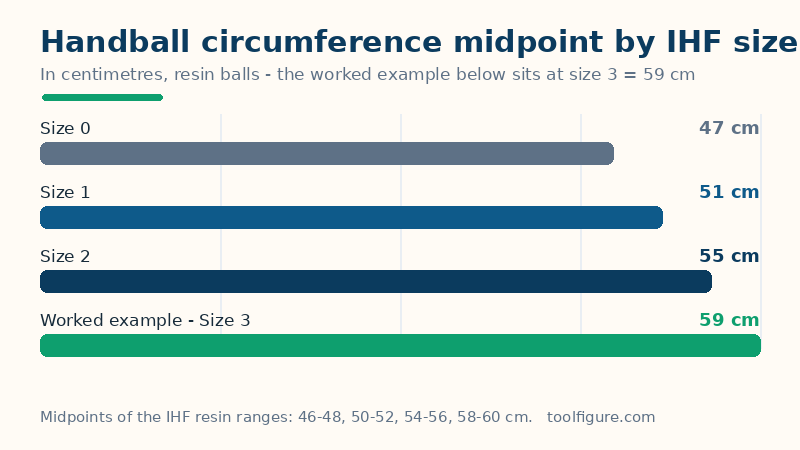
The boundary rule is the part worth stating plainly, because the bands overlap on paper: a boy is on size 1 from 8 to 12 and on size 2 from 12 to 16, so at exactly 12 he takes size 2; a girl is on size 1 from 8 to 14 and on size 2 from 14 on, so at exactly 14 she takes size 2; and a boy is on size 2 up to 16 and on size 3 from 16 on, so at exactly 16 he takes size 3. The calculator applies that rule — higher size at the boundary age — and says so in its result. The diameter follows from the circumference by dividing by π: a size 3 ball at the 59 cm midpoint is 59 ÷ π = 18.78 cm across, a size 2 at 55 cm is 17.51 cm, a size 1 at 51 cm is 16.23 cm, and a size 0 at 47 cm is 14.96 cm.
Worked example: 17-year-old boy, resin ball
A 17-year-old boy playing with resin takes IHF size 3: 58–60 cm around, 425–475 g. In inches the circumference is 58 ÷ 2.54 = 22.83 in to 60 ÷ 2.54 = 23.62 in; in ounces the weight is 425 ÷ 28.349523125 = 15.0 oz to 475 ÷ 28.349523125 = 16.8 oz; and the diameter at the 59 cm midpoint is 59 ÷ π = 18.78 cm. The same player without resin would take the same size number but a smaller ball: 55.5–57.5 cm and 400–425 g, which is 21.85–22.64 in and 14.1–15.0 oz. Two more spot checks from the table: a 10-year-old girl takes size 1 (50–52 cm, 290–330 g = 10.2–11.6 oz), and a 13-year-old boy takes size 2 (54–56 cm, 325–375 g = 11.5–13.2 oz). A 7-year-old of either gender takes size 0 (46–48 cm, 255–280 g = 9.0–9.9 oz).
How to read your result, and its limits
Three checks before buying. First, confirm resin or no resin with the league: the size number alone does not settle the ball, because the no-resin size 3 (55.5–57.5 cm, 400–425 g) is a different ball from the resin size 3 (58–60 cm, 425–475 g), and leagues differ. Second, never size up early: a ball one size too big for a young player is not a growth investment, it is extra shoulder load on every throw, and the guides flag it as an overuse-injury risk for developing shoulders. Third, remember the beginners sizes below size 0: size 00 runs 44–46 cm and 165–190 g for the youngest beginners, and non-inflatable squeeze balls run 46–48 cm and 190–225 g — both exist so that a child under 8 who finds even size 0 hard to grip still has a ball. As a practical tip rather than a rule, a hand span (thumb tip to little-finger tip, fully stretched) under about 18 cm argues for staying on the smaller size even at a boundary age — the IHF bands are the rule, but grip is the reality.
Common mistakes
- Buying by the size number alone. Size 3 with resin and size 3 without resin are different balls. Always match the league's resin rule as well as the size.
- Sizing up at a boundary the wrong way. At 12, 14 and 16 the higher size applies — but that is the ceiling, not a reason to jump a 13-year-old to size 3 because he looks big.
- Weighing a flat ball. Weight is verified after inflation. An underinflated ball reads lighter and plays dead, and it fails the IHF check for the wrong reason.
- Using a men's ball for a women's game. The women's senior ball is size 2 (54–56 cm, 325–375 g), a full step below the men's size 3 — the most common club mix-up.
Related tools: Basketball Size Calculator — The right basketball size from age and gender: sizes 1 to 7 with circumference, weight and diameter; Volleyball Size Calculator — The right volleyball size from age: indoor sizes 3, 4 and 5 plus the beach ball, with circumference, weight and diameter; American Football Size Calculator — The right American football from the player's age: Pee Wee size 5, Junior 6, Youth 7 or Official 9, with lengths and weights.
Frequently asked questions
What size handball does a 10-year-old need?
Size 1, for both boys and girls: 50–52 cm around and 290–330 g with resin. Girls stay on size 1 until 14 and boys until 12, so a 10-year-old is safely inside the band either way.
What is the difference between resin and no-resin handballs?
The same size number is smaller and lighter without resin: size 3 drops from 58–60 cm and 425–475 g to 55.5–57.5 cm and 400–425 g, and sizes 2 and 1 drop by a similar step. Always check which ball your league uses.
What size handball is used at exactly 16, 14 or 12 years old?
The higher size: a 16-year-old boy takes size 3, a 14-year-old girl takes size 2, and a 12-year-old boy takes size 2. The IHF bands read '16 and older', '14 and older' and '12 to 16', and the calculator applies that rule.
What is a size 0 handball?
The beginners ball: 46–48 cm and 255–280 g, for children aged 8 and younger and for beginners of any age. Below it sit size 00 (44–46 cm, 165–190 g) and squeeze balls for the very youngest players.
