The formula: age bands, then diameter from circumference
League ball size is an age band, not a calculation: ages 4–8 play size 3, ages 9–12 play size 4, and ages 13 and over play size 5. Skills balls are deliberately smaller: size 1 up to age 3, size 2 from age 4 up. The one piece of arithmetic on the page is the diameter, worked out from the circumference because ball sizes are specified by circumference:
Diameter = circumference ÷ π (using the midpoint of the size's circumference range)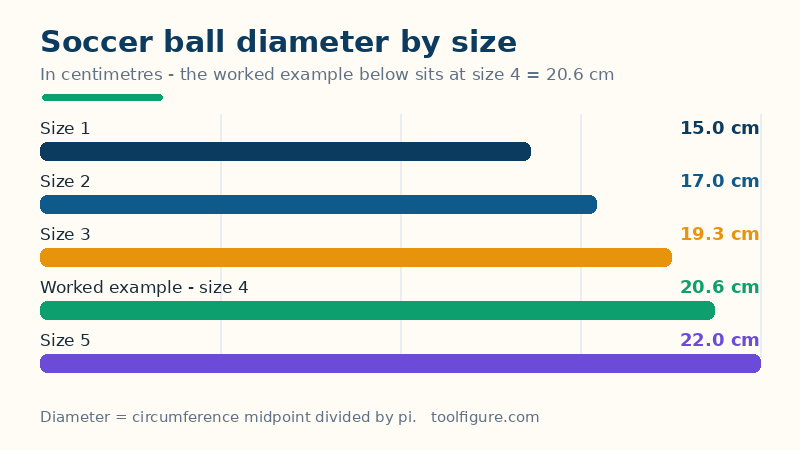
| Ball size | Circumference | Weight | Diameter |
|---|---|---|---|
| Size 1 (mini) | 43–51 cm (17–20 in) | Varies | 15.0 cm |
| Size 2 (skills) | 51–56 cm (20–22 in) | 250–280 g (8.8–9.9 oz) | 17.0 cm |
| Size 3 | 58–63.5 cm (23–25 in) | 283–340 g (10.0–12.0 oz) | 19.3 cm |
| Size 4 | 63.5–66 cm (25–26 in) | 350–390 g (12.3–13.8 oz) | 20.6 cm |
| Size 5 | 68–70 cm (27–28 in) | 410–450 g (14.5–15.9 oz) | 22.0 cm |
Worked example: age 10, league match
Age 10 falls in the 9–12 band, so the ball is size 4. Its circumference range is 25–26 in (63.5–66 cm), its weight range is 350–390 g (12.3–13.8 oz), and its diameter is the circumference midpoint divided by pi: (63.5 + 66) / 2 = 64.75 cm, and 64.75 ÷ 3.1416 = 20.6 cm. A second check: age 5 in a league takes size 3 — 23–25 in, 283–340 g, diameter (58 + 63.5) / 2 = 60.75 cm ÷ π = 19.3 cm — and the same 5-year-old doing skills work takes a size 2.
How to read your result, and its limits
Three checks before buying. First, the league's table beats this page: age cutoffs move between leagues and seasons, and U13 is the known wobble — some leagues still play size 4 there. Second, a ball that is too big teaches bad habits: a child who cannot lift the ball stops using the instep and starts toe-poking, which is why the bands exist. Third, sizes 1 and 2 are not match balls at older ages: they are skills tools, and an older player juggling a size 2 is training touch, not preparing for a match.
Common mistakes
- Buying size 5 for a young child. A full-size ball is too heavy and too big for a small player to strike properly — it teaches toe-poking instead of instep kicking.
- Using a skills ball in a match. Size 1 and 2 balls are for control work; league games require the age-band size.
- Assuming 13 means size 5 everywhere. U13 varies by league — some still play size 4, so check before buying.
- Judging by height instead of age. Ball size follows the age band, not how tall the player is — a tall 10-year-old still plays size 4.
Related tools: Baseball Bat Size Calculator — Your baseball bat length from height, with the age-group drop weight and the bat weight in ounces; Cricket Bat Size Calculator — The right cricket bat size from your height, with bat length, typical age group and a next-size-up warning near a boundary; Hockey Stick Length Calculator — The right ice hockey stick length from your height and position: height times 0.84, minus 2 in for forwards, plus 2 in for defence.
Frequently asked questions
What size soccer ball for a 10-year-old?
Size 4 for league play: 25–26 in circumference, 350–390 g, about 20.6 cm across. The same child doing skills work uses a size 2.
What size soccer ball for a 5-year-old?
Size 3 for league play: 23–25 in, 283–340 g, about 19.3 cm across. For skills practice, a 5-year-old uses a size 2.
What is the difference between a size 4 and a size 5 soccer ball?
Size 4 is 25–26 in around and 350–390 g; size 5 is 27–28 in and 410–450 g — about 1.4 cm wider across (20.6 cm against 22.0 cm). Size 4 is the 9–12 band; size 5 is 13 and over and the adult ball.
Does a 13-year-old use size 4 or size 5?
Size 5 on this page's rule — 13 and over plays the full-size ball. But U13 is the one band where leagues disagree: some still play size 4, so check your league's rules before buying.
