One field, two systems of units
Magnetic field strength — properly, magnetic flux density — is measured in two systems that refuse to die. The SI system uses the tesla, named for Nikola Tesla: one tesla is a strong field, the kind an MRI scanner or a laboratory magnet makes. The older CGS system uses the gauss, named for Carl Friedrich Gauss: one gauss is a small field, the kind a refrigerator magnet or the Earth makes. Everyday life speaks both. A fridge magnet is quoted in gauss, an MRI scanner in tesla, the Earth's field in microtesla, and a geophysics paper in nanotesla — and the same field can wear any of those labels. This page restates any field in all eight units at once, worked through tesla with every factor defined, so a figure in any dialect can be read in any other.
The formula
answer = tesla ÷ (tesla in one "to" unit)
Two terms, both visible on the page. value is the number you enter. tesla in one "from" unit is the definition of the unit you are converting from: 1 for the tesla itself, 0.001 for the millitesla, 0.000001 for the microtesla, 0.000000001 for the nanotesla, 0.0001 for the gauss, 0.0000001 for the milligauss, 0.1 for the kilogauss, and 0.0001 for the oersted in vacuum or air. answer is the result in the unit you asked for. The oersted is the one unit on the page that is not quite a flux density — it measures field strength, a related but different quantity — and in vacuum or air the two agree numerically, which is why the page carries it with that condition attached rather than silently equating them.
Worked example
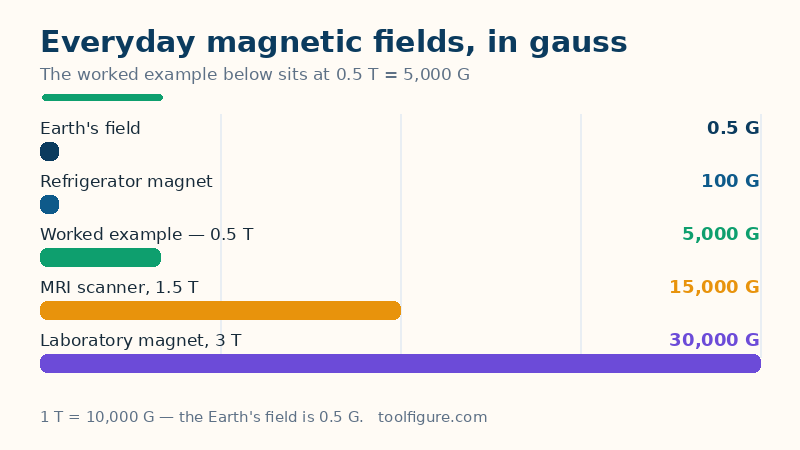
Convert 0.5 tesla to gauss — a small laboratory magnet, or a strong MRI fringe field — the way the tool does it.
Step 1 — get to tesla. The input is already in tesla, so 0.5 × 1 = 0.5 T.
Step 2 — divide by the target factor. One gauss is 0.0001 T, so 0.5 ÷ 0.0001 = 5,000.
Step 3 — read the display. The page prints six decimals below 0.001, four below 10 and two above, so the headline reads 5,000 G, and the detail line shows the working: 0.5 T = 5,000 G — worked through tesla: 0.5 T ÷ the Gauss factor.
Check it. Multiplying back, 5,000 × 0.0001 = 0.5 exactly — the gauss factor closes with nothing lost. The table underneath restates the same 0.5 T in all eight units (500 mT, 500,000 µT, 500,000,000 nT, 5,000 G, 5,000,000 mG, 5 kG, 5,000 Oe), so the from/to choice only changes which row is the headline.
Conversions worth memorising
Every row below is the tool's own output, checked figure by figure:
| From | To | Result |
|---|---|---|
| 1 T | gauss | 10,000 G |
| 0.5 T | gauss | 5,000 G |
| 1 mT | gauss | 10 G |
| 50 µT | gauss | 0.5 G |
| 1 G | tesla | 0.0001 T |
| 500 G | tesla | 0.05 T |
| 1.5 T | gauss | 15,000 G |
| 3 T | gauss | 30,000 G |
| 100 µT | gauss | 1 G |
| 0.032 T | gauss | 320 G |
| 1 kG | tesla | 0.1 T |
| 10,000 G | tesla | 1 T |
Three rows deserve a second look. The 50 µT row is the Earth's field at the surface — 0.5 G — the field a compass needle follows, and the reason a "0.5 gauss" magnetometer reading and a "50 microtesla" geology paper are describing the same planet. The 1 mT row is the other everyday trap inverted: 10 G looks like a small number in gauss and a tiny number in tesla, and both readings are the same field — a millitesla is simply ten gauss. And the 1.5 T and 3 T rows are the two MRI standards — 15,000 G and 30,000 G — thirty thousand times the Earth's field, which is why an MRI suite has a controlled perimeter and a compass is useless inside it.
Three traps worth knowing
Gauss and oersted share a number, not a meaning. In vacuum or air, 1 G and 1 Oe convert with the same factor, and this page's oersted row will always match its gauss row. Inside iron, ferrite or any magnetic material they part ways, because the oersted tracks the field strength applied while the gauss tracks the flux density that results, and the material's permeability sits between them. Use the oersted row for air and vacuum only; inside a magnetic material it is the wrong quantity, not just the wrong unit.
Microtesla and milligauss differ by a factor of ten, and both appear on EMF meters. 1 µT = 0.01 G = 10 mG, so a meter reading "2 mG" is 0.2 µT, not 2 µT. The page prints both rows side by side precisely so a milligauss figure is never mistaken for a microtesla figure — a tenfold error that turns an ordinary household field into a headline.
Tiny fields hit the display floor in tesla. The page prints six decimals below 0.001, so the Earth's 50 µT reads as 0.00005 T — exact — but a 100 nT field reads as 0 T at the page's finest step, because 0.0000001 T rounds to zero at six decimals. Read the microtesla or nanotesla row for anything below a microtesla: the factor is exact, and the readable row is the one on the field's own scale.
How to read your result, and the limits
Results show six decimals below 0.001, four below 10 and two above — more precision than any Hall probe justifies, so round to the probe for real use. Four limits belong with the page. Negative values are refused: −0.5 T gets a clear error, because this page converts sizes, and a minus sign here would mean direction, not size — if your sign carries direction, take the magnitude first. Empty input clears quietly; type and the table rebuilds, delete and the page waits. Anything past a trillion in any unit gets a clear error instead of a meaningless digit string. And this page converts field sizes, not field shapes: it will restate any field in any unit, but it will not tell you whether a field is uniform, what it does to a compass at an angle, or whether a material saturates in it — for that you need the field's direction and the material, and this page will at least help you read its size in the right unit.
Related tools: Electric Current Converter — Amps to milliamps, microamps and more — every answer in all eight units, plus the watts at your voltage; Power Converter — Horsepower to kW, kW to hp, watts and tons of refrigeration — every answer in all eight units, through the exact definitions; Energy Converter — Joules to calories, kcal to kJ, kWh to joules and BTU — every answer in all ten units, through the exact definitions.
Frequently asked questions
How many gauss are in a tesla?
Exactly 10,000. So 1 T is 10,000 G, 0.5 T is 5,000 G, and 1.5 T — a standard MRI field — is 15,000 G. To go back, divide gauss by 10,000: 500 G is 0.05 T and 10,000 G is 1 T. This page does both directions and restates every answer in all eight units at once.
What is the Earth's magnetic field in tesla and gauss?
About 50 microtesla at the surface, which is 0.5 gauss, 0.00005 tesla and 500 milligauss. It varies with latitude — roughly 25 to 65 µT around the world — but 50 µT (0.5 G) is the figure to carry in your head, and the one a compass needle actually follows.
What is the difference between gauss and oersted?
In vacuum or air they convert with the same factor (1 Oe = 0.0001 T, like 1 G), so their rows on this page always match. Physically they are different quantities — gauss measures flux density, oersted measures field strength — and inside magnetic materials like iron they diverge, because the material's permeability sits between them. Use the oersted row for air and vacuum only.
What magnetic field does an MRI scanner use?
Most clinical scanners are 1.5 T (15,000 G) or 3 T (30,000 G) — thirty thousand times the Earth's field, which is why MRI suites have controlled perimeters. Research scanners reach 7 T (70,000 G) and beyond. Enter any of those figures on this page to see them in gauss, millitesla and the rest.