One budget, ten categories, one per-guest figure
The whole calculation is one multiplication per category and one division for the guests. Each category's amount is the total budget times its national share, and the cost per guest is the total budget divided by the guest count:
category amount ($) = total budget × category share %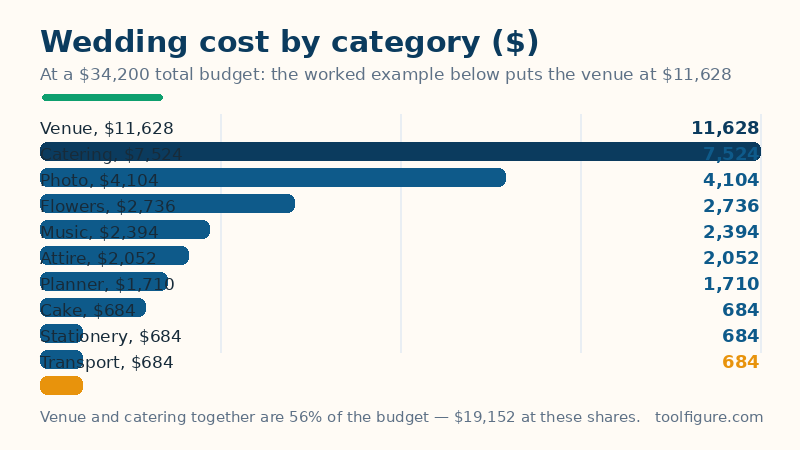
cost per guest ($) = total budget ÷ number of guestssum check ($) = the ten category amounts, which must add back to the total budgetThe shares are the national averages from The Knot's 2026 Real Weddings Study, and they add to exactly 100%: venue & rentals 34%, catering & bar 22%, photography & video 12%, flowers & decor 8%, music & entertainment 7%, attire & beauty 6%, planner & officiant 5%, cake & desserts 2%, stationery & favors 2%, transportation 2%. The table above shows the split at the national average budget of $34,200: the venue takes $11,628, catering $7,524, photography $4,104, flowers $2,736, music $2,394, attire $2,052, the planner $1,710, and cake, stationery and transport $684 each — and the ten lines add to $34,200 exactly. The venue and the catering together are 56% of the budget — $19,152 at the average — which is why those two lines decide whether the budget holds.
Worked example: a $34,200 wedding for 100 guests
At the national average budget of $34,200 for 100 guests, the split is: venue & rentals 34% = $11,628, catering & bar 22% = $7,524, photography & video 12% = $4,104, flowers & decor 8% = $2,736, music & entertainment 7% = $2,394, attire & beauty 6% = $2,052, planner & officiant 5% = $1,710, cake & desserts 2% = $684, stationery & favors 2% = $684, transportation 2% = $684. The ten lines add to $34,200, and the cost per guest is $34,200 ÷ 100 = $342. The same total at other guest counts shows why the guest list is the budget lever: 50 guests would be $684 a guest, 150 guests $228, and 200 guests $171 — the total does not change, only the share each guest carries. Two published cross-checks reproduce exactly. OnlyCalculators' Wedding Budget Calculator uses the same The Knot figures, and its $34,200 example is the worked example above — the same ten amounts, the same $342 a guest. The ToolsKit publishes a different split convention on a $30,000 budget — venue 45% ($13,500), photography 10% ($3,000), attire 10% ($3,000), flowers 8% ($2,400), music 8% ($2,400), rings 3% ($900), stationery 2% ($600), favours 2% ($600), transport 2% ($600) and a buffer of 10% ($3,000) — which also adds to $30,000 exactly. The honest difference is the convention, not an error: their venue share is 45% against The Knot's 34%, so the same wedding priced two ways differs by $3,300 on the venue alone at a $30,000 budget ($13,500 against this page's $10,200). On this page's shares, a $30,000 budget splits as venue $10,200, catering $6,600, photography $3,600, flowers $2,400, music $2,100, attire $1,800, planner $1,500, and cake, stationery and transport $600 each — $300 a guest at 100 guests.
How to read your result, and its limits
Four cautions keep the number honest. First, the shares are national averages, not your city's prices: a big-city venue can take far more than 34% of the budget, and a backyard wedding far less — the split is a starting point, and the venue quote you actually receive is the number that matters. Second, the per-guest figure is the total divided by the guests, nothing more: $342 a guest at 100 guests does not mean each guest costs $342 of food and drink — most of the budget is fixed (the venue, the photography, the music) and does not shrink when the guest list does, which is why cutting 50 guests saves far less than $17,100. Third, rings, the honeymoon and the rehearsal dinner are outside these ten categories: The Knot's ten shares sum to 100% without them, so a budget built only from this page understates the whole wedding — add the ring, the honeymoon and the rehearsal dinner as separate lines. Fourth, the average is not the typical wedding: $34,200 is a national mean, pulled up by very expensive weddings, and The Knot's own per-guest figure of about $292 works out to about 117 guests at that total — a smaller wedding at the same total is more per guest, and a larger one less. For the monthly side of the same household budget, the rent calculator prices what a home costs each month and the salary converter turns an annual salary into the monthly figure the wedding savings plan is built from; for the other kind of family planning on this site, the dog cost calculator prices the first year of a new member of the household the same way — one-off costs, yearly lines, and the total they add to.
Common mistakes
- Treating the total as the plan. A $34,200 budget with no split is a wish, not a plan: the venue alone is $11,628 at the national share, and a venue quote of $15,000 has already taken 44% of the budget before anything else is booked.
- Reading the per-guest figure as the cost of feeding a guest. The $342 a guest at 100 guests is the whole budget divided by the guest count — the venue, photography and music are in it. Cutting 50 guests does not save 50 × $342, because most of those lines do not shrink with the list.
- Forgetting the lines outside the ten categories. Rings, the honeymoon and the rehearsal dinner are not in the 100% — a budget that stops at this page's ten lines is short by exactly those three.
- Comparing two published splits as if one were wrong. The Knot's venue share is 34% and The ToolsKit's is 45% — different conventions, both adding to their own totals. Compare the shares, not just the totals, and pick the convention whose venue line matches the quotes you actually receive.
- Budgeting the average wedding instead of your wedding. $34,200 is a national mean, not a price list. A backyard wedding and a big-city ballroom are both real weddings, and their venue lines can differ by $10,000 or more.
Frequently asked questions
How much does a wedding cost on average?
The Knot's 2026 Real Weddings Study puts the national average wedding at $34,200 — about $292 a guest, which works out to about 117 guests. At 100 guests the same total is $342 a guest. The average is a mean, pulled up by very expensive weddings, so it is a planning benchmark rather than a price list.
What is the biggest wedding cost?
The venue and rentals, at 34% of the budget — $11,628 at the $34,200 national average. Catering and bar is next at 22% ($7,524), so the venue and the catering together are 56% of the budget ($19,152) and decide whether the budget holds.
How much does a wedding cost per guest?
The total budget divided by the guest count. At the $34,200 national average that is $342 a guest for 100 guests, $684 for 50 guests, $228 for 150 and $171 for 200. The total does not change with the guest list — only the share each guest carries.
What is not included in the wedding cost split?
Rings, the honeymoon and the rehearsal dinner sit outside the ten categories on this page — The Knot's ten shares already add to 100% without them. Budget those three as separate lines on top of the split, or the plan will be short by exactly those amounts.