Three steps: daily energy, yearly energy, cost
The whole calculation is one multiplication with a correction for the cycling. Running watts times the hours the compressor actually runs gives the day's watt-hours; dividing by 1,000 turns them into kilowatt-hours; multiplying by 365 gives the year; multiplying by the electricity price gives the money. The duty hours are the correction that makes the answer honest — they are the effective full-power hours, not the hours the fridge is switched on:
daily energy (kWh) = running watts × duty hours a day ÷ 1,000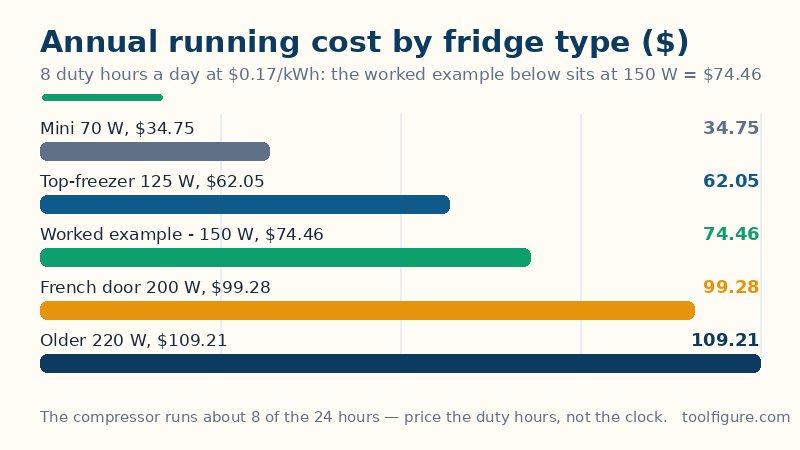
annual energy (kWh) = daily energy × 365annual cost ($) = annual energy × electricity priceaverage watts (W) = annual energy × 1,000 ÷ 8,760The last line is the figure the yellow EnergyGuide label is built on: the annual kilowatt-hours divided by the 8,760 hours in a year gives the average draw around the clock, which is far below the running watts because the compressor rests most of the time. A 150 W fridge averaging 50 W has its compressor on roughly a third of the time — a duty cycle of about 33%, which is why 8 duty hours a day is the planning figure for a modern fridge. The share of the household bill uses a typical 10,500 kWh a year for the whole home, so a 438 kWh fridge is about 4.2% of it — small beside heating and cooling, but the only load that never takes a day off.
Worked example: 150 W, 8 duty hours a day, $0.17/kWh
A standard fridge draws 150 W while its compressor runs, and the compressor runs about 8 effective hours a day. Daily energy is 150 × 8 ÷ 1,000 = 1.2 kWh a day. Over a year that is 1.2 × 365 = 438 kWh, costing 438 × $0.17 = $74.46 a year, or 36.5 kWh and $6.21 a month. The average draw is 438 × 1,000 ÷ 8,760 = 50.0 W around the clock, and the fridge is 4.2% of a typical 10,500 kWh household year. Over ten years it costs $744.60 to run. The table above shows the same maths for other fridges at the same 8 duty hours: a mini fridge at 70 W costs $34.75 a year, a top-freezer at 125 W costs $62.05, a French door at 200 W costs $99.28, and an older pre-2001 fridge at 220 W costs $109.21. The trap is the 24-hour version: 150 W × 24 hours ÷ 1,000 = 3.6 kWh a day, 1,314 kWh a year, $223.38 — three times the real cost, and the number most quick estimates quote.
How to read your result, and its limits
Four cautions keep the number honest. First, the duty hours are an estimate, not a meter reading: a fridge in a hot garage cycles far more than one in a cool kitchen, a full fridge holds its temperature better than an empty one, and opening the door often adds cycles — 8 hours is the planning figure for a modern fridge in a normal kitchen, and the EnergyGuide label's annual kWh is the measured figure to trust over any estimate. Second, the nameplate is not the running watts: the label on the back may quote the maximum draw or the defrost heater, which can be several hundred watts for a few minutes a day — the compressor's running watts are what this page wants, and the label's annual kWh divided by 365 is the better starting point when it is printed. Third, starting watts are a different question: the compressor draws 800 to 1,200 W for a fraction of a second when it spins up, which matters for sizing a generator or an inverter but adds almost nothing to the energy bill — for the surge, the generator size calculator sizes it properly. Fourth, the electricity price is the all-in rate: the total on the bill divided by the kilowatt-hours on the bill, including delivery charges. For the cost of running anything else in the house, the electricity cost calculator prices any appliance by watts and hours; for the appliance that costs the most to run, the air conditioner cost calculator prices the cooling by SEER; and for the cheapest upgrade in the house, the LED bulb savings calculator prices the swap bulb by bulb.
Common mistakes
- Multiplying the watts by 24 hours. The fridge is switched on all day, but the compressor runs about a third of it. The 24-hour figure — 1,314 kWh and $223.38 a year for a 150 W fridge — is three times the real 438 kWh and $74.46, and it is the single most common error in fridge cost estimates.
- Using the starting watts as the running watts. A fridge that draws 150 W while running can demand 1,200 W for a fraction of a second at startup. Priced as energy, that surge is negligible; priced as power, it would make the fridge look eight times as expensive as it is.
- Trusting the nameplate over the EnergyGuide label. The yellow label's annual kWh is measured under a standard test. If it is printed on the fridge, divide it by 365 for the daily figure and multiply by your rate — that number beats any estimate from watts and guessed duty hours.
- Forgetting that an old fridge costs twice as much to run. An older pre-2001 fridge at 220 W costs $109.21 a year against $74.46 for the modern 150 W unit — a $34.75 a year gap, every year, which is the running-cost half of the replacement decision.
Frequently asked questions
How much does a refrigerator cost to run per year?
A modern standard fridge at 150 running watts and about 8 duty hours a day uses 438 kWh a year, which costs $74.46 at $0.17 per kWh — about $6.21 a month. A mini fridge costs about $34.75 a year and a large French door about $99.28 at the same duty hours and rate.
Why can't I just multiply the watts by 24 hours?
Because the compressor cycles: it runs only part of each hour, about 8 effective hours a day for a modern fridge. Multiplying 150 W by 24 hours gives 1,314 kWh a year and $223.38 — three times the real 438 kWh and $74.46. The duty hours, not the clock, are the number that matters.
How do I use the EnergyGuide label?
The yellow label on a new fridge shows an estimated annual kWh figure measured under a federal test. Divide it by 365 for the daily figure and multiply it by your electricity rate for the yearly cost — a 600 kWh fridge costs about $96 a year at $0.16/kWh. That measured figure beats any estimate from watts and guessed duty hours.
How much does an old refrigerator cost to run?
An older pre-2001 fridge draws about 220 W while running, which at 8 duty hours a day is 642 kWh a year and $109.21 at $0.17/kWh — against $74.46 for a modern 150 W unit. ENERGY STAR notes an old refrigerator uses about 20% more energy on average than an ENERGY STAR model, so replacing one saves roughly $34.75 a year at these inputs, before any purchase price is counted.