One resistor, four labels
Resistance is a conductor's opposition to current — R = voltage ÷ current, in ohms, where one ohm passes one ampere under one volt. The ohm itself is far too small for most circuit work and far too large for the rest, so real resistors are labelled in its thousandths and thousands: milliohms for shunts and wire, ohms for speakers and heaters, kiloohms for the pull-ups and dividers on every board, megaohms for insulation and sensor work, gigaohms where leakage itself is the measurement. This page restates any resistance in all eight units at once, worked through the ohm with every factor defined, so a figure in any dialect can be read in any other. It also answers the question the conversion alone cannot: at a voltage you enter, how much current does this resistance draw, and how much power does it turn into heat?
The formula
answer = ohms ÷ (ohms in one "to" unit)
Two terms, both visible on the page. value is the number you enter. ohms in one "from" unit is the definition of the unit you are converting from: 10⁻⁶ for the microohm, 10⁻³ for the milliohm, 1 for the ohm itself, 10³ for the kiloohm, 10⁶ for the megaohm, 10⁹ for the gigaohm, 10⁻⁹ for the abohm, and approximately 8.987551787 × 10¹¹ for the statohm. answer is the result in the unit you asked for. Every SI step is a factor of exactly a thousand — that is the whole conversion, and it is why the kiloohm-to-ohm step never needs a calculator once the pattern is seen. The abohm and statohm are CGS units, kept here because they still appear in old tables; the statohm's factor is approximate because it inherits the speed of light, while the abohm's is exact within its own system.
Worked example
Convert 4.7 kiloohms to ohms — the pull-up resistor on countless boards, written 4k7 on schematics and in parts lists — the way the tool does it.
Step 1 — get to ohms. One kiloohm is 10³ Ω, so 4.7 × 1,000 = 4,700 Ω.
Step 2 — divide by the target factor. One ohm is 1 Ω, so 4,700 ÷ 1 = 4,700.
Step 3 — read the display. The page prints six decimals below 0.001, four below 10 and two above, so the headline reads 4,700 Ω, and the detail line shows the working: 4.7 kΩ = 4,700 Ω — worked through ohms: 4,700 Ω ÷ the Ohm factor.
Check it. Multiplying back, 4,700 Ω ÷ 1,000 = 4.7 kΩ, the value we started from. The full table for this example reads: 4,700,000,000 µΩ, 4,700,000 mΩ, 4,700 Ω, 4.7 kΩ, 0.0047 MΩ, 0.000005 GΩ, 4,700,000,000,000 abΩ and 0 stΩ — the gigaohm row is the page's six-decimal finest step applied to the exact 0.0000047 GΩ, and the statohm row reads 0 at that same step, the exact figure being about 5.23 × 10⁻⁹ stΩ. At 5 V, the power line reads 1.0638 mA and 5.3191 mW: 5 ÷ 4,700 = 0.0010638 A, and 25 ÷ 4,700 = 0.0053191 W.
Conversion table
The conversions bench work reaches for most, each one the same two steps as the example:
| From | To |
|---|---|
| 1 kΩ | 1,000 Ω |
| 1 MΩ | 1,000 kΩ |
| 220 Ω | 0.22 kΩ |
| 10 kΩ | 10,000 Ω |
| 1 Ω | 1,000 mΩ |
| 100 Ω | 0.1 kΩ |
| 47 kΩ | 47,000 Ω |
| 1 mΩ | 0.001 Ω |
| 330 Ω | 0.33 kΩ |
| 2.2 MΩ | 2,200 kΩ |
| 1 GΩ | 1,000 MΩ |
| 10 MΩ | 10,000,000 Ω |
| 1 µΩ | 0.001 mΩ |
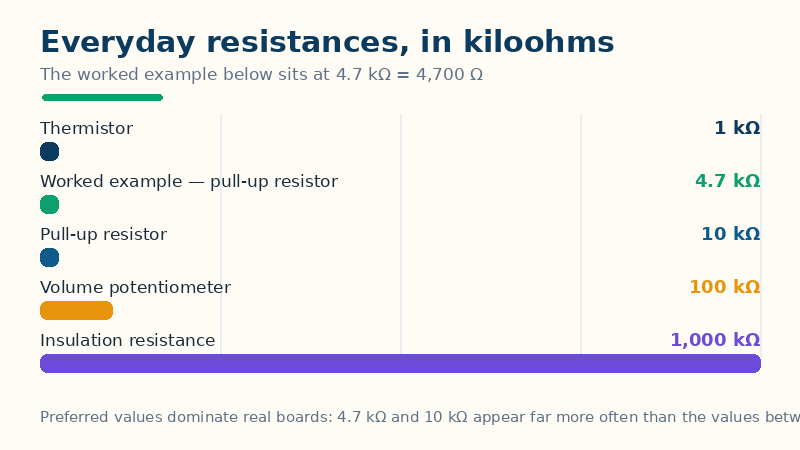
Two of those rows are the values a bench sees daily: 220 Ω and 330 Ω are the series resistors for indicator LEDs, and 10 kΩ is the default pull-up on microcontroller pins. The 4.7 kΩ of the worked example is an E12 preferred value — the colour bands yellow, violet, red, gold read 4, 7, two zeroes, ±5% — which is why it appears on boards far more often than 4.6 kΩ or 4.8 kΩ ever would.
Reading the result, and its limits
Three traps catch real work. First, the case trap: mΩ is not MΩ. A milliohm is a thousandth of an ohm and a megaohm is a million ohms — a billion apart — so a shunt marked 5 mΩ and an insulation test marked 5 MΩ differ by far more than a capital letter suggests. Second, the compact notation trap: 4k7, 4K7 and 4.7 kΩ are the same resistor, but a handwritten K in a parts list is sometimes a kiloohm and sometimes, in older European notation, nothing at all — always confirm against the schematic value, not the shorthand. Third, the power trap: a converted value says nothing about what the resistor can survive. A 4.7 kΩ resistor at 5 V dissipates only 5.3191 mW and any ordinary part handles it, but the same resistance at 230 V would dissipate about 11.26 W — over forty times an ordinary quarter-watt part's rating — so the conversion is correct and the resistor would still fail in smoke, because the wattage rating, not the resistance, is the limit. Check the rating in the datasheet before trusting any converted figure in a real circuit, and remember that a correct conversion of the wrong part is still the wrong part.
Related tools: Ohm's Law Calculator — Enter any two of voltage, current, resistance and power — get the other two, with the working; Electric Current Converter — Amps to milliamps, microamps and more — every answer in all eight units, plus the watts at your voltage; Capacitance Converter — Microfarads to nanofarads, picofarads, farads and more — every answer in all eight units.
Frequently asked questions
How many ohms are in a kiloohm?
Exactly 1,000. So 1 kΩ is 1,000 Ω and 1,000,000 mΩ, 4.7 kΩ is 4,700 Ω, and 10 kΩ is 10,000 Ω. Every SI step is a factor of a thousand: microohms to milliohms to ohms to kiloohms to megaohms to gigaohms.
What is the difference between mΩ and MΩ?
A factor of a billion. Small m means milli, one thousandth: 1 mΩ is 0.001 Ω. Capital M means mega, one million: 1 MΩ is 1,000,000 Ω. A 5 mΩ current shunt and a 5 MΩ insulation resistance are not remotely the same measurement, and the case of the letter is the whole difference.
What does 4k7 mean on a resistor?
It means 4.7 kΩ — the k replaces the decimal point so the value survives a smudged print. Its colour bands are yellow, violet, red, gold: 4, 7, two zeroes, ±5%. It is an E12 preferred value, which is why it turns up on boards far more often than 4.6 kΩ or 4.8 kΩ.
How much power does a resistor dissipate?
P = V² ÷ R: the voltage squared, divided by the resistance. A 4.7 kΩ resistor at 5 V dissipates 25 ÷ 4,700 = 0.0053191 W, which is 5.3191 mW, drawing 1.0638 mA. Enter the voltage on this page and the power line works it out for any resistance — and always check the part's wattage rating, which the conversion alone cannot tell you.