One flux, three labels
Magnetic flux is the total magnetic field passing through a surface — Φ = field × area, in webers, where one weber is the flux that, falling to zero in one second, induces one volt in a single-turn loop. The weber itself is far too large for ordinary magnetics, so real cores and sensors are labelled in its thousandths: milliwebers for transformer cores, microwebers for sensors, maxwells wherever an old CGS table is still in use. This page restates any flux in all eight units at once, worked through the weber with every factor defined, so a figure in any dialect can be read in any other. It also answers the question the conversion alone cannot: if this flux changes over a time you enter, how much voltage does that change induce?
The formula
answer = webers ÷ (webers in one "to" unit)
Two terms, both visible on the page. value is the number you enter. webers in one "from" unit is the definition of the unit you are converting from: 10³ for the kiloweber, 1 for the weber itself, 10⁻³ for the milliweber, 10⁻⁶ for the microweber, 10⁻⁹ for the nanoweber, 1 for the volt-second, 10⁻⁸ for the maxwell and 10⁻⁵ for the kilomaxwell. answer is the result in the unit you asked for. Every SI step is a factor of exactly a thousand — that is the whole conversion, and it is why the milliweber-to-maxwell step never needs a calculator once the pattern is seen. The volt-second needs no step at all: one weber is one volt-second by definition, which is the identity Faraday's law rests on.
Worked example
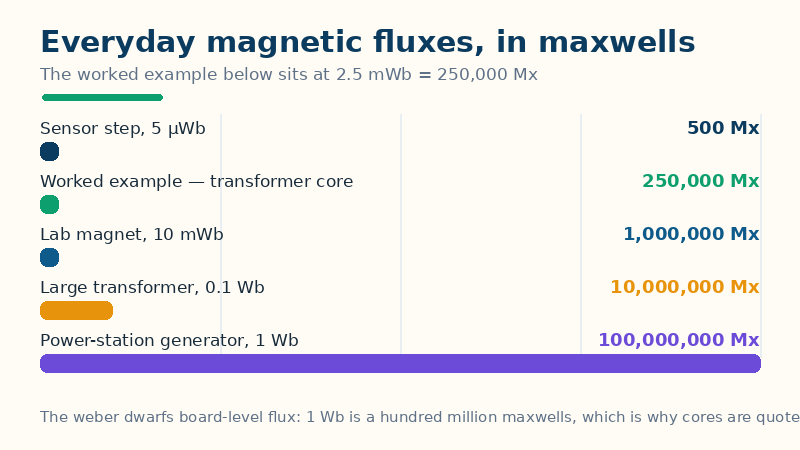
Convert 2.5 milliwebers to maxwells — the peak flux of a small transformer core, and the value a magnetics datasheet reaches for first — the way the tool does it.
Step 1 — get to webers. One milliweber is 10⁻³ Wb, so 2.5 × 0.001 = 0.0025 Wb.
Step 2 — divide by the target factor. One maxwell is 10⁻⁸ Wb, so 0.0025 ÷ 0.00000001 = 250,000.
Step 3 — read the display. The page prints six decimals below 0.001, four below 10 and two above, so the headline reads 250,000 Mx, and the detail line shows the working: 2.5 mWb = 250,000 Mx — worked through webers: 0.0025 Wb ÷ the Maxwell factor.
Check it. Multiplying back, 250,000 × 10⁻⁸ = 0.0025 Wb, the value we started from. The full table for this example reads: 0.0025 Wb, 0.000003 kWb, 2.5 mWb, 2,500 µWb, 2,500,000 nWb, 0.0025 V·s, 250,000 Mx and 250 kMx — the kiloweber row is the page's six-decimal finest step applied to the exact 0.0000025 kWb. If that flux fell to zero in 10 ms, the voltage line reads 250 mV: 0.0025 ÷ 0.01 = 0.25 V. And the same flux appears from the field side too: a 0.5 T field through 0.005 m² — 50 cm² — gives 0.5 × 0.005 = 0.0025 Wb, which is this example again.
Conversion table
The conversions magnetics work reaches for most, each one the same two steps as the example:
| From | To |
|---|---|
| 1 Wb | 100,000,000 Mx |
| 1 Wb | 1,000 mWb |
| 1 mWb | 100,000 Mx |
| 5 µWb | 500 Mx |
| 1 µWb | 100 Mx |
| 10 mWb | 0.01 Wb |
| 250,000 Mx | 2.5 mWb |
| 1 kWb | 1,000 Wb |
| 3 Wb | 300,000,000 Mx |
| 0.5 Wb | 50,000,000 Mx |
| 1 nWb | 0.1 Mx |
| 1 kMx | 0.01 mWb |
Two voltage cross-checks for the Faraday line, each one the same division: a 5 µWb change in 10 ms induces 0.5 mV, and a 1 Wb change in 1 second induces 1 V — the second one is the definition of the weber itself, stated as a measurement rather than a slogan.
Reading the result, and its limits
Three distinctions keep this page honest. First, flux is not field. The magnetic field converter restates flux density — tesla and gauss, field per unit area — while this page restates flux itself, field times area. A weber can never be converted to a tesla without an area, and a tesla can never be converted to a weber without one either; any table that appears to do so has silently assumed an area of one square metre. Second, the milli-versus-micro trap: mWb and µWb differ by a factor of a thousand, and a sensor reading copied in the wrong one is wrong by exactly that factor — the full table exists so the error is visible at a glance. Third, the uniform-field condition: Φ = B × A holds exactly only when the field is uniform and perpendicular to the surface; a real core's fringing field and a real coil's angle both change the true flux, and the conversion, however exact, cannot correct a field figure that was measured the wrong way. Check the geometry before trusting any converted figure in a real design, and remember that a correct conversion of the wrong flux is still the wrong flux.
Related tools: Magnetic Field Converter — Tesla to gauss, millitesla, microtesla and more — every answer in all eight units; Inductance Converter — Microhenries to millihenries, nanohenries, henries and more — every answer in all eight units; Electric Current Converter — Amps to milliamps, microamps and more — every answer in all eight units, plus the watts at your voltage.
Frequently asked questions
How many maxwells are in a weber?
Exactly 100,000,000. So 1 Wb is 100,000,000 Mx, 1 mWb is 100,000 Mx, and 2.5 mWb is 250,000 Mx. Every SI step is a factor of a thousand, and the CGS maxwell sits eight powers of ten below the weber.
What is the difference between magnetic flux and magnetic field?
Flux is the total field through a surface, in webers; field — flux density — is field per unit area, in teslas or gauss. They are related by Φ = B × A, so converting between them needs an area: a 0.5 T field through 0.005 m² gives 0.0025 Wb. The field converter on this site handles the tesla and gauss side; this page handles the weber side.
What is a volt-second?
Another name for the weber: 1 Wb = 1 V·s exactly. It comes from Faraday's law — a flux change of one weber per second induces one volt — which is why the volt-second appears in this converter with a factor of exactly 1, and why the voltage line on this page is a division rather than a lookup.
How much voltage does a changing flux induce?
V = change in flux ÷ change in time. A 2.5 mWb flux falling to zero in 10 ms induces 0.0025 ÷ 0.01 = 0.25 V, which is 250 mV. A 5 µWb change in the same 10 ms induces 0.5 mV, and a 1 Wb change in 1 second induces exactly 1 V. Enter the time on this page and the voltage line works it out for any flux.
