What mass flow rate is
Mass flow rate is how much mass passes a point every second — the kilograms per second through a pipe, the tons per hour over a conveyor, the pounds per hour a burner consumes. It is the quantity process engineers balance across a plant, because mass, unlike volume, does not change when a fluid is heated, compressed or cooled: a kilogram of steam is a kilogram of steam at any pressure, while its litres are not. The SI unit is the kilogram per second, and process datasheets, pump manuals and bulk-handling sheets quote it in kilograms per hour, metric tons per hour, pounds per hour and short tons per hour, so the same flow arrives under half a dozen labels. This page restates any mass flow rate in all ten units at once, worked through kilograms per second with every factor defined, and answers the question the conversion alone cannot: over a running time you enter, how much mass actually moves?
The formula
answer = kilograms per second ÷ (kg/s in one "to" unit)
total mass = kilograms per second × hours × 3,600
Three terms, all visible on the page. value is the number you enter. kg/s in one "from" unit is the definition of the unit you are converting from: 1 for the kilogram per second itself, 1/60 for the kilogram per minute, 1/3,600 for the kilogram per hour, 0.001 for the gram per second, 0.001/60 for the gram per minute, 1,000/3,600 for the metric ton per hour, 0.45359237 for the pound per second, that figure divided by 60 for the pound per minute, divided by 3,600 for the pound per hour, and 907.18474/3,600 for the short ton per hour. answer is the result in the unit you asked for. hours is the running time you enter, and the total-mass line multiplies the rate by it, with 3,600 seconds in the hour, so the kilograms moved fall out of the rate on the datasheet.
Worked example
Convert 2.5 kilograms per second to kilograms per hour — the feed rate of a small process line — the way the tool does it.
Step 1 — get to kilograms per second. The input is already in kilograms per second, so the base value is 2.5 kg/s itself.
Step 2 — divide by the target factor. One kilogram per hour is 1/3,600 kg/s, so 2.5 ÷ (1/3,600) = 2.5 × 3,600 = 9,000.
Step 3 — read the display. The headline reads 9,000 kg/h, and the detail line shows the working: 2.5 kg/s = 9,000 kg/h — worked through kilograms per second: 2.5 kg/s ÷ the Kilogram per hour factor. The full table for this example reads: 2.5 kg/s, 150 kg/min, 9,000 kg/h, 2,500 g/s, 150,000 g/min, 9 t/h, 5.5116 lb/s, 330.69 lb/min, 19,841.6 lb/h and 9.9208 short ton/h. The total-mass line, at the default running time of 8 hours, reads 72,000 kg (72 t): 2.5 × 8 × 3,600 = 72,000 kg, and 72,000 ÷ 1,000 = 72 t.
Check it. Multiplying back, 9,000 kg/h ÷ 3,600 = 2.5 kg/s exactly, and 19,841.6 lb/h × 0.45359237 ÷ 3,600 = 2.5 kg/s to the displayed rounding — the exact value multiplies back to 2.5 exactly, because the pound definition is exact. The total line checks the same way: 72,000 kg ÷ 8 hours ÷ 3,600 = 2.5 kg/s, the rate we started from.
Conversion table
The conversions process datasheets, pump manuals and bulk-handling sheets reach for most, each one the same two steps as the example:
| From | To |
|---|---|
| 1 kg/s | 60 kg/min |
| 1 kg/s | 3,600 kg/h |
| 1 kg/s | 2.2046 lb/s |
| 50 kg/h | 110.23 lb/h |
| 100 lb/min | 45.36 kg/min |
| 1 t/h | 1,000 kg/h |
| 1 t/h | 2,204.62 lb/h |
| 500 g/min | 30 kg/h |
| 2 kg/s | 7.2 t/h |
| 1 short ton/h | 0.9072 t/h |
| 1 lb/s | 1,632.93 kg/h |
| 5 kg/min | 11.02 lb/min |
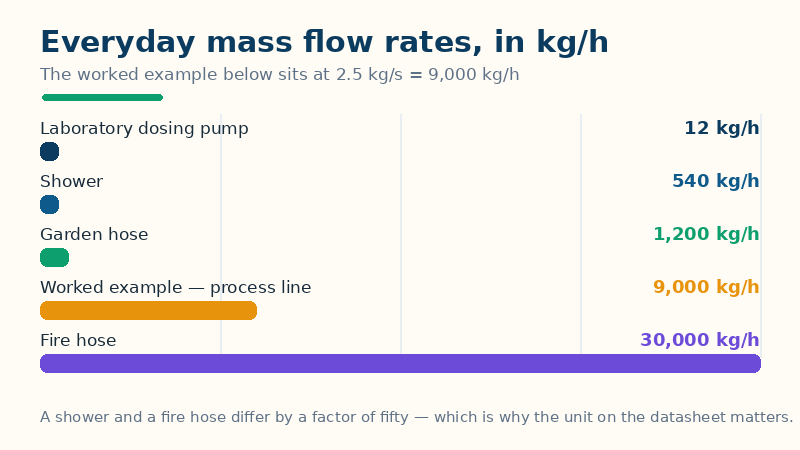
Two everyday cross-checks for the scale, each one the same two steps: a garden hose delivering 20 litres of water a minute moves 1,200 kg/h, because a litre of water weighs a kilogram; and a burner rated at 100 lb/h consumes 45.36 kg/h, which over a 10-hour day is 453.6 kg of fuel.
Reading the result, and its limits
Four distinctions keep this page honest. First, mass flow is not volume flow: litres per minute cannot become kilograms per second without the fluid's density — multiply a volume flow by kg/L to get a mass flow — and the companion flow rate converter handles the volume side, while this page handles the mass side. Second, a metric ton is not a short ton: 1 t/h is 1,000 kg/h, while 1 short ton/h is 907.18474 kg/h, and the two differ by about 9% — the table above exists so that slip is visible. Third, the pound here is a mass, not a force: lb in these units means pound-mass, and a pound-force per second would be a different quantity entirely, one this page does not convert. Fourth, the total-mass line assumes a steady rate: a line that ramps up, shuts down or pulses moves less than rate × time, and the line is exact only for the steady flow the datasheet quotes.
Related tools: Flow Rate Converter — Litres per minute to GPM, CFM, cubic metres per hour and more — every answer in all eleven units; Volume Converter — Convert US cups, gallons, litres, millilitres and spoons — every answer in all ten units, through the exact US customary definitions; Density Converter — kg/m³ to lb/ft³, g/cm³ to lb/in³, lb/gal and more — every answer in all nine units, through the exact definitions.
Frequently asked questions
How do I convert kg/s to lb/h?
Multiply by 7,936.64, which is 3,600 ÷ 0.45359237. A flow of 2.5 kg/s is 2.5 × 7,936.64 = 19,841.6 lb/h, the worked example on this page. To go the other way, multiply lb/h by 0.45359237 and divide by 3,600.
What is the difference between mass flow rate and volume flow rate?
Mass flow rate counts kilograms per second; volume flow rate counts litres per minute. The two differ by the fluid's density: mass flow = volume flow × density. Mass flow is preferred in process work because it does not change when a fluid is heated or compressed, while its volume does.
Is a short ton the same as a metric ton?
No. A metric ton is 1,000 kilograms and a short ton is 2,000 pounds, which is 907.18474 kilograms — about 9% less. A flow of 1 short ton per hour is 0.9072 metric tons per hour, and confusing the two under-reports a bulk flow by nearly a tenth.
Why does the total-mass line need a running time?
A rate alone says nothing about how much material moves in total — 2.5 kg/s for a minute is 150 kg and for an 8-hour shift is 72,000 kg. Enter the running time and the page multiplies rate × time, so a shift total, a day total or a batch total falls out of the datasheet rate.
