Measure first, then size
Skate sizing starts from foot length in centimetres, not from shoe size: most players wear 1 to 1.5 sizes smaller in skates than in shoes, so a US shoe size 10 is not a size 10 skate. Stand on a ruler or tape on a hard floor with the heel against a wall, measure to the longest toe, and do both feet — most people have one foot slightly longer, and the guides size to the larger foot. If the measurement falls between two lengths, the published rule is to take the larger skate size.
US men's shoe = foot length (cm) − 17, rounded to the nearest half size — then Hockey skate = shoe − 1.5, Figure (adult) = shoe − 1.0, Figure (youth) = shoe − 0.5, UK = US skate − 0.5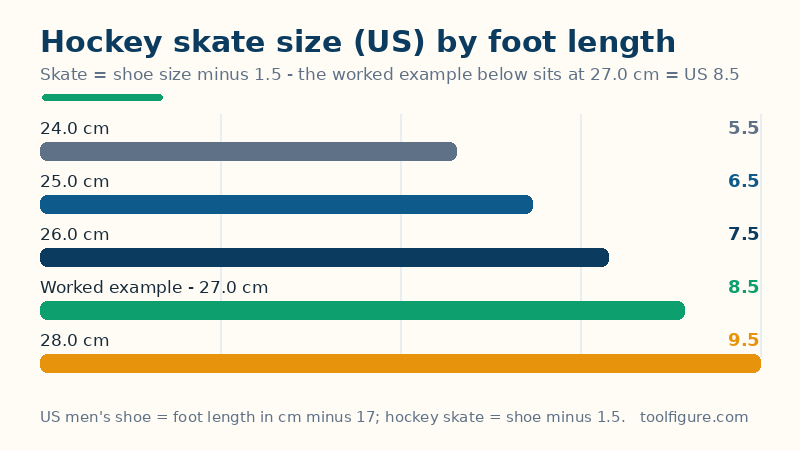
| Foot length | US men's shoe | Hockey skate | Figure skate (adult) | Figure skate (youth) |
|---|---|---|---|---|
| 24.0 cm | 7 | 5.5 | 6 | 6.5 |
| 25.0 cm | 8 | 6.5 | 7 | 7.5 |
| 26.0 cm | 9 | 7.5 | 8 | 8.5 |
| 27.0 cm | 10 | 8.5 | 9 | 9.5 |
| 28.0 cm | 11 | 9.5 | 10 | 10.5 |
The shoe column follows the published foot-length table exactly at the half-centimetre steps (22.0 cm is a US 5, 22.5 cm a 5.5, 27.0 cm a 10, 30.0 cm a 13), and the calculator rounds any in-between measurement to the nearest half size before applying the skate rule. The UK column is the US skate size minus a half, which matches the published table at every row (a US 10 shoe is a UK 9.5, a US 8.5 skate is a UK 8).
Worked example: 27.0 cm foot, hockey skates
A 27.0 cm foot is a US men's shoe 10 (27.0 − 17 = 10), so a hockey skate US 8.5 (10 − 1.5) and UK 8. The same foot in adult figure skates takes US 9 (10 − 1.0, UK 8.5), and in youth figure skates US 9.5 (10 − 0.5, UK 9) — one foot, three answers, which is why the skate type is part of the question. Two more spot checks: a 25.0 cm foot is a US shoe 8, so a hockey skate 6.5 (UK 6) and an adult figure skate 7 (UK 6.5); a 24.0 cm foot is a US shoe 7, so a hockey skate 5.5 and a youth figure skate 6.5 (UK 6).
How to read your result, and its limits
Three checks before buying. First, brands vary: the guides warn that skate sizes differ by brand and model by up to a full size, so this chart is a starting point and the brand's own chart has the last word. Second, width and volume matter as much as length: two feet the same length can need different fits, and a wide foot takes the wide fitting of the same size rather than a size up. Third, fit is snug by design: toes should just brush the front with about a quarter inch of room at most, and a boot that feels roomy in the shop will feel loose on the ice — but a boot that pinches will not break in to comfort, because skates do not stretch in length. For growing children, at most a half size up for growth room; more than that loses the ankle support the boot exists to give.
Common mistakes
- Ordering your shoe size. A size 10 shoe in a size 10 skate is one to one-and-a-half sizes too big — the single most common first-pair mistake.
- Using one skate rule for both sports. Hockey runs 1.5 down, adult figure 1.0 down and youth figure 0.5 down; applying the hockey rule to figure skates undersizes the pair.
- Measuring one foot. Feet differ; sizing to the shorter foot leaves the longer foot cramped for every session.
- Buying big for growth. More than a half size up for a growing child trades ankle support for a season of wear — and ankle support is the point of the boot.
Related tools: Ski Boot Size Calculator — Your ski boot size from your foot length: Mondopoint with US, UK and EU equivalents, plus the performance fit, from one measurement; Snowboard Boot Size Calculator — Your snowboard boot size from a foot measurement: Mondo point plus US men's, US women's, UK and EU sizes, with a performance fit; Shoe Size Converter — US, UK, EU and Japan shoe sizes — every system at once, men and women.
Frequently asked questions
Why are ice skates smaller than shoe size?
Because a stiff skate boot needs no walking toe room: toes should just brush the front, so skaters wear 1 to 1.5 sizes below their shoe size. A skate bought in shoe size is one to one-and-a-half sizes too big.
What is the difference between hockey and figure skate sizing?
The step down from shoe size: hockey skates run 1.5 sizes down, adult figure skates 1.0 down, and youth and junior figure skates only 0.5 down. One foot therefore gives three different skate sizes, which is why the calculator asks for the skate type.
What if my foot measures between sizes?
Take the larger size — that is the published rule for in-between feet (Riedell's charts say so explicitly). Skates do not stretch in length, so a size that is already tight has nowhere to go.
Should I buy big for a growing child?
At most a half size up for growth room, and only for youth and junior skaters. More than that and the ankle support the boot exists to give is lost, which matters more than an extra season of wear.
