Four energy tribes, one converter
Energy is measured in dialects that grew up in different trades, and they almost never speak to each other. Physicists use joules. Nutritionists and dieters use calories and kilocalories — and the food "Calorie" on a label is a kilocalorie, a thousand small calories, wearing a capital C. Your electricity bill speaks kilowatt-hours. Heating engineers speak BTU. This page is the interpreter: any amount, restated in all ten units at once, every conversion worked through the joule with the factors defined in the open.
How the conversion works, with every factor defined
Joules = value × the from-unit's factor · Converted value = joules ÷ the to-unit's factorKilojoule 1,000 · Megajoule 1,000,000 · Calorie 4.184 (thermochemical, exact) · Kilocalorie 4,184 · Watt-hour 3,600 · Kilowatt-hour 3,600,000 · BTU 1,055.05585262 (International Steam Table) · Foot-pound 1.3558179483314004 · Electronvolt 1.602176634e-191 kWh = 3,600,000 J exactly · 1 cal = 4.184 J exactly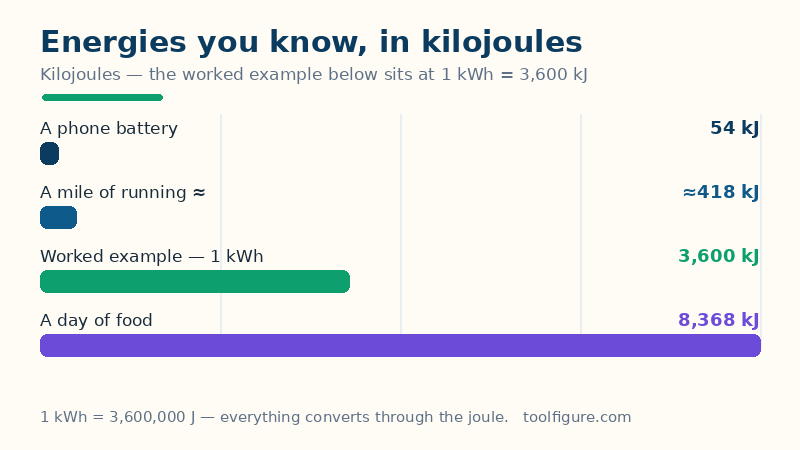
These factors are definitions, not measurements, which is why they never drift. A kilowatt-hour is 1,000 watts for 3,600 seconds — 3,600,000 joules, exactly. A thermochemical calorie is defined as 4.184 joules, exactly. Two rival definitions are kept in the open rather than merged: the BTU used here is the International Steam Table BTU (1,055.05585262 J), not the thermochemical BTU (1,054.35 J); the calorie used here is the thermochemical calorie (4.184 J), not the International Steam Table calorie (4.1868 J). If another converter gives you a figure that differs in the third decimal, it probably chose the rival definition — not an error, just a different standard. Converting to a bigger unit always makes the number smaller: 1 of anything becoming thousands of joules is the correct shape.
Worked example: 1 kilowatt-hour, the unit on your electricity bill
The defaults above convert 1 kilowatt-hour — the "unit" your meter records. Through the base unit: 1 × 3,600,000 = 3,600,000 J. Dividing by each unit's factor: 3,600 kJ, 3.6 MJ, 1,000 Wh, 860.42 kcal (and 860,420.65 small calories), 3,412.14 BTU, 2,655,223.74 ft·lb — and about 2.2469 × 10²⁵ electronvolts, which the converter prints in full. Three readings deserve a pause. The 860.42 kcal is the bridge to food: one unit of electricity holds roughly the energy of a large meal — eat it and your body gets it; run a 1,000-watt heater for an hour and the same amount becomes warmth. The 3,412.14 BTU is the bridge to heating catalogues: American furnaces and air conditioners are rated in BTU, and a 3,412 BTU heater running for an hour has consumed exactly one unit of electricity. And the 3.6 MJ is the bridge to the fuel world, where petrol and gas are sold by the megajoule.
The conversions people actually ask for
| Conversion | Answer | How it is worked |
|---|---|---|
| 1 kWh to kJ (worked example) | 3,600 kJ | 3,600,000 ÷ 1,000 |
| 1 kWh to kcal | 860.42 kcal | 3,600,000 ÷ 4,184 |
| 1 kWh to BTU | 3,412.14 BTU | 3,600,000 ÷ 1,055.05585262 |
| A day of food: 2,000 kcal to kJ | 8,368 kJ | 2,000 × 4,184 ÷ 1,000 |
| A large meal: 500 kcal to kJ | 2,092 kJ | 500 × 4.184 |
| Heater output: 10 kWh to BTU | 34,121.42 BTU | 10 × 3,600,000 ÷ 1,055.05585262 |
| Furnace rating: 50,000 BTU to kWh | 14.65 kWh | 50,000 × 1,055.05585262 ÷ 3,600,000 |
| 100 kJ to kcal | 23.9 kcal | 100,000 ÷ 4,184 |
| 100 J to calories | 23.9 cal | 100 ÷ 4.184 |
| 250 cal to joules | 1,046 J | 250 × 4.184 |
| 1 calorie to joules | 4.184 J | The definition itself |
| 1 BTU to joules | 1,055.06 J | International Steam Table BTU |
| 1 foot-pound to joules | 1.3558 J | The exact definition |
| 1 kWh to watt-hours | 1,000 Wh | By definition |
| 1 kWh to megajoules | 3.6 MJ | 3,600,000 ÷ 1,000,000 |
Three rows deserve a second look. The day-of-food row is why food labels moved to kilocalories: nobody wants to read "8,368,000 joules" on a sandwich. The 50,000 BTU row is the furnace shortcut — heating engineers divide BTU by 3,412 to get the electrical equivalent in kWh, which is this row in reverse. And the two definition rows are the page's spine: if another tool disagrees with the 4.184 or the 1,055.06, check which calorie or BTU it used before assuming either side is wrong.
How to read your result, and the limits
Results show four decimal places below 10 and two above — more precision than any meter justifies, so round to the precision of your source figure for real use. Four limits belong with the page. kWh is energy; kW is power: a kilowatt-hour is an amount, a kilowatt is a rate — converting one into the other needs a duration, and the power converter plus this one together cover that. Food Calories are kilocalories: if your label says 250 Calories, enter 250 kilocalories here, not 250 calories. The rival definitions: results using the thermochemical BTU (1,054.35 J) or the IT calorie (4.1868 J) differ slightly — this page states its standards so you can compare honestly. No prices: this page converts energy, not money — what a kWh costs belongs on the electricity cost calculator, which this page links below.
Related tools: Unit Converter — Convert length, weight, temperature and volume — km to miles, kg to pounds, °C to °F, litres to gallons; Electricity Cost Calculator — What any appliance costs to run — per day, per month and per year — from watts, hours and your rate; Calorie Calculator — Daily calorie needs (TDEE) from your BMR and activity level, with weight-loss and weight-gain targets.
Frequently asked questions
How many joules are in a kWh?
3,600,000 joules — exactly. A kilowatt is 1,000 joules per second and an hour is 3,600 seconds, so 1,000 × 3,600 = 3,600,000. Running a 1,000-watt appliance for one hour consumes exactly one kilowatt-hour: the 'unit' your electricity meter records.
What is the difference between a calorie and a Calorie?
A small calorie (cal) is defined as exactly 4.184 joules. A food Calorie — capital C — is a kilocalorie: 1,000 small calories, 4,184 joules. Food labels use the big one; this page lists both separately so there is no ambiguity.
How many kcal is 1 kWh?
860.42 kcal. The full worked example on this page shows 1 kWh = 3,600,000 J = 860.42 kcal = 3,412.14 BTU — roughly the energy of a large meal, which is why the same 'unit' can be eaten or burned.
How many BTU are in a kWh?
3,412.14 BTU, using the International Steam Table BTU (1,055.05585262 J) this page states. Heaters rated in BTU per hour convert to watts with the same factor — 3,412 BTU/h for one hour is exactly one kilowatt-hour of energy.