What radioactivity is
Radioactivity — more precisely, activity — is a count rate: how many atomic nuclei in a sample disintegrate each second. The SI unit is the becquerel, one disintegration per second, named for Henri Becquerel, who discovered radioactivity in 1896. The older unit, the curie, was defined from radium itself — the activity of one gram of radium-226 — and was later fixed by definition at exactly 3.7 × 10¹⁰ disintegrations per second, which is 37 gigabecquerels. American nuclear medicine still writes dose cards in millicuries, European datasheets write megabecquerels, and counting instruments print disintegrations per minute, so the same source arrives under several labels. This page restates any activity in all eight units at once, worked through the becquerel with every factor defined, and answers the question the conversion alone cannot: over a time you enter, how many nuclei actually decay?
The formula
answer = becquerels ÷ (Bq in one "to" unit)
decays = becquerels × minutes × 60
Three terms, all visible on the page. value is the number you enter. Bq in one "from" unit is the definition of the unit you are converting from: 1 for the becquerel itself, 1,000 for the kilobecquerel, 1,000,000 for the megabecquerel, 1,000,000,000 for the gigabecquerel, 37,000,000,000 for the curie, 37,000,000 for the millicurie, 37,000 for the microcurie, and 1/60 for one disintegration per minute. answer is the result in the unit you asked for. minutes is the counting time you enter, and the decays line multiplies the becquerel rate by the seconds in that time — 60 per minute — to give the total count. That line assumes the activity stays constant over the time entered: real sources decay as they are counted, so over long times the figure is an upper bound, and for a short counting window it is exact to the precision the activity itself carries.
Worked example
Convert 4 millicuries to megabecquerels — a small diagnostic dose on a nuclear medicine card, and the conversion a technologist does most — the way the tool does it.
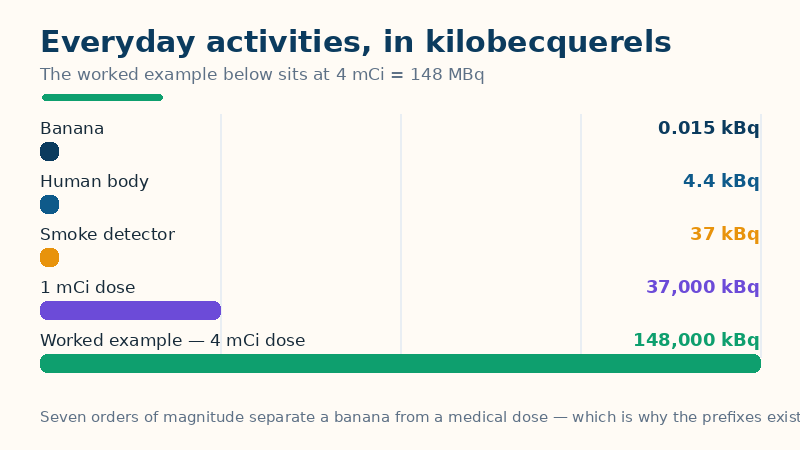
Step 1 — get to becquerels. One millicurie is 37,000,000 Bq, so 4 × 37,000,000 = 148,000,000 Bq.
Step 2 — divide by the target factor. One megabecquerel is 1,000,000 Bq, so 148,000,000 ÷ 1,000,000 = 148.
Step 3 — read the display. The headline reads 148 MBq, and the detail line shows the working: 4 mCi = 148 MBq — worked through becquerels: 148,000,000 Bq ÷ the Megabecquerel factor. The full table for this example reads: 148,000,000 Bq, 148,000 kBq, 148 MBq, 0.148 GBq, 0.004 Ci, 4 mCi, 4,000 µCi and 8,880,000,000 dpm. The decays line, at the default 60 minutes, reads 532,800,000,000 nuclei: 148,000,000 × 60 × 60.
Check it. Multiplying back, 148 MBq × 1,000,000 = 148,000,000 Bq, and 148,000,000 ÷ 37,000,000 = 4 mCi exactly — no rounding shadow anywhere, because the curie factor is exact and the example divides cleanly. The decays line checks the same way: 532,800,000,000 ÷ 3,600 = 148,000,000 Bq, the rate we started from.
Conversion table
The conversions dose cards, datasheets and counter printouts reach for most, each one the same two steps as the example:
| From | To |
|---|---|
| 1 Ci | 37 GBq |
| 1 mCi | 37 MBq |
| 1 µCi | 37 kBq |
| 1 MBq | 0.027 mCi |
| 10 mCi | 370 MBq |
| 500 Bq | 30,000 dpm |
| 1 GBq | 0.027 Ci |
| 37 kBq | 1 µCi |
| 2.5 GBq | 0.0676 Ci |
| 1 Bq | 60 dpm |
Two everyday cross-checks for the scale, each one the same two steps: the americium in a household smoke detector is about 37 kBq, which is 1 µCi — the row above — and the potassium-40 in a human body gives about 4,400 Bq, which is 4.4 kBq and 0.000119 mCi, a figure the page prints at its six-decimal finest step because it falls below 0.001. The old rutherford belongs in the same family as a footnote: 1 Rd was 1,000,000 Bq, exactly 1 MBq, used in the 1940s and 1950s before the megabecquerel replaced it.
Reading the result, and its limits
Three distinctions keep this page honest. First, activity is not dose. The becquerel counts disintegrations per second and says nothing about the energy of each disintegration or what it does to tissue; absorbed dose is measured in grays and biological effect in sieverts, and no conversion on this page can turn an activity into either — a source's activity, its radiation type and energy, and the exposure geometry are all needed before a dose exists. Second, activity is not amount: two samples with the same activity can hold very different masses of material, because a short-lived isotope reaches a given decay rate with far fewer atoms than a long-lived one — the half-life, not this page, connects activity to quantity. Third, the decays line is a constant-rate figure: it holds the activity fixed over the counting time, which is exact for a short count and an upper bound over times comparable to the source's half-life. Check the half-life before using any long-window count in a real procedure, and treat every figure here as a conversion of a stated activity, never as a safety assessment.
Related tools: Energy Converter — Joules to calories, kcal to kJ, kWh to joules and BTU — every answer in all ten units, through the exact definitions; Frequency Converter — Hz to kHz, MHz, GHz, THz, RPM and rad/s — every answer in all seven units, through the exact definitions; Unit Converter — Convert length, weight, temperature and volume — km to miles, kg to pounds, °C to °F, litres to gallons.
Frequently asked questions
How many becquerels are in one curie?
Exactly 37,000,000,000 — 37 GBq. The curie was fixed at 3.7 × 10¹⁰ disintegrations per second by definition, so the conversion is exact, not approximate. That is why 1 mCi = 37 MBq and 1 µCi = 37 kBq exactly, and why the worked example on this page divides back to 4 mCi with no rounding left over.
What is the difference between becquerels and sieverts?
Becquerels count disintegrations per second — the activity of a source. Sieverts measure the biological effect of the radiation dose a person receives, and grays measure the energy absorbed per kilogram. Activity alone cannot be converted to dose: the radiation type, its energy and the exposure geometry all matter, so a dose assessment needs more than this converter.
Why do dose cards use millicuries while datasheets use megabecquerels?
Tradition by region: American nuclear medicine kept the curie family, and the rest of the world adopted the SI becquerel. The bridge is exact — multiply millicuries by 37 to get megabecquerels — so a 4 mCi card and a 148 MBq datasheet describe the same dose.
What are disintegrations per minute?
The counting unit of radiation instruments: how many decays the counter records in one minute. Since a becquerel is one decay per second, 1 Bq = 60 dpm. A counter that prints 30,000 dpm measured a 500 Bq source, and this page converts between the two directly.
