The most-typed conversion on the internet, done with the exact definition
Kilograms to pounds is the weight conversion people perform daily — packing a suitcase, weighing luggage, reading a parcel label, following a recipe from another country, checking a body weight. Most converters on the web answer it with a rounded factor and no explanation of where that factor comes from. This one works from the definition: since 1959 the avoirdupois pound has been defined as exactly 0.45359237 kilograms. Everything on the page — grams, kilograms, tonnes, ounces, pounds, stone, the US ton and the UK ton — converts through kilograms with that exact factor, and every answer is restated in all eight units at once, so a figure a label, a landlord or a gym quotes is already on the page.
How the conversion works, with every factor defined
Kilograms = value × the from-unit's factor · Converted value = kilograms ÷ the to-unit's factorGram 0.001 · Ounce 0.028349523125 · Pound 0.45359237 (exact) · Stone 6.35029318 · US ton 907.18474 · UK ton 1,016.0469088 · Tonne 1,0001 kg = 2.20462262185 lb · 1 lb = 0.45359237 kg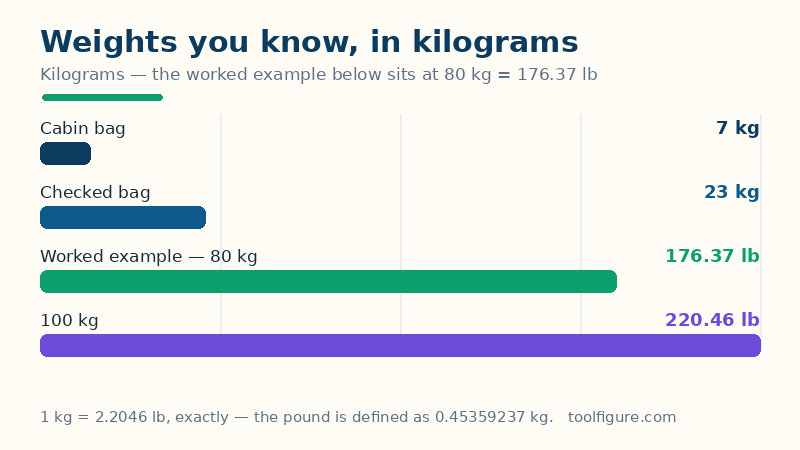
These factors are definitions, not measurements. The pound was fixed at exactly 0.45359237 kg by the 1959 international yard and pound agreement, which makes 2.20462262185 lb per kilogram the exact reciprocal — the long decimal is not sloppiness, it is 1 ÷ 0.45359237 written out. The ounce is exactly 1/16 of the pound (28.349523125 g); the stone is exactly 14 lb (6.35029318 kg); the US ton is exactly 2,000 lb (907.18474 kg) and the UK ton exactly 2,240 lb (1,016.0469088 kg). Converting to a bigger unit always makes the number smaller — 80 of anything becoming 176 of a smaller thing is the correct shape — and if a converter ever tells you 80 kg is 160 lb, it has quietly used "a pound is half a kilo" instead of the definition.
Worked example: 80 kilograms in pounds, stone and the rest
The defaults above convert 80 kilograms. Through the base unit: 80 × 1 = 80 kg. Dividing by the pound's factor: 80 ÷ 0.45359237 = 176.37 lb. The same 80 kg restates as 80,000 grams, 0.08 tonnes, 2,821.92 ounces, 12.6 stone — and, the reading British scales still give, 12 st 8.4 lb (176.37 ÷ 14 = 12 stone with 8.4 lb left over), shown under every answer. Two habits follow from the method. First, the quick mental version — double the kilos and add ten percent — gives 176 for 80 kg, within 0.2% of the true 176.37; fine for a suitcase, not for a shipping quote, which is why this page uses the exact factor. Second, always convert before you compare: 176 lb and 80 kg are the same person, not two readings to argue about.
The conversions people actually ask for
| Conversion | Answer | How it is worked |
|---|---|---|
| 80 kilograms to pounds (worked example) | 176.37 lb | 80 ÷ 0.45359237 |
| 150 pounds to kilograms | 68.04 kg | 150 × 0.45359237 |
| 1 kilogram to pounds | 2.2046 lb | The exact reciprocal, rounded to 4 places |
| 75 kilograms, UK style | 165.35 lb — 11 st 11.3 lb | 75 ÷ 0.45359237, then 14 lb to the stone |
| Standard cabin bag: 10 kg to pounds | 22.05 lb | 10 ÷ 0.45359237 |
| Cabin bag: 7 kg to pounds | 15.43 lb | 7 ÷ 0.45359237 |
| Checked bag: 23 kg to pounds | 50.71 lb | 23 ÷ 0.45359237 |
| Heavy luggage limit: 32 kg to pounds | 70.55 lb | 32 ÷ 0.45359237 |
| 70 kilograms to pounds | 154.32 lb | 70 ÷ 0.45359237 |
| 100 kilograms to pounds | 220.46 lb | 100 ÷ 0.45359237 |
| 1 US ton to kilograms | 907.18 kg | 2,000 × 0.45359237 |
| 1 UK ton to kilograms | 1,016.05 kg | 2,240 × 0.45359237 |
Three rows deserve a second look. The UK-style row is why the stone survives: 75 kg as "11 st 11.3 lb" is how a British bathroom scale still speaks, and converting the two parts separately is the classic mistake — convert the whole thing first, then split. The two ton rows show why the word "ton" alone is unreliable: the US ton (907.18 kg) and the UK ton (1,016.05 kg) differ by more than a tenth, so always check which ton a figure means before converting. And the ounce behind them all is the avoirdupois ounce of 28.35 g — the one for kitchens and parcels, not the troy ounce of 31.1035 g used for precious metals, which this page does not offer.
How to read your result, and the limits
Results show four decimal places below 10 and two above — more precision than any scale justifies, so round to the precision of the thing you weighed for real use. Four limits belong with the page. Mass versus weight, honestly: strictly these are units of mass, and weight is a force; on Earth's surface the everyday usage is fine, and nobody's suitcase cares about the distinction. No troy weights: gold, silver and gemstones use the troy ounce (31.1035 g); do not use the avoirdupois ounce result for a quantity specified in troy ounces. Cooking weights are volumes wearing costumes: grams-to-cups needs the ingredient's own weight per cup, which is why volume-to-weight cooking conversions belong on a dedicated cooking converter, not here. And the stone row is a reading, not a unit you enter: a mixed "12 st 7 lb" must be converted by first expressing it in one unit (12 × 14 + 7 = 175 lb); the single input field does not parse the combined expression.
Frequently asked questions
How many pounds are in a kilogram?
2.2046 lb — exactly 1 ÷ 0.45359237, because the pound has been defined as 0.45359237 kg since 1959. The quick mental version is to double the kilos and add ten percent: 70 kg becomes 140 + 14 = 154 lb, against the true 154.32 — within 0.2%, fine for everyday use but not for anything that gets weighed for money.
Why is a pound not half a kilogram?
Because the pound was never defined as half a kilogram — it was defined as exactly 0.45359237 kg, which is about 9% lighter than half a kilo. The relative error in the half-kilo shortcut is the same at any scale: 100 lb is 45.36 kg, not 50 kg. Use the defined factor whenever the difference matters.
What is a stone in kilograms?
A stone is exactly 14 pounds, which is 6.3503 kg. It survives almost entirely as a UK body-weight unit — 75 kg is 11 st 11.3 lb. The converter shows the stone-and-pounds reading beside every answer automatically.
What is the difference between a tonne, a US ton and a UK ton?
They are three different units wearing one word. The metric tonne is 1,000 kg; the US (short) ton is 2,000 lb = 907.18 kg; the UK (long) ton is 2,240 lb = 1,016.05 kg. All three are listed separately on this page — check which ton your source means before converting.