Durations converted the way the SI defines them — through the second
How long is 10,000 seconds? How many weeks is a 2,000-hour project? What is 90 minutes in decimal hours for a timesheet? Time-unit questions come up in sprint planning, payroll, travel and homework, and the mistakes are always the same: dividing by 100 instead of 60, forgetting that days are 24 hours not 10, or treating a month as exactly 30 days. This converter runs every duration through the second — the SI base unit of time — with every factor stated, and answers in all eight units at once, plus the plain-words breakdown of what the duration actually is: days, hours, minutes and seconds as words.
How the conversion works, with every factor defined
Seconds = value × the from-unit's factor · Converted value = seconds ÷ the to-unit's factorMillisecond 0.001 · Minute 60 · Hour 3,600 · Day 86,400 · Week 604,800 · Month (average) 2,629,800 · Year (average) 31,557,6001 hour = 60 minutes = 3,600 seconds · 1 day = 24 hours = 1,440 minutes = 86,400 seconds · 1 week = 168 hours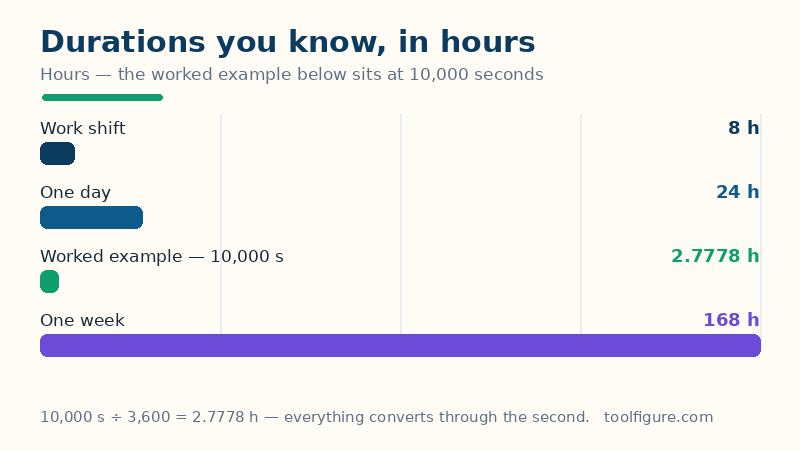
The factors up to the week are exact by definition: 60 seconds in a minute, 60 minutes in an hour, 24 hours in a day, 7 days in a week. The month and the year are the honest exceptions on the page. A real month is 28 to 31 days depending on which one, so this converter uses the calendar average: a year of 365.25 days (the leap-year average) divided by 12 gives a month of 30.44 days (exactly 30.4375) — 2,629,800 seconds. They are labelled "(average)" everywhere and explained here rather than quietly rounded, because a converter that calls a month exactly 30 days is wrong by half a day every month. Converting to a bigger unit always makes the number smaller — 10,000 of anything becoming 2.78 of a larger thing is the correct shape — and if a converter ever tells you 90 minutes is 0.9 hours, it has divided by 100.
Worked example: 10,000 seconds in hours, minutes and plain words
The defaults above convert 10,000 seconds. Through the base unit: 10,000 × 1 = 10,000 s. Dividing by the hour's factor: 10,000 ÷ 3,600 = 2.7778 h. The same 10,000 seconds restates as 166.67 minutes, 0.1157 days, 0.0165 weeks — and in plain words, 2 hours, 46 minutes, 40 seconds (2 × 3,600 = 7,200; 46 × 60 = 2,760; 7,200 + 2,760 + 40 = 10,000, which is the check to run on any breakdown). Two habits follow from the method. First, the minutes-to-decimal-hours step for timesheets is just ÷ 60: 90 minutes is 1.5 h, and 1.75 h is 1 hour 45 minutes (0.75 × 60) — the 7.75-vs-7.45 trap is called out on the hours page and it bites here too. Second, always sanity-check the direction: 10,000 seconds becoming 2.78 hours is right; becoming 166 hours would mean the factor ran backwards.
The conversions people actually ask for
| Conversion | Answer | How it is worked |
|---|---|---|
| 10,000 seconds to hours (worked example) | 2.7778 h | 10,000 ÷ 3,600 |
| 72 hours to days | 3 days | 72 ÷ 24 |
| 72 hours to minutes | 4,320 min | 72 × 60 |
| 90 minutes to hours | 1.5 h | 90 ÷ 60 = 5,400 s |
| 1 day to minutes | 1,440 min | 24 × 60 |
| 1 day to seconds | 86,400 s | 24 × 3,600 |
| 1 week to hours | 168 h | 7 × 24 |
| 1 year (average) to days | 365.25 days | The leap-year average |
| 1 year (average) to hours | 8,766 h | 365.25 × 24 |
| 1 year (average) to minutes | 525,960 min | 365.25 × 1,440 |
| 6 months (average) to days | 182.63 days | 6 × 30.4375 |
| 1,000 days to years | 2.7379 years | 1,000 ÷ 365.25 |
| 2,000 work hours to work weeks | 50 work weeks | 2,000 ÷ 40 |
| 8-hour shift to seconds | 28,800 s | 8 × 3,600 |
Three rows deserve a second look. The 1,000-days row is where the month averaging shows its value: 1,000 ÷ 365.25 = 2.7379 years, about 2 years and 9 months — anyone dividing by 365 exactly loses a day. The work-weeks row is the planning shortcut: 2,000 hours at the standard 40-hour week is 50 work weeks, the rough size of a working year that project estimates are often quoted against. And the 90-minutes row is the timesheet row: decimal hours are ÷ 60, so 45 minutes is 0.75 h, 30 minutes 0.5 h, 15 minutes 0.25 h — never 0.45, 0.30 or 0.15.
How to read your result, and the limits
Results show four decimal places below 10 and two above — more precision than a stopwatch justifies, so round to the precision of the thing you timed for real use. Three limits belong with the page. Months and years are averages: for an exact calendar span — a contract, a notice period, a deadline — count real days with the date tools instead; this page converts durations, not calendar dates. Work time is not calendar time: 2,000 hours is 50 work weeks only at 40 hours a week; a 35-hour week gives 57, and neither accounts for holidays. And durations cannot be negative: this page refuses negative inputs rather than printing a negative duration, because a negative duration is a data-entry error, not a result.
Frequently asked questions
How many seconds are in a day?
86,400 — 24 hours × 60 minutes × 60 seconds. A week is 604,800 seconds, and an average year (365.25 days) is 31,557,600 seconds. These are the factors this page converts through.
How do I convert minutes to decimal hours?
Divide by 60: 90 minutes is 1.5 h, 45 minutes is 0.75 h, 15 minutes is 0.25 h. The common error is treating 45 minutes as 0.45 hours — that reads minutes as hundredths, which they are not.
Why are months and years labelled as averages?
Because a real month is 28 to 31 days depending on which one, so no exact factor exists. This page uses the calendar average: 365.25 days a year (the leap-year average), divided by 12, gives 30.4375 days a month. For an exact calendar span, count real days with the date tools instead.
How many hours is 10,000 seconds?
2.7778 hours — 10,000 ÷ 3,600 — which is 2 hours, 46 minutes and 40 seconds in plain words. It is also 166.67 minutes, or 0.1157 days.