Three steps: energy per cycle, loads a year, cost
The whole calculation is one multiplication with a correction for the cycling. Energy per cycle times the electricity price is the cost of one load; energy per cycle times the loads a week times 52 weeks is the year's energy; the year's energy times the price is the year's money. The correction that makes the answer honest is the energy per cycle itself — it is a measured figure, not the nameplate watts times the cycle length:
cost per load ($) = energy per cycle (kWh) × electricity price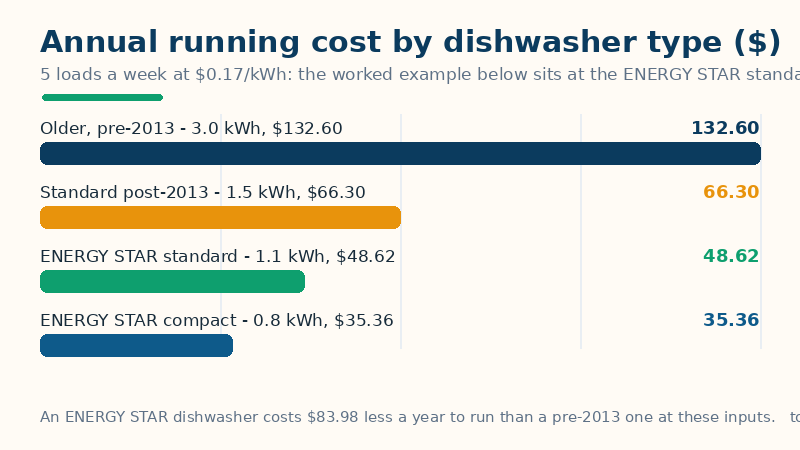
annual energy (kWh) = energy per cycle × loads a week × 52annual cost ($) = annual energy × electricity priceThe energy-per-cycle figures on this page are the published ones: a standard ENERGY STAR dishwasher uses about 1.1 kWh a cycle (1.0 to 1.2 kWh, up to 270 kWh a year), an ENERGY STAR compact uses 0.7 to 0.9 kWh (up to 203 kWh a year), a standard post-2013 machine that is not certified uses 1.0 to 2.0 kWh, and a pre-2013 machine uses about 3.0 kWh a cycle. The heating element in a standard dishwasher is rated around 1,800 W, but it switches off for much of every cycle — which is why 1,800 W for an hour (1.8 kWh) is not the cycle's energy, and why the measured 1.1 kWh is the figure to price. The label is the honest source for your own machine: a European or British label shows kWh per 100 cycles, so divide by 100 — 76 becomes 0.76 kWh a cycle — and a US EnergyGuide label shows kWh a year, so divide by the loads you run a year.
Worked example: 1.1 kWh a cycle, 5 loads a week, $0.17/kWh
A standard ENERGY STAR dishwasher uses 1.1 kWh per cycle, and a household runs 5 loads a week at $0.17 per kWh. One load costs 1.1 × $0.17 = $0.19. A week is 1.1 × 5 = 5.5 kWh, costing $0.94. A month is 286.0 ÷ 12 = 23.8 kWh, costing $4.05. A year is 1.1 × 5 × 52 = 286.0 kWh, costing $48.62. The table above shows the same maths for the other dishwasher types at the same 5 loads a week: a pre-2013 machine at 3.0 kWh a load costs $0.51 a load and $132.60 a year — $83.98 a year more than the ENERGY STAR machine — a standard post-2013 machine at 1.5 kWh costs $0.26 a load and $66.30 a year, and an ENERGY STAR compact at 0.8 kWh costs $0.14 a load and $35.36 a year. At 7 loads a week the ENERGY STAR machine costs $68.07 a year, and at 3 loads a week $29.17. Three published cross-checks reproduce exactly: at the US average rate of 18.34 cents per kWh and 20 loads a month, the same 1.1 kWh machine costs $0.20 a load, $4.03 a month and $48.42 a year, while a pre-2013 machine at 3.0 kWh costs $0.55 a load, $11.00 a month and $132.05 a year; a British label showing 76 kWh per 100 cycles is 0.76 kWh a cycle, which at 26.32p per kWh and 5 loads a week is 20p a cycle, £1.00 a week and £52.01 a year; and a label showing 75 kWh per 100 cycles is 0.75 kWh a cycle, which at 26.11p per kWh and 5 loads a week is £0.20 a cycle, £0.98 a week and £50.91 a year.
How to read your result, and its limits
Four cautions keep the number honest. First, the year is 52 weeks: 364 days, one day short of a calendar year, so a 365-day year adds about one load's cost — about $0.19 at the worked example's inputs. Second, this page prices electricity only: a dishwasher also uses water and detergent, which are separate costs — a typical machine uses about 12 litres a cycle, 3,120 litres a year at 5 loads a week, which at 0.30p a litre adds about £9.36 a year in Britain. Third, the label figure is the eco programme at rated capacity: a normal or heavy cycle uses more energy than the eco figure, and heated dry adds energy on top — air-dry or no-heat dry is the cheaper finish. Fourth, the electricity price is the all-in rate: the total on the bill divided by the kilowatt-hours on the bill, including delivery charges. For the other half of the kitchen, the washing machine cost calculator prices the wash — where the water heating, not the motor, is the cost; for the appliance that follows the wash, the clothes dryer cost calculator prices the drying by kWh per load; and for the cost of running anything else in the house, the electricity cost calculator prices any appliance by watts and hours.
Common mistakes
- Multiplying the nameplate watts by the cycle hours. An 1,800 W element for an hour is 1.8 kWh, which at $0.17/kWh is $0.31 a load and $79.56 a year at 5 loads a week — against the measured $0.19 a load and $48.62 a year. The element cycles off for much of the cycle, so the nameplate figure overstates the bill by nearly two-thirds.
- Comparing dishwashers on watts instead of kWh per cycle. Two dishwashers can carry the same 1,800 W rating and use very different energy per cycle, because one has a better pump, a soil sensor and a heat exchanger and the other does not. The kWh per cycle — 3.0, 1.5, 1.1 or 0.8 — is the comparison; the watts are not.
- Forgetting the loads a week. The per-load cost is the interesting number, but the yearly cost is the budget number, and it scales directly with frequency: 3 loads a week is $29.17 a year, 5 is $48.62 and 7 is $68.07 at the worked example's inputs. Count the loads before quoting the year.
- Adding the standing charge to every load. The daily supply charge is payable whether the dishwasher runs or not. Only the per-kWh rate belongs in the per-load maths — the fixed charge is a separate line on the bill.
Frequently asked questions
How much does a dishwasher cost to run per load?
A standard ENERGY STAR dishwasher at 1.1 kWh a cycle costs $0.19 a load at $0.17 per kWh. A standard post-2013 machine at 1.5 kWh costs $0.26 a load, an ENERGY STAR compact at 0.8 kWh costs $0.14, and a pre-2013 machine at 3.0 kWh costs $0.51 a load at the same rate.
How much does a dishwasher cost to run per year?
At 5 loads a week and $0.17 per kWh, an ENERGY STAR dishwasher uses 286.0 kWh a year and costs $48.62. At 7 loads a week it costs $68.07 a year, and at 3 loads a week $29.17 — the yearly cost scales directly with how often the dishwasher runs.
How do I work out the cost from the energy label?
Divide the label's kWh per 100 cycles by 100: a label showing 76 kWh per 100 cycles is 0.76 kWh a cycle, which at 26.32p per kWh is 20p a cycle. In the US, divide the EnergyGuide label's kWh a year by the loads you run a year — a machine rated 270 kWh a year run 260 times is about 1.04 kWh a cycle.
Why can't I just multiply the watts by the hours?
Because the heating element cycles: it is rated around 1,800 W while it is on, but it switches off for much of every cycle. Multiplying 1,800 W by an hour gives 1.8 kWh and $0.31 a load, against the measured 1.1 kWh and $0.19. The kWh per cycle is the number that matters.