Three steps: battery watt-hours, charger efficiency, charges a week
The whole calculation is one division and one multiplication repeated, and the charger efficiency is the one people get wrong. Battery watt-hours divided by 1,000 is kilowatt-hours; kilowatt-hours divided by the charger efficiency is the wall energy, the energy the meter actually records; the wall energy times the price is the cost of one full charge; one charge times the charges a week times 52 is the year's cost. The month is the year divided by 12, not the week times 4 — the two differ by about nine cents on an e-bike, and the year-divided-by-12 figure is the one this page uses, so it agrees with the yearly total exactly:
wall energy per charge (kWh) = battery Wh ÷ 1,000 ÷ charger efficiency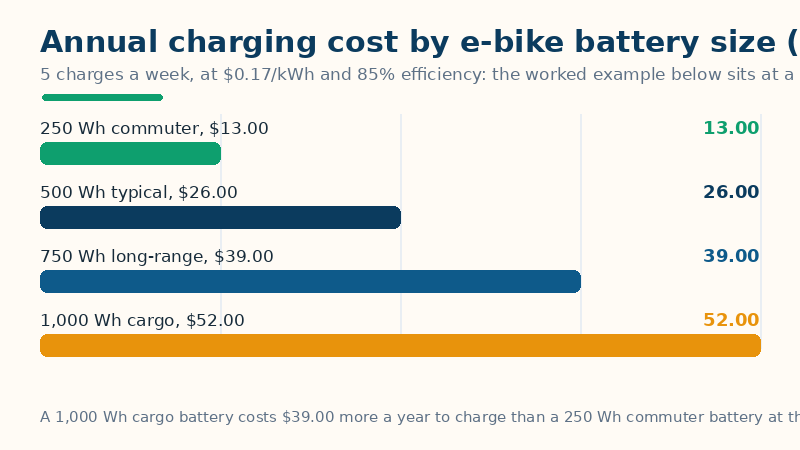
annual cost ($) = wall energy per charge × charges a week × 52 × electricity priceThe battery label gives the energy that ends up in the cells, and the wall meter records more: a typical charger converts about 85% of wall power into stored energy, so a 500 Wh battery actually draws about 0.588 kWh from the wall — the label alone under-prices every charge by about 15%. Most e-bike batteries hold 300 to 700 Wh, and most chargers run 85 to 90% efficient, so the wall energy for a full charge is roughly a tenth more than the label. If the label gives volts and amp-hours instead of watt-hours, multiply them: a 36 V, 10 Ah battery is 360 Wh.
Worked example: 500 Wh battery, 85% efficiency, 5 charges a week, 40 miles a charge, $0.17/kWh
A 500 Wh battery charged at 85% efficiency draws 0.50 ÷ 0.85 = 0.588 kWh from the wall per charge, costing $0.10. Five charges a week is 0.588 × 5 = 2.941 kWh, costing $0.50. A month is 152.9 ÷ 12 = 12.7 kWh, costing $2.17. A year is 2.941 × 52 = 152.9 kWh, costing $26.00. The table above shows the same maths for the other battery sizes at 5 charges a week and $0.17/kWh: a 250 Wh commuter battery draws 0.294 kWh from the wall, costing $0.05 a charge, $1.08 a month and $13.00 a year, a 750 Wh long-range battery draws 0.882 kWh, costing $0.15 a charge, $3.25 a month and $39.00 a year, and a 1,000 Wh cargo battery draws 1.176 kWh, costing $0.20 a charge, $4.33 a month and $52.00 a year. One charge covers 40 miles, so about 0.25¢ a mile; ten years at this pace costs $260.00. Five published cross-checks reproduce exactly: dincalculator's E-bike Charging Cost Calculator at 85% efficiency gives €0.18 a charge for a 500 Wh battery at €0.30 per kWh — this page gives the same €0.18 — and their battery-size table matches exactly too, €0.09 for 250 Wh and €0.35 for 1,000 Wh at €0.30. embatterysystems' 360 Wh battery at 90% efficiency and $0.16 costs about $0.06 a charge — this page gives the same $0.06 (their table says 0.396 kWh a charge because they add 10% to the battery energy, 0.36 × 1.1, while this page divides by 90% efficiency and gives 0.400 kWh — the same rounded cost) — and their 720 Wh and 1,040 Wh rows match exactly at $0.13 and $0.18. cycrown's 500 Wh battery at $0.15 and 90% efficiency costs about $0.08 a charge — this page gives the same $0.08 — and their band for a 500 Wh battery is $0.07 to $0.10 a charge, which the $0.08 sits inside. hitway's 500 Wh battery at $0.13 and 90% efficiency costs $0.07 a charge — this page gives the same $0.07 — and their 700 Wh row matches exactly at $0.10. And ebykes.nl's 500 Wh battery at €0.28 with 10% added loss costs €0.15 a charge and €7.39 a year for 48 charges — this page at 90% efficiency gives €0.16 a charge and €7.47 a year; the one-cent difference is the convention, adding 10% loss against dividing by 90% efficiency.
How to read your result, and its limits
Four cautions keep the number honest. First, the charger efficiency is the estimate, not the label: at the worked example's inputs a 500 Wh battery draws 0.588 kWh from the wall, not 0.500 kWh, so pricing the label alone under-prices the charge by about 15% — enter the real efficiency, and 85% is the usual starting estimate. Second, the electricity is the small half of the bill: ebykes.nl puts battery wear at about €0.40 to €1.20 per full cycle, several times the electricity, so a 500 Wh battery costs about €0.15 a charge in electricity but roughly €0.68 a charge in wear at their defaults — the charging bill is $26.00 a year, and the battery is the cost that matters. Third, the month is not thirty days: the week times 4 gives $2.00 a month at the worked example's inputs, while the year divided by 12 gives $2.17 — use the year-divided-by-12 figure, which is the one that adds up. Fourth, this page prices electricity only: the bike itself, the replacement battery and the charger are separate lines, and the electricity price is the all-in rate, the total on the bill divided by the kilowatt-hours on the bill. For the cost of charging the car instead of the bike, the EV charging cost calculator prices a full charge by battery size; for the cost of running anything else in the house, the electricity cost calculator prices any appliance by watts and hours.
Common mistakes
- Pricing the label watt-hours as the wall energy. A 500 Wh battery draws 0.588 kWh from the wall at 85% efficiency, not 0.500 kWh — $0.10 a charge, not $0.09. Divide by the efficiency.
- Pricing one charge and stopping there. A charge is $0.10, but five charges a week for a year is $26.00 — the frequency is half the calculation. Count the charges.
- Multiplying the weekly cost by 4 for the month. Four weeks is not a twelfth of a year: the week times 4 gives $2.00 a month at the worked example's inputs, while the year divided by 12 gives $2.17. Use the year-divided-by-12 figure, which is the one that adds up.
- Forgetting that a partial charge costs a partial price. Topping up from half costs about half a full charge — $0.05 at the worked example's inputs — because the wall energy scales with the energy put back in. Count the full-charge equivalents, not the plug-ins.
- Adding the standing charge to every charge. The daily supply charge is payable whether the bike charges or not. Only the per-kWh rate belongs in the per-charge maths — the fixed charge is a separate line on the bill.
Related tools: Solar Panel Calculator — How many panels your roof needs — system size, panel count, roof area, cost and payback from your monthly use and local sun.
Frequently asked questions
How much does it cost to charge an e-bike?
At the worked example's inputs — a 500 Wh battery, 85% charger efficiency, 5 charges a week — an e-bike costs $0.10 a full charge, $2.17 a month and $26.00 a year at $0.17 per kWh. A 250 Wh commuter battery costs $0.05 a charge and $13.00 a year, and a 1,000 Wh cargo battery $0.20 a charge and $52.00 a year at the same times and rate.
How many kWh does it take to charge an e-bike?
A 500 Wh battery draws 0.588 kWh from the wall at 85% charger efficiency — the label watt-hours divided by 1,000, divided again by the efficiency. A 250 Wh battery draws 0.294 kWh and a 1,000 Wh battery 1.176 kWh per full charge at the same efficiency.
How much does it cost to charge an e-bike per mile?
About 0.25¢ a mile in electricity at the worked example's inputs — a $0.10 charge covering 40 miles. ebykes.nl puts the all-in figure, battery wear included, at about 1 cent per kilometre, because the wear on the battery costs several times the electricity.
How can I reduce my e-bike charging cost?
Charge on an off-peak tariff if your supplier offers one, and look after the battery — the electricity is only $26.00 a year at the worked example's inputs, so the saving that matters is the battery: a replacement pack costs far more than a year of charging, and keeping the charge between about 20% and 80% when the bike sits unused stretches its life.