Three steps: miles, miles per gallon, pump price
This fuel cost calculator is one division and one multiplication: trip miles divided by miles per gallon is the gallons needed, and gallons times the price per gallon is the fuel cost. The price per gallon divided by the miles per gallon is the cost of a single mile. The whole calculation is one division and one multiplication, and the economy is the one people get wrong. Trip miles divided by miles per gallon is the gallons needed; gallons times the price per gallon is the fuel cost; the price per gallon divided by the miles per gallon is the cost of a single mile — the same figure as the fuel cost divided by the miles, which is a useful check. A round trip doubles the one-way miles, and a split divides the cost by the passengers:
gallons needed = trip miles ÷ miles per gallon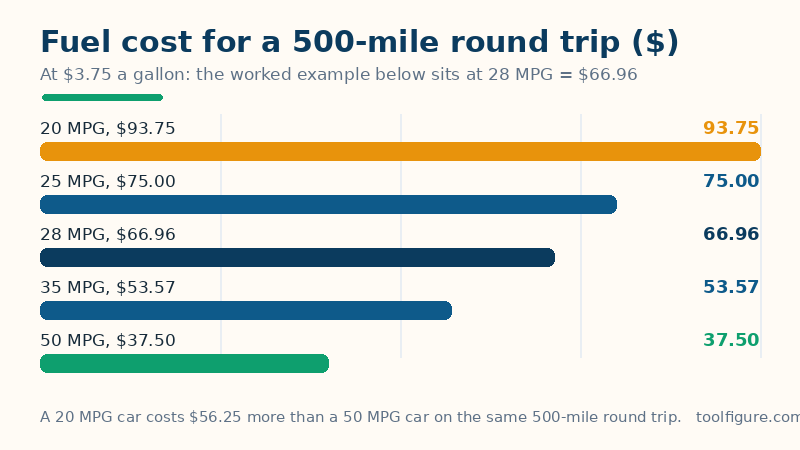
fuel cost ($) = gallons needed × price per galloncost per mile ($) = price per gallon ÷ miles per gallonThe economy is the one your car actually returns, not the figure on the window sticker: the EPA's own note is that speed, traffic, terrain, weather, load and tyre pressure all move real mileage, so a measured figure from a fill-up beats the rated figure every time. The MPG calculator finds it from the miles you drove and the gallons you used — a 28 MPG car on a 500-mile trip uses 17.857 gallons, while the same trip at a measured 25 MPG uses 20 gallons, and that three-MPG gap is $8.04 at $3.75 a gallon.
Worked example: 250 miles one way, round trip, 28 MPG, $3.75 a gallon, 4 people, $20 of tolls
A 250-mile drive each way is 250 × 2 = 500 miles of fuel. At 28 MPG that is 500 ÷ 28 = 17.857 gallons, and at $3.75 a gallon the fuel costs 17.857 × $3.75 = $66.96, or $0.13 a mile (13.4¢). Split four ways, each person pays $66.96 ÷ 4 = $16.74 for fuel. With $20 of tolls and parking the trip is $66.96 + $20.00 = $86.96 all-in, $21.74 each. The same trip every week for a year costs $66.96 × 52 = $3,482.14 in fuel. In a 35 MPG car the same trip costs 500 ÷ 35 × $3.75 = $53.57 — $13.39 less. The table above shows the same maths for the other economies at 500 miles and $3.75 a gallon: a 20 MPG car uses 25.000 gallons, costing 18.8¢ a mile and $93.75, a 25 MPG car uses 20.000 gallons, costing 15.0¢ a mile and $75.00, the worked example's 28 MPG car uses 17.857 gallons, costing 13.4¢ a mile and $66.96, a 35 MPG car uses 14.286 gallons, costing 10.7¢ a mile and $53.57, and a 50 MPG hybrid uses 10.000 gallons, costing 7.5¢ a mile and $37.50. Six published cross-checks reproduce exactly, and a seventh differs by one cent for a stated reason: everydaytools' 100-mile drive at 25 MPG and $3.50 uses 4.00 gallons and costs $14.00, or $0.14 a mile — this page gives the same 4.00 gallons, $14.00 and $0.14 a mile. Their 400-mile drive at 32 MPG and $3.60 uses 12.5 gallons and costs $45.00, or $0.1125 a mile — this page gives the same 12.5 gallons and $45.00. EZ Calculators' 500-mile round trip at 28 MPG and $3.75 costs $66.96, $16.74 each for four people and $21.74 each with $20 of tolls — the worked example above, the same figures. Ponderloop's 300-mile round trip at 30 MPG and $4.00 uses 10 gallons and costs $40.00, split three ways at $13.33 each with one person paying $13.34 — this page gives the same $40.00 and the same $13.33/$13.34 split. Calcworker's 350-mile trip at 28 MPG and $3.65 uses 12.5 gallons and costs $45.63, or $0.13 a mile — this page gives the same 12.5 gallons and $45.63. And everydaytools' 500-mile round trip at 28 MPG and $3.45 costs $61.61 — this page gives the same $61.61. The seventh, calcworker's 1,200-mile round trip at 28 MPG and $3.65, is $156.43 on this page against their $156.44 — one cent less, because they round the gallons to 42.86 before multiplying (42.86 × $3.65 = $156.44) while this page multiplies the unrounded 42.857 gallons.
How to read your result, and its limits
Four cautions keep the number honest. First, this is fuel only: the IRS standard mileage rate is much higher than the fuel cost per mile because it also covers wear, maintenance, insurance and depreciation — at the worked example's inputs the fuel is 13.4¢ a mile, while the full cost of running the car is several times that, so do not compare the two directly and do not use the fuel-only figure for a work mileage claim. Second, the MPG is an estimate: the EPA's own note is that speed, traffic, terrain, weather, load and tyre pressure all move real mileage, so the same car returns a different figure on a motorway cruise and in stop-start traffic — measure it from a fill-up on roads like the planned route. Third, the price is the one you enter: this page does not fetch live pump prices, and the example price is a typical figure, not a current one — use the price at the pump you will actually use, since prices differ by place and change often. Fourth, the split is exact to the cent: when the total does not divide evenly, one person pays a cent more so the shares add to the total exactly — at the ponderloop cross-check above, $40.00 split three ways is $13.33 each with one person paying $13.34. For the cost of running the car itself rather than its fuel, the auto loan calculator prices the payment side; for the electric equivalent of the same trip, the EV charging cost calculator prices a charge by battery size and efficiency.
Common mistakes
- Entering the round-trip distance and ticking round trip as well. The distance field takes the one-way miles — 250 in the worked example — and the round-trip box doubles it to 500. Enter 500 with the box ticked and the trip is priced at 1,000 miles.
- Using the window-sticker MPG instead of a measured one. A car rated at 32 MPG that returns 28 MPG in real driving costs $66.96 on the worked example's trip, not $58.59 — measure the economy from a fill-up on roads like the planned route.
- Entering the price per litre in the per-gallon field. The price field is dollars per US gallon — $3.75 a gallon is about $0.99 a litre, so a litre price entered as a gallon price understates the trip by nearly four times.
- Forgetting tolls and parking in the split. The fuel is $16.74 each for four people at the worked example's inputs, but the tolls add $5.00 each — the all-in share is $21.74, not $16.74.
- Comparing the fuel cost to the IRS mileage rate. The IRS rate covers the whole cost of running the car — wear, maintenance, insurance and depreciation — while this page prices fuel only. The two answer different questions.
Frequently asked questions
How much does gas cost for a 500-mile trip?
At the worked example's inputs — a 500-mile round trip at 28 MPG and $3.75 a gallon — the fuel costs $66.96, or $0.13 a mile (13.4¢), using 17.857 gallons. The same trip costs $93.75 in a 20 MPG car and $37.50 in a 50 MPG hybrid at the same price.
How do you calculate fuel cost for a trip?
Divide the trip miles by the car's miles per gallon to get the gallons needed, then multiply by the price per gallon: fuel cost = (miles ÷ MPG) × price. A 100-mile drive at 25 MPG and $3.50 a gallon uses 4.00 gallons and costs $14.00, or $0.14 a mile.
What is a good MPG?
The US fleet average for a modern passenger car is about 28.5 MPG. A large SUV or truck returns around 20 MPG, an efficient sedan around 35 MPG and a hybrid around 50 MPG — on a 500-mile trip at $3.75 a gallon that is $93.75, $53.57 and $37.50 of fuel respectively, against $66.96 at the 28 MPG average.
Does the fuel cost calculator include tolls?
Fuel only, by default — the tolls and parking field adds them to the split without mixing them into the fuel. At the worked example's inputs the fuel is $16.74 each for four people, and $20 of tolls makes the all-in share $21.74 each. The IRS standard mileage rate is a separate, higher figure because it also covers wear, maintenance, insurance and depreciation.