What a thermal expansion coefficient is
A thermal expansion coefficient says how much a material grows per unit length for each degree it warms: a steel rail grows about 12 micrometres per metre for every kelvin, a copper wire about 17 and an aluminium frame about 23 — and the same rail quoted in three different unit systems reads 12 µm/(m·K), 6.6667 ppm/°F and 1.20e-05 1/K. It is the number behind every expansion joint, every bridge gap and every piping loop, and it is simply fractional length change per degree, so a 10-metre rail grows ten times as much as a 1-metre rail of the same steel over the same temperature rise. Materials datasheets quote micrometres per metre-kelvin (µm/(m·K)); American suppliers quote parts per million per Fahrenheit (ppm/°F); and textbooks quote per kelvin (1/K) — and all of them measure the same quantity, so steel at 12 µm/(m·K) in one datasheet is 6.6667 ppm/°F in the supplier's table it arrived with. This page restates any coefficient in all ten units at once, worked through 1/K with every factor defined, and answers the question the conversion alone cannot: how much does a length you enter actually grow over a temperature rise you enter?
The formula
1/K = value × (1/K in one "from" unit)
answer = 1/K ÷ (1/K in one "to" unit)
length change = coefficient (1/K) × length × temperature change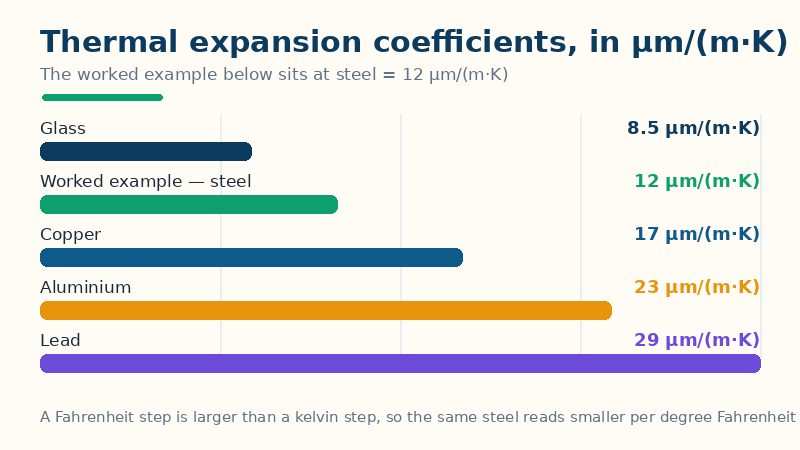
Three terms, all visible on the page. value is the number you enter. 1/K in one "from" unit is the definition of the unit you are converting from: 1 for per kelvin itself and for per degree Celsius, 1.8 for per degree Fahrenheit and for per degree Rankine, 0.000001 for micrometres per metre-kelvin, 0.0000018 for micrometres per metre-Fahrenheit, 0.000001 for parts per million per kelvin, 0.0000018 for parts per million per Fahrenheit, 0.001 for millistrain per kelvin, and 0.000001 for microstrain per kelvin — the 1.8 appears because a Fahrenheit step is 5/9 of a kelvin step, so a coefficient per Fahrenheit step is the per-kelvin figure divided by 1.8, and converting back multiplies by 1.8. answer is the result in the unit you asked for. length change is the coefficient times the length times the temperature change you enter, shown in metres and in millimetres, so the per-degree figure turns into the gap a bridge joint actually needs.
Worked example
Convert steel at 12 µm/(m·K) to micrometres per metre-Fahrenheit — the unit jump every American supplier table forces on a reader of European datasheets — the way the tool does it.
Step 1 — get to 1/K. One µm/(m·K) is 0.000001 per kelvin, so 12 × 0.000001 = 1.20e-05 1/K.
Step 2 — read the display. The headline reads 6.6667 µm/(m·°F), and the detail line shows the working: 12 µm/(m·K) = 6.6667 µm/(m·°F) — worked through 1/K: 1.20e-05 1/K ÷ the Micrometre per metre-Fahrenheit factor. The full table for this example reads: 1.20e-05 1/K, 1.20e-05 1/°C, 6.67e-06 1/°F, 6.67e-06 1/°R, 12 µm/(m·K), 6.6667 µm/(m·°F), 12 ppm/K, 6.6667 ppm/°F, 0.012 millistrain/K and 12 microstrain/K. The extra line, at the default length of 10 m and temperature change of 50 K, reads: Length change for 10 m over 50 K: 0.006 m (6 mm) — length change = coefficient × length × temperature change.
Check it. Multiplying back, 6.6667 µm/(m·°F) × 0.0000018 = 1.20e-05 1/K to the displayed rounding, and the length-change line checks the same way: 1.20e-05 × 10 × 50 = 0.006 m exactly, which is 6 mm.
Conversion table
The conversions materials datasheets, American suppliers and textbooks reach for most, each one the same two steps as the example:
| From | To |
|---|---|
| 1 1/K | 1,000,000 ppm/K, 0.5556 1/°F |
| 1 1/°F | 1.8 1/K, 1.8 ppm/K per ppm/°F — 1 ppm/°F is 1.8 ppm/K |
| Aluminium, 23 µm/(m·K) | 12.78 ppm/°F |
| Copper, 17 µm/(m·K) | 9.4444 ppm/°F |
| Glass, 8.5 µm/(m·K) | 4.7222 ppm/°F |
| Lead, 29 µm/(m·K) | 16.11 ppm/°F |
Three everyday cross-checks for the scale, each one the same two steps: a 25-metre concrete highway section poured at 10 °C and heated to 50 °C grows 12 µm/(m·K) × 25 m × 40 K = 0.012 m, which is why the joint gap is 1.2 cm and not a guess; a copper telephone wire 35 m long between poles grows 17 µm/(m·K) × 35 m × 55 K = 0.0327 m from a winter day at −20 °C to a summer day at 35 °C, which is why the summer sag exists; and a steel bridge deck quoted at 12 ppm/°C in one datasheet and 6.6667 ppm/°F in another is the same steel, because a Fahrenheit step is larger than a Celsius step, so the per-degree figure in Fahrenheit must be smaller by exactly 5/9.
Reading the result, and its limits
Four distinctions keep this page honest. First, a difference is not a reading: converting a coefficient between kelvin and Fahrenheit multiplies by 5/9 or 1.8, and never adds or subtracts 32 or 273.15 — those offsets belong to temperature readings, and a coefficient multiplies a difference, so the offsets cancel. Second, per kelvin and per degree Celsius always agree: the two scales share their step size, so the two columns agree by definition, not by coincidence, and a datasheet in either unit needs no conversion at all. Third, micrometres per metre-kelvin, parts per million per kelvin and microstrain per kelvin always agree too: a micrometre per metre is one part per million, and a microstrain is one part per million of strain, so all three columns read the same number for the same material. Fourth, a coefficient is an average, not a constant: it drifts with temperature, especially for polymers and composites, so this page converts the quoted average exactly and never claims the converted figure holds outside the temperature range the datasheet quoted it for.
Related tools: Temperature Converter — Convert °C, °F, K, °R and °Ré — every answer in all five scales, formulas shown; Thermal Conductivity Converter — W/m·K to Btu/h·ft·°F, Btu·in/h·ft²·°F, cal/s·cm·°C and more — every answer in all ten units; Thermal Resistance Converter — R-value to RSI, m²·K/W to ft²·°F·h/Btu, clo and tog — every answer in all ten units.
Frequently asked questions
How do I convert µm/(m·K) to ppm/°F?
Multiply by 5/9. The worked example's 12 µm/(m·K) is 12 × 5/9 = 6.6667 ppm/°F. To go the other way, multiply by 1.8 — 1 ppm/°F is 1.8 ppm/K.
Is 1/K the same as 1/°C?
Yes, for a coefficient. A kelvin step and a Celsius step are the same size, so a per-kelvin figure and a per-degree-Celsius figure are the same number. Only the zero differs, and a coefficient multiplies a temperature difference, so the zero cancels.
Why is the Fahrenheit figure smaller?
Because a Fahrenheit step is larger than a kelvin step — 1 °F of change is 5/9 K of change — so a material grows less per Fahrenheit degree than per kelvin. Steel at 12 µm/(m·K) is only 6.6667 µm/(m·°F), and the 5/9 factor is the whole conversion.
How much does a length actually grow?
Multiply the coefficient by the length and the temperature change. The worked example's steel rail, 10 m long over 50 K, grows 1.20e-05 × 10 × 50 = 0.006 m, which is 6 mm — enter your own length and rise in the tool for any other case.
