Three steps: heat delivered, what each machine pays, the breakeven COP
The fair comparison prices the same heat from both machines. First, work out how much heat your home actually gets from the fuel you burn — the fuel's energy content times how much you use, times the furnace's efficiency. Then price that heat twice: once at your fuel's price, once through a heat pump, which delivers several units of heat for each unit of electricity it consumes. One million BTU is 293.071 kWh of heat, one therm of gas is 29.3071 kWh, one gallon of propane is 26.816 kWh and one gallon of heating oil is 40.5904 kWh (1 kWh is 3,412.14 BTU):
heat delivered (kWh) = annual use × kWh per unit × efficiency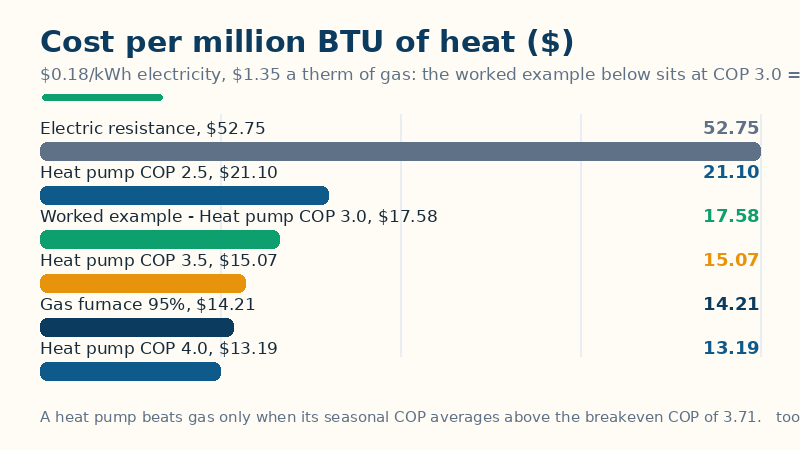
current cost ($) = annual use × fuel priceeffective COP = 1 ÷ ((1 − backup share) ÷ COP + backup share ÷ 1)heat pump cost ($) = heat delivered ÷ effective COP × electricity pricecost per million BTU ($) = fuel price ÷ kWh per unit of heat × 293.071breakeven COP = electricity price ÷ cost per kWh of heat from your fuelThe breakeven COP is the single number that settles the question: if the heat pump's seasonal COP averages above it, the heat pump is cheaper to run; below it, the furnace is. The effective COP is what the backup-heat share does to the headline COP — resistance backup runs at a COP of exactly 1.0, so a system taking a tenth of its heat from the strips gives up a quarter of its efficiency advantage before the comparison even starts. And the seasonal COP is the number that matters, not the COP on the brochure at a mild 47 °F: a heat pump's COP falls as the outdoor temperature drops, so the average across the whole heating season is what the bill sees.
Worked example: gas furnace against a COP 3.0 heat pump
A home burns 800 therms of gas a year in a 95% efficient furnace at $1.35 a therm. The heat delivered is 800 × 29.3071 × 95% = 22,273 kWh a year, and the gas bill is 800 × $1.35 = $1,080 a year. A heat pump at a seasonal COP of 3.0 needs 22,273 ÷ 3.00 = 7,424 kWh of electricity to deliver the same heat, costing 7,424 × $0.18 = $1,336 a year — $256 more than the gas furnace. The breakeven COP is $0.18 ÷ $0.0485 = 3.71: the heat pump would need to average a COP above 3.71 to beat this furnace at these prices. That is the same answer the published comparisons reach — one heating-cost guide puts the breakeven at about 3.75 for a 95% furnace at 18.19 cents per kWh and $1.35 a therm, and its cost-per-million-BTU table matches this page's to the cent: electric resistance $53.31, a COP 3.0 heat pump $17.77 and a 95% gas furnace $14.21 at those prices. The same home on electric resistance heat tells the opposite story: 22,273 kWh at $0.18 is $4,009 a year, and the same COP 3.0 heat pump at $1,336 saves $2,673 a year, two-thirds of the bill. Propane sits in between: 600 gallons at $2.50 a gallon in an 85% furnace delivers 600 × 26.816 × 85% = 13,676 kWh for $1,500, and the heat pump delivers it for 13,676 ÷ 3.00 × $0.18 = $821, saving $679 a year. And the backup share matters: if a tenth of the gas example's heat comes from resistance strips, the effective COP falls to 1 ÷ (0.9 ÷ 3.0 + 0.1 ÷ 1) = 2.50 and the heat pump's cost rises from $1,336 to $1,604 a year.
How to read your result, and its limits
Four cautions keep the number honest. First, this is the running cost only: it excludes what either machine costs to buy and install, any rebates, financing, and the fact that a heat pump also replaces the air conditioner — all of which change the capital comparison considerably, and none of which this page pretends to price. The US federal heat pump credit ended for systems placed in service after 31 December 2025, so check current state and utility rebates rather than a headline rate. Second, the seasonal COP is a guess until the winter is measured: the COP on the nameplate is measured at one mild temperature, and a cold-climate heat pump in a cold winter averages well below it — enter the seasonal average your climate actually delivers, and treat a COP above 4.0 with suspicion in a cold region. Third, the backup share is where cold-climate bills come from: resistance strips at COP 1.0 are the most expensive heat on this page, and a system that leans on them for a quarter of the season gives up roughly a quarter of its efficiency advantage before the comparison starts. Fourth, your prices decide, not the national average: at 12.46 cents per kWh a COP 3.0 heat pump costs about $12.17 per million BTU, less than gas at $14.21, while at 30.14 cents it costs about $29.44 — twice gas — so the same two machines trade places between states. For the solar panels that can supply the heat pump's electricity, the solar panel calculator sizes the array and the solar payback calculator prices the return; for the emissions side of the same switch, the carbon footprint calculator totals the household's yearly CO2.
Common mistakes
- Comparing the machines' efficiencies instead of their prices. A COP of 3.0 sounds like it must beat a 95% furnace, but electricity costs roughly three times as much per unit of energy as gas in the US, so the efficiency advantage is almost exactly cancelled by the price — which is why the breakeven COP, not the COP alone, is the number that matters.
- Using the brochure COP instead of the seasonal COP. The headline figure is measured at a mild outdoor temperature. The seasonal average across a real winter is lower, and in a cold climate the difference can move the answer from a saving to a loss.
- Leaving the backup heat out. A system that takes 10% of its heat from resistance strips runs at an effective COP of 2.50, not 3.0 — and the worked example's cost rises from $1,336 to $1,604 a year on that alone.
- Forgetting the heat pump also cools. This page prices heating only. A heat pump replaces the air conditioner too, and in a warm climate the summer cooling saving can outweigh a small winter loss — price the whole year before deciding.
Frequently asked questions
Is a heat pump cheaper than a gas furnace?
It depends on your prices and the heat pump's seasonal COP, not on the machines alone. At US average prices — $0.18/kWh electricity, $1.35 a therm of gas, a 95% furnace — a COP 3.0 heat pump costs $1,336 a year against $1,080 for gas, $256 more; it needs to average a COP above 3.71 to win. Where electricity is cheap or gas is dear, the same machines trade places.
What COP do I need to beat my gas furnace?
The breakeven COP, which this calculator shows for your own prices: electricity price divided by the cost per kWh of heat from your fuel. In the worked example it is 3.71 at $0.18/kWh and $1.35 a therm with a 95% furnace; a published heating-cost guide puts it at about 3.75 at 18.19 cents per kWh.
Does a heat pump save money against electric baseboard heat?
Yes, everywhere, by roughly the COP. Against electric resistance heat the same 22,273 kWh of heat costs $4,009 a year, and a COP 3.0 heat pump delivers it for $1,336 — a saving of $2,673 a year, two-thirds of the heating bill. Against propane and heating oil it usually wins too; against a high-efficiency gas furnace it is a close call decided by local prices.
Why does the calculator ask about backup resistance heat?
Because backup heat runs at a COP of exactly 1.0 and drags the effective COP down fast. If 10% of the season's heat comes from resistance strips, a COP 3.0 heat pump runs at an effective COP of 2.50, and the worked example's annual cost rises from $1,336 to $1,604. Cold-climate systems lean on backup heat the most, which is where the surprise bills come from.