The formula: millimetres ÷ 10 for centimetres, ÷ 25.4 for inches
Table tennis paddle sizing starts with an honest fact: there is no official size. The ITTF regulates the bat's build — the blade must be flat and rigid, and at least 85% of its thickness must be natural wood — but not its dimensions, so makers sell blade classes instead of a single standard. The table below is this calculator's table, from a maker's three published classes, checked against the typical dimensions the buying guides quote (blade 14.5–16 cm wide, 15.5–17 cm long, handle 10–11.5 cm, total 24–27 cm). Conversions use centimetres = millimetres ÷ 10 and inches = millimetres ÷ 25.4, and the tool computes them itself rather than asking you to trust a rounded chart.
Total length (cm) = total length (mm) ÷ 10 — e.g. 253 ÷ 10 = 25.3 cm | Total length (in) = total length (mm) ÷ 25.4 — e.g. 253 ÷ 25.4 = 9.96 in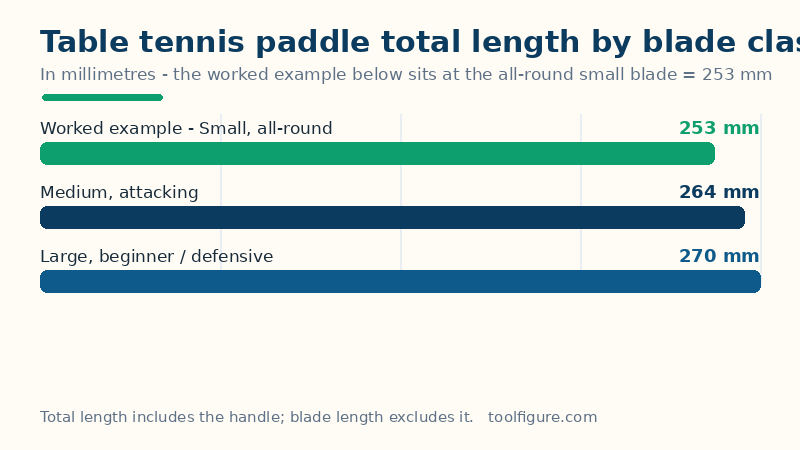
| Blade class | Width | Blade length | Total length | Sponge by style | Suits |
|---|---|---|---|---|---|
| Small | 157 mm (15.7 cm, 6.18 in) | 152 mm (15.2 cm, 5.98 in) | 253 mm (25.3 cm, 9.96 in) | 2.0 mm | All-round players |
| Medium | 162 mm (16.2 cm, 6.38 in) | 162 mm (16.2 cm, 6.38 in) | 264 mm (26.4 cm, 10.39 in) | 2.1–2.2 mm | Attacking loopers |
| Large | 162 mm (16.2 cm, 6.38 in) | 168 mm (16.8 cm, 6.61 in) | 270 mm (27.0 cm, 10.63 in) | 1.8–2.0 mm beginner, 1.5–1.8 mm defensive | Beginners, defensive players |
| Playing style | Sponge thickness | Character |
|---|---|---|
| Beginner | 1.8–2.0 mm | Controlled, easy to place |
| All-round | 2.0 mm | Balanced spin and touch |
| Attacking looper | 2.1–2.2 mm (Max for advanced attackers) | Fast and spinny, real catapult |
| Defensive / chopper | 1.5–1.8 mm | Slow, controlled, least catapult |
Spot checks against the tables: the small blade's total is 253 mm, which is 25.3 cm and 9.96 in; the medium blade's total is 264 mm, which is 26.4 cm and 10.39 in; and the large blade's total is 270 mm, which is 27.0 cm and 10.63 in — the top of the typical total range. Note the one apparent overlap honestly: beginners and defensive players both take the large blade, and only the sponge separates them — 1.8–2.0 mm for a beginner, 1.5–1.8 mm for a defender — because a larger blade gives both players the same forgiveness, while the sponge decides how much speed it returns.
Worked example: all-round, shakehand
An all-round shakehand player takes the small blade: 157 mm wide (15.7 cm, 6.18 in), 152 mm long (15.2 cm, 5.98 in), 253 mm in total (25.3 cm, 9.96 in), with 2.0 mm sponge and a flared (FL) handle. The small blade is the reference size in the maker's classes — the balanced feel against which the medium and large blades are measured — and 2.0 mm is the honest all-round sponge, sitting between the beginner's 1.8–2.0 mm and the attacker's 2.1–2.2 mm. The flared handle widens towards the end so the bat seats into the palm and cannot slip out of the hand, which is why it is the safe choice for nine out of ten shakehand players. The same calculator at attacking, shakehand, returns the medium blade (264 mm total) with 2.1–2.2 mm sponge and a straight (ST) handle, which lets a looper spin the bat freely between forehand and backhand; at defensive, penhold, it returns the large blade (270 mm total) with 1.5–1.8 mm sponge and a short penhold handle gripped like a pen.
How to read your result, and its limits
Three checks before buying. First, read the sponge rule, not just the number: thicker sponge stores more energy for speed and spin and gives less margin, thinner sponge trades that gear for control and touch — so a beginner on Max sponge will spray balls long, and an attacker on 1.5 mm sponge will wonder where the speed went. Second, pick the handle by how you hold it, not by looks: the handle does not change how the ball comes off the blade, it changes how the blade sits in the grip — flared for most shakehand players, straight for loopers who rotate the bat, anatomic for a locked, moulded fit, and penhold (Chinese CS or Japanese JS) only for penhold styles. Third, remember what this tool does not decide: rubber type (smooth inverted for spin, pips for defensive play), blade composition (carbon layers add speed over all-wood) and the red-on-one-side, black-on-the-other rule all matter, and a coach who has seen you play will beat any table. The weight difference between blade classes can reach 20 g, which is noticeable in the hand — if you can, hold the class before buying it.
Common mistakes
- Looking for an official paddle size. There is none: the ITTF regulates build, not dimensions, so any guide quoting a single "standard size" is quoting typical dimensions, not a rule.
- Buying Max sponge as a beginner. Thicker is faster, not better — a beginner needs the control of 1.8–2.0 mm, and Max sponge (2.2 mm and over) is the least forgiving choice.
- Choosing a handle by appearance. Flared, straight and anatomic handles feel different in the hand but do not change the ball; pick by grip style, not by the photo.
- Confusing blade length with total length. Blade length excludes the handle (152–168 mm here); total length includes it (253–270 mm) — comparing one maker's blade length against another's total length is the easiest sizing error in the sport.
Related tools: Badminton Racket Size Calculator — The right badminton racket from age and level: length, weight class (U) and grip size (G) in grams and millimetres; Tennis Racket Size Calculator — The right tennis racket length from height: 19 in to the 27 in adult standard, with a grip-size starting point and the fit checks; Pickleball Paddle Size Calculator — The right pickleball paddle from one hand measurement and your style of play: grip size, weight class and shape in a single lookup.
Frequently asked questions
What is the standard size of a table tennis paddle?
There is no official size: the ITTF regulates the blade's build, not its dimensions. Typical published dimensions are a blade 14.5–16 cm wide and 15.5–17 cm long, a handle 10–11.5 cm long, and a total length of 24–27 cm.
What sponge thickness should a beginner use?
1.8–2.0 mm. Thinner sponge (1.5–1.8 mm) suits defensive players, 2.0 mm suits all-round players, and 2.1–2.2 mm up to Max suits attacking loopers — thicker sponge gives more speed and spin but less margin.
What is the difference between flared and straight table tennis handles?
The handle does not change how the ball comes off the blade, only how it sits in the grip: flared (FL) widens towards the end and suits most shakehand players, straight (ST) lets loopers spin the bat between forehand and backhand, and anatomic (AN) gives a locked, moulded fit.
What blade size should an all-round player choose?
The small blade class: 157 mm wide, 152 mm long, 253 mm in total (25.3 cm, 9.96 in), with 2.0 mm sponge — the balanced reference size, with control and a balanced feel.
