Three steps: watts, duty, meals a week
The whole calculation is three multiplications, and the duty is the one people get wrong. Rated watts divided by 1,000 is kilowatts; kilowatts times the heating duty divided by 100 is the average kilowatts across the whole cycle, because the element only draws full power while the pot is heating up and building pressure, then cycles on and off to hold it; average kilowatts times the minutes divided by 60 is the energy of one meal; the energy per meal times the meals a week times 52 weeks is the year's energy; the year's energy times the price is the year's money. The month is the year divided by 12, not the week times 4 — the two differ by a few cents, and the year-divided-by-12 figure is the one this page uses, so it agrees with the yearly total exactly:
average watts (W) = rated watts × heating duty ÷ 100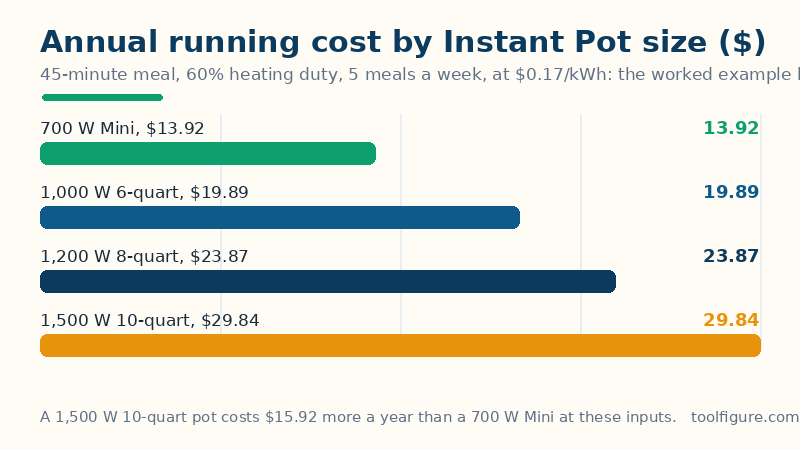
energy per meal (kWh) = average watts ÷ 1,000 × minutes ÷ 60annual cost ($) = energy per meal × meals a week × 52 × electricity priceThe watts on the label are the full-power heating figure, and the pot does not draw them for the whole cycle. A Mini draws about 700 W, a 6-quart about 1,000 W, an 8-quart about 1,200 W and a 10-quart up to 1,500 W — and the element works hard only for the first 25 minutes or so, while the pot heats up and reaches pressure, then cycles to hold it, so the average across a 45-minute cycle is about 60% of the rated watts. What matters is the meals a week: one meal is 0.45 kWh, but seven meals is 3.15 kWh, and the pot that cooks every night will always cost more than the one that cooks twice a week.
Worked example: 1,000 W, 45 minutes, 60% duty, 5 meals a week, $0.17/kWh
A 1,000 W Instant Pot at 60% duty averages 600 W, so a 45-minute meal uses 0.6 × 0.75 = 0.45 kWh, costing 7.7¢. A week is 0.45 × 5 = 2.25 kWh, costing $0.38. A month is 117 ÷ 12 = 9.8 kWh, costing $1.66. A year is 2.25 × 52 = 117 kWh, costing $19.89. The table above shows the same maths for the other pot sizes at a 45-minute meal, 60% heating duty and 5 meals a week: a 700 W Mini costs 5.4¢ a meal and $13.92 a year, a 1,200 W 8-quart costs 9.2¢ a meal and $23.87 a year, and a 1,500 W 10-quart costs 11.5¢ a meal and $29.84 a year. One hour at full power costs 17.0¢ at these settings, and ten years of pressure cooking at this pace costs $198.90. At 100% duty — the ceiling, as if the element never cycled — the same routine costs $33.15 a year; a 30-minute meal costs $13.26 and a 90-minute meal $39.78; cooking every day costs $27.85 a year, once a week $3.98. Four published cross-checks reproduce exactly: joteo's 6-quart Instant Pot averages 410 W across a 0.9-hour session at 17 cents, using 0.369 kWh and costing about 6 cents a meal — this page gives the same 0.369 kWh, 6.3¢ a meal, 95.94 kWh a year and $16.31 — while its $1.38 a month is 22 meals at the per-meal figure, against this page's year-divided-by-12 month of $1.36; thekitchenpot's ceiling figures at 18 cents are 6.3¢ for 30 minutes, 12.6¢ for an hour and 25.2¢ for 2 hours at 700 W, and 21 cents for a 70-minute cycle at 1,000 W — this page at 100% duty gives the same 6.3¢, 12.6¢, 25.2¢ and 21.0¢ — while its $3.78 a month for an hour a day is the day times 30 against this page's $3.82; applianceenergycost's Instant Pot at 1,000 W, 45 minutes a day and 16.9 cents costs 12.7¢ a day, $3.85 a month and $46.26 a year — this page gives the same 12.7¢ a meal, while its $46.26 a year is the day times 365 against this page's $46.14, and its $3.85 a month against this page's $3.84; and jackery's 1,000 W Instant Pot at 30 minutes and 15 cents uses 0.5 kWh and costs about 7 to 8 cents a use — this page gives the same 0.5 kWh and 7.5¢ a meal.
How to read your result, and its limits
Four cautions keep the number honest. First, the duty is the whole story: the 100% duty ceiling is $33.15 a year against $19.89 at 60% duty — the element only draws full power while the pot is heating up, and joteo's measured 410 W average on a 1,000 W 6-quart pot is a 41% duty, so the real meal is closer to 6.3¢ than 12.8¢. Enter the duty you actually see, not the duty you hope for. Second, the meals a week are the count, not the days: 5 meals a week is 260 meals a year, so the year is the week times 52 — 117 kWh and $19.89 — while multiplying one meal by 365 days would give $27.92, as if you pressure-cooked every single day. Third, the pressure cooker beats the oven on time: a 45-minute pressure meal is 0.45 kWh and 7.7¢, against 2 kWh and 34.0¢ for one hour in a 2,000 W oven — and the 8-hour slow cooker it replaces uses 1.6 kWh and 27.2¢ for the same meal, so the pressure cooker is the cheapest hot meal of the three. Fourth, the electricity price is the all-in rate: the total on the bill divided by the kilowatt-hours on the bill, including delivery charges. For the all-day cook the pressure cooker replaces, the slow cooker cost calculator prices the stew by watts, hours and cooks a week; for the roast that takes the oven instead, the oven cost calculator prices it by watts and minutes — one hour of a 2,000 W oven is 2 kWh and 34.0¢, more than four pressure-cooker meals — and for the cost of running anything else in the house, the electricity cost calculator prices any appliance by watts and hours.
Common mistakes
- Pricing the label watts for the whole cycle. A 1,000 W pot for 45 minutes is 0.75 kWh and 12.8¢ at full power, but the element cycles once the pot reaches pressure — the real meal is 0.45 kWh and 7.7¢ at 60% duty. Use the duty, not just the watts.
- Multiplying one meal by 365 days. Five meals a week is 260 meals a year, not 365: $0.0765 × 365 gives $27.92, while the real year is $19.89. Count the meals a week, then multiply by 52.
- Multiplying the weekly cost by 4 for the month. Four weeks is not a twelfth of a year: the week times 4 gives $1.53 a month at the worked example's inputs, while the year divided by 12 gives $1.66. Use the year-divided-by-12 figure, which is the one that adds up.
- Comparing pots on watts. A 1,500 W 10-quart pot and a 700 W Mini look far apart on watts, but the meal is 45 minutes either way: 0.675 kWh against 0.315 kWh, 11.5¢ against 5.4¢ — and the larger pot reaches pressure faster, so the cost per meal can be closer still. Compare kilowatt-hours per meal, not watts.
- Adding the standing charge to every meal. The daily supply charge is payable whether the pot runs or not. Only the per-kWh rate belongs in the per-meal maths — the fixed charge is a separate line on the bill.
Frequently asked questions
How much does an Instant Pot cost per meal?
A 1,000 W Instant Pot at 60% heating duty costs 7.7¢ a meal for a 45-minute cycle at $0.17 per kWh — 0.45 kWh a meal, $19.89 a year at 5 meals a week. At the full-power ceiling, 100% duty, the same meal is 12.8¢.
How many watts does an Instant Pot use?
Instant Pots are rated 700 to 1,500 W: a Mini about 700 W, a 6-quart about 1,000 W, an 8-quart about 1,200 W and a 10-quart up to 1,500 W. The average across a cycle is 40 to 60% of the rated watts — joteo's measured 410 W average on a 6-quart pot is a 41% duty.
Is an Instant Pot cheaper to run than a slow cooker?
Yes, per meal: a 45-minute pressure meal at 1,000 W and 60% duty is 0.45 kWh and 7.7¢, against 1.6 kWh and 27.2¢ for an 8-hour slow-cooker cook at 200 W — about 70% less energy for the same meal. The slow cooker still wins on hands-off time; the pressure cooker wins on the bill.
Does an Instant Pot use a lot of electricity?
No: 5 meals a week is 117 kWh a year and $19.89 at $0.17 per kWh — less than a 100 W TV watched 5 hours a day, which costs $32.20 a year. A pressure cooker is one of the cheapest ways to cook a hot meal.