Two buckets: one-off costs, then yearly costs
The whole calculation is two additions and two divisions, and the size is the one people get wrong. The one-off costs — adoption or purchase, the first vet visit with vaccines and spay or neuter, and the setup supplies — are added together once. The yearly lines — food, routine vet and prevention, grooming, insurance, boarding and walking, and supplies — are added together for the annual cost. The first year is the one-off total plus one year of the annual cost; the monthly budget is the annual cost divided by 12; and the lifetime cost is the one-off total plus the annual cost multiplied by the expected lifespan:
first year ($) = one-off costs + annual costs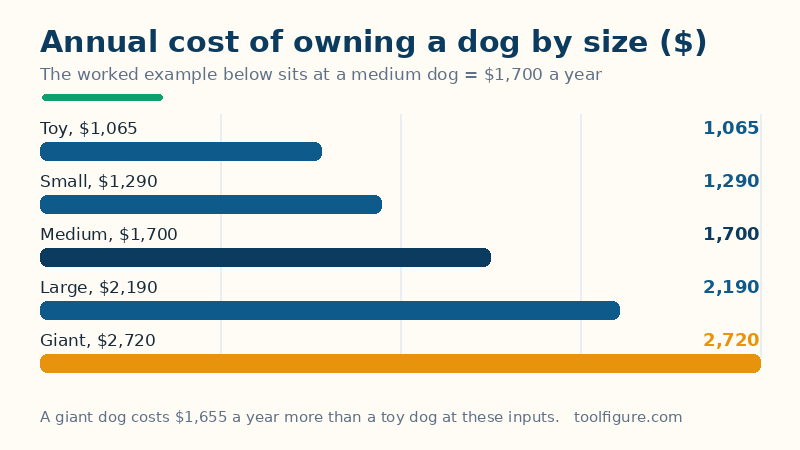
monthly budget ($) = annual costs ÷ 12lifetime cost ($) = one-off costs + annual costs × expected lifespanBreed size matters twice: it changes both the yearly cost and the number of years. A giant dog eats more, takes larger medication doses and pays a higher insurance premium every year, and then lives about eight years against a toy dog's fifteen — so the giant costs more per year and the toy costs more years. The table above shows the same maths for every size: a toy dog costs $1,065 a year over 15 years for a $17,075 lifetime, a small dog $1,290 a year over 14 years for $19,230, the worked example's medium dog $1,700 a year over 12 years for $21,710, a large dog $2,190 a year over 10 years for $23,380, and a giant dog $2,720 a year over 8 years for $23,430. Each row's lifetime arithmetic checks: the toy's $1,100 of one-off costs plus 15 × $1,065 is $17,075, the small's $1,170 plus 14 × $1,290 is $19,230, the large's $1,480 plus 10 × $2,190 is $23,380, and the giant's $1,670 plus 8 × $2,720 is $23,430.
Worked example: a medium dog, 12-year life
A medium dog bought for $300 costs $560 for the first vet visit, vaccines and spay or neuter, and $450 for the bed, crate, lead, collar, bowls and toys — one-off costs of $300 + $560 + $450 = $1,310. Every year after that costs $400 for food, $280 for routine vet care and prevention, $200 for grooming, $540 for insurance, $180 for boarding and walking, and $100 for supplies — annual costs of $1,700. The first year is $1,310 + $1,700 = $3,010, the monthly budget is $1,700 ÷ 12 = $141.67, or $4.66 a day, and the lifetime cost is $1,310 + 12 × $1,700 = $21,710. Insurance is the biggest single line at $540 a year — 31.8% of the annual total — and food is next at $400; without insurance the annual total would be $1,160, or $96.67 a month. The first year on its own, divided by 12, is $250.83 a month — nearly double the $141.67 monthly budget — which is why the first year is always quoted separately from the years after it. Three published cross-checks reproduce exactly: Hownd's medium-dog row gives a $3,010 first year, $1,700 a year and a $21,710 lifetime over 12 years — the worked example above, the same figures. DogCalcs' medium-dog defaults give a $3,765 first year, $2,340 a year and a $29,505 lifetime over 12 years — this page gives the same $3,765, $2,340 and $29,505 with their one-off costs of $1,425 ($400 adoption, $600 first vet, $425 setup) and their yearly lines ($600 food, $400 vet, $300 grooming, $600 insurance, $240 boarding, $200 supplies). And OnlyCalculators' annual figure of $4,145 — food $1,030, healthcare $1,650, grooming $400, services $650 and supplies $415 — is $345.42 a month on this page (their page rounds it to $345) and $50,140 over a 12-year life with a $400 one-off cost, the same $50,140 they publish. The spread between those three sources is the point: published estimates for a medium dog run from about $1,700 to about $4,145 a year, depending on what is included — premium food, daycare and a higher insurance tier push the total up, and the same dog costs different amounts in different towns. NovaCalculator's example sits at the top of that range, with a $5,020 first year — $418 a month on the first-year figure — and a lifetime near $42,000, on the same logic: their example includes daycare and premium items this page's defaults leave out.
How to read your result, and its limits
Four cautions keep the number honest. First, this is routine cost only: the estimate excludes the thing most likely to break it — an unexpected illness or injury. A single cruciate repair or cancer course can cost more than several years of everything else combined, which is exactly what insurance is for: it does not lower the total, it caps the surprise. Second, the first year is not the monthly budget: the monthly figure is the annual cost divided by 12, while the first year — $3,010 for the medium dog, or $250.83 a month — carries the one-off costs and is nearly double the ongoing $141.67. Third, size is a range, not a breed: a 25 lb dog and a 50 lb dog are both "medium" here, and a long-coated breed grooms for far more than a short-coated one of the same weight — use the size selector as a starting point and edit the lines. Fourth, prices are local: veterinary fees, insurance premiums and food prices vary enormously between countries and even between neighbouring towns, so your own vet's price list beats any published average. For the monthly side of the same household budget, the rent calculator prices what a home costs each month and the salary converter turns an annual salary into the hourly and monthly figures the budget is built from; for the other kind of family planning on this site, the retirement calculator prices a pot the same way — a monthly contribution, a rate and a number of years.
Common mistakes
- Budgeting only the purchase price. The dog itself is the smallest part of the first year: at the worked example's inputs the $300 adoption is less than a tenth of the $3,010 first year, and the lifetime cost is $21,710 — more than seventy times the purchase price.
- Dividing the lifetime total by the lifespan and calling it the monthly budget. The lifetime total includes the one-off costs once, not every year. The monthly budget is the annual cost divided by 12 — $141.67 for the medium dog — while the first year alone is $250.83 a month.
- Comparing totals across sources that include different things. A $1,700-a-year estimate and a $4,145-a-year estimate can both be right: one leaves out daycare and premium food and the other includes them. Compare line by line, not total by total.
- Leaving insurance out and then being surprised by the emergency. Insurance is the biggest single line at the worked example's inputs — $540 a year, 31.8% of the annual total — and dropping it saves $45 a month while leaving the whole emergency risk on the owner.
- Using the puppy's food bill for an adult dog, or the adult's for a puppy. Puppies eat more per pound and need more vet visits in the first year; the first-year vet line is higher than the routine line for exactly that reason.
Frequently asked questions
How much does a dog cost per year?
At the worked example's inputs a medium dog costs $1,700 a year — $141.67 a month, $4.66 a day. Published estimates for a medium dog run from about $1,700 to about $4,145 a year depending on what is included: premium food, daycare and a higher insurance tier push the total up. A toy dog costs about $1,065 a year and a giant dog about $2,720.
How much does a dog cost in the first year?
A medium dog costs $3,010 in the first year at the worked example's inputs — $1,310 of one-off costs (adoption $300, first vet $560, setup $450) plus $1,700 of yearly costs. The first year is nearly double the ongoing monthly budget: $250.83 a month against $141.67 after the first year.
How much does a dog cost over its lifetime?
A medium dog costs $21,710 over a 12-year life at the worked example's inputs — $1,310 once plus $1,700 a year for 12 years. By size the lifetime runs from $17,075 for a toy dog over 15 years to $23,430 for a giant dog over 8 years. Commonly quoted lifetime ranges are $15,000–$30,000, and up to $50,000 or more with daycare and premium costs included.
Is pet insurance worth it?
Insurance is the biggest single line at the worked example's inputs — $540 a year, 31.8% of the annual total — and dropping it saves $45 a month while leaving the whole emergency risk on the owner. A single cruciate repair or cancer course can cost more than several years of everything else combined, so insurance does not lower the total, it caps the surprise.