Two times added together, then breaks on top
Naismith's Rule, published by the Scottish mountaineer William Naismith in 1892, is deliberately simple: it times the distance and the climb separately and adds them. On flat ground a fit walker covers 5 kilometres an hour (3 miles an hour), so distance time is distance divided by that speed. Climbing costs one hour for every 600 metres of ascent (2,000 feet), so climb time is ascent divided by 600 metres an hour. The two are added for the walking time, and breaks — rest stops, lunch and summit time — are added on top, because a break is not walking and no rule should pretend it is. That separation is the whole value of the rule: when an estimate looks wrong, you can see at once whether the distance or the climb is responsible.
Metric: walking time = distance (km) ÷ 5 + ascent (m) ÷ 600, in hours — Imperial: walking time = distance (miles) ÷ 3 + ascent (ft) ÷ 2,000, in hours — Total time = walking time + breaks — Arrival = start time + total time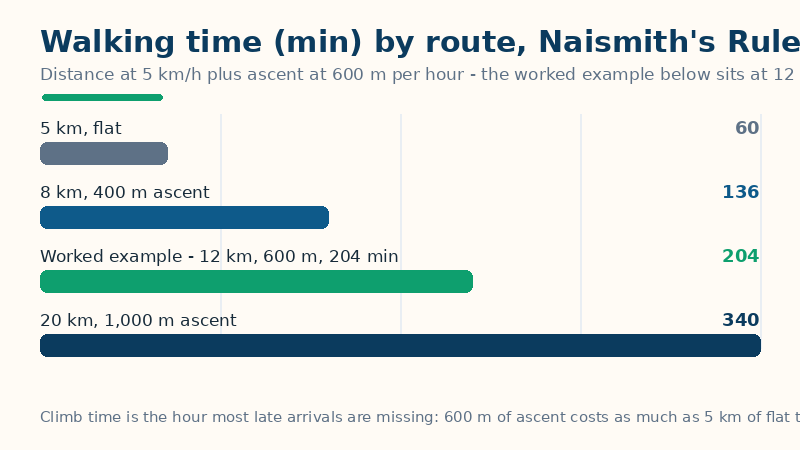
The metric and imperial forms are the same rule in different units, not two rules: 5 kilometres an hour and 3 miles an hour are close but not identical speeds, which is why this page applies the form that matches the units you chose instead of converting one into the other and quietly changing the answer.
Worked example: 12 kilometres, 600 metres of ascent, 30 minutes of breaks
A 12-kilometre trail with 600 metres of total ascent, starting at 08:00 with 30 minutes of breaks, takes 3 hours 54 minutes in total — 3 hours 24 minutes of walking plus 30 minutes of breaks — arriving at 11:54. The working: distance time = 12 ÷ 5 = 2.40 hours = 2 hours 24 minutes. Climb time = 600 ÷ 600 = 1.00 hour = 1 hour 0 minutes. Walking time = 2 hours 24 minutes + 1 hour 0 minutes = 3 hours 24 minutes. Total = 3 hours 24 minutes + 30 minutes = 3 hours 54 minutes. Arrival = 08:00 + 3 hours 54 minutes = 11:54. Average speed including breaks = 12 ÷ 3.90 = 3.08 km/h over the route distance. The same arithmetic on other routes:
| Route | Walking time | Breaks | Total and arrival from 08:00 |
|---|---|---|---|
| 5 km, flat | 1 h 00 min | 0 min | 1 h 00 min, arriving 09:00 |
| 8 km, 400 m ascent | 2 h 16 min | 20 min | 2 h 36 min, arriving 10:36 |
| 12 km, 600 m ascent (worked example) | 3 h 24 min | 30 min | 3 h 54 min, arriving 11:54 |
| 20 km, 1,000 m ascent | 5 h 40 min | 60 min | 6 h 40 min, arriving 14:40 |
| 10 miles, 2,000 ft ascent | 4 h 20 min | 30 min | 4 h 50 min, arriving 12:50 |
Check the imperial row by hand: distance time = 10 ÷ 3 = 3.33 hours = 3 hours 20 minutes; climb time = 2,000 ÷ 2,000 = 1 hour; walking time = 4 hours 20 minutes; plus 30 minutes of breaks = 4 hours 50 minutes; 08:00 + 4 hours 50 minutes = 12:50. And check the 8-kilometre row: 8 ÷ 5 = 1.60 hours = 1 hour 36 minutes, plus 400 ÷ 600 = 0.67 hours = 40 minutes, is 2 hours 16 minutes of walking, plus 20 minutes of breaks = 2 hours 36 minutes.
How to read your result, and its limits
Three checks before trusting the figure. First, the rule assumes a fit walker on a decent path carrying little: it was never a promise for a beginner, a large group, a full overnight pack or rough ground, and each of those adds time — roughly 20–25% for a full pack, roughly 25–50% for rough, rocky or boggy ground. Second, descent is not counted: the classic rule adds nothing for going down, so a long steep descent on tired legs will take longer than this estimate, and a route that climbs then descends steeply needs a margin the rule does not supply. Third, ascent means total ascent: add up every climb on the route, not the height of the highest point, because rolling ground climbs and descends repeatedly and every climb costs its hour per 600 metres. If the arrival time lands after dark, shorten the route or start earlier — the estimate is the first line of the plan, not the plan itself.
Common mistakes
- Timing the distance and forgetting the climb. Six hundred metres of ascent is a full hour by this rule — the same as 5 kilometres of flat trail — and it is the hour most late arrivals are missing.
- Using summit height instead of total ascent. An out-and-back over rolling ground climbs far more than the summit height suggests; add up every climb.
- Counting breaks as walking. Breaks are added on top of the walking time, not inside it — a route with an hour of stops is an hour longer, whatever the walking speed.
- Treating the estimate as a guarantee. Weather, ground, pack weight and group speed all move the real time; build in a margin, especially for a descent-heavy return.
Related tools: Hiking Water Calculator — Your hiking water from hours, heat and effort — litres to carry, 1-litre bottles and the pack weight, with a delay hour and camp water included; Pace Calculator — Running pace, speed and predicted finish times for 5K, 10K, half marathon and marathon; Backpack Size Calculator — Your backpack size in two parts: frame size from torso length, and litres from trip length, packing style and season.
Frequently asked questions
What is Naismith's Rule?
Allow one hour for every 5 kilometres (3 miles) of distance, plus one hour for every 600 metres (2,000 feet) of ascent. William Naismith published it in 1892 for a fit walker on a decent path, and it is still the standard first estimate for a trail's walking time.
Does Naismith's Rule count descent?
No — the classic rule adds nothing for going down. A long steep descent on tired legs takes real time, so treat the estimate as a floor on a descent-heavy route and add a margin, rather than assuming the downhill is free.
How long does a 10 km hike with 500 m of ascent take?
Walking time = 10 ÷ 5 = 2 hours for the distance, plus 500 ÷ 600 = 50 minutes for the climb, which is 2 hours 50 minutes of walking. Add your breaks on top: with 30 minutes of breaks the total is 3 hours 20 minutes.
Why is my hike slower than Naismith's estimate?
Because the rule assumes a fit walker on a good path carrying little. A full overnight pack adds roughly 20–25%, rough or boggy ground roughly 25–50%, and a slower group or bad weather adds more — and the rule never counted descent or breaks, which this calculator adds separately.