The formula: none — a profile table, stated in full
Squash racket sizing has no height formula to solve, because adult squash frames are all roughly the same length and there is no junior length ladder like tennis has. What the fitting guides publish instead is a profile table: match your game to a row, and read off grip, weight, balance and string tension. The table below is this calculator's table, taken from the fitting guides that agree on it. Three measures decide how a frame plays in the hand — the grip you hold, the weight you swing, and the balance that sets the frame's temperament — and each row below fixes all three, plus the string tension that suits the same player.
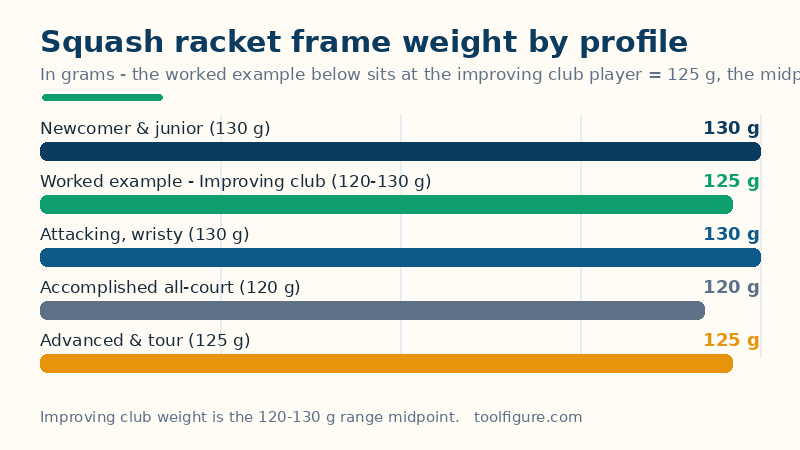
| Player profile | Grip | Frame weight | Balance | String tension |
|---|---|---|---|---|
| Newcomer & junior | Grip 0–1 | 130 g | Even | 24 lb |
| Improving club player | Grip 1 | 120–130 g | Even | 26 lb |
| Attacking, wristy game | Grip 1 | 130 g | Head-light | 26 lb |
| Accomplished all-courter | Grip 1–2 | 120 g | Even to head-heavy | 26 lb |
| Advanced & tour player | Grip 2 | 125 g | Head-heavy | 28 lb |
Spot checks against the table: a newcomer takes grip 0–1 at 130 g with an even balance, an attacking player takes grip 1 at 130 g but head-light, and the advanced and tour row is the only one at grip 2 and 28 lb. Note what the table does not do: it does not size by height, and it does not offer a junior length — juniors take the same frame lengths with the newcomer row's grip and weight.
Worked example: improving club player
An improving club player takes grip 1 — the standard most club players use — at 120–130 g with an even balance and 26 lb string tension. The weight range is a range, not a single figure, because 120 g and 130 g feel different in the hand: 120 g is a lively, quick frame that rewards a fast hand, 130 g is more forgiving and stable and kinder to the arm, and 125 g — the midpoint of the range, and the advanced and tour row's weight — is the tour compromise of control with real drive. An improving player who is unsure should start at the heavier end of the range, because a frame that is too light twists on off-centre hits, while a slightly heavy frame only asks for a stronger swing. The same calculator at newcomer returns grip 0–1, 130 g, even balance and 24 lb — the softer tension giving more power and a more comfortable arm — and at advanced returns grip 2, 125 g, head-heavy and 28 lb, the crisper tension giving more control to a grooved swing.
How to read your result, and its limits
Three checks before buying. First, do the finger-gap check: hold the frame as you would to strike — there should be a finger's width between your fingertips and your palm. Fingers crowding the palm means move up a grip; a gap you could lose a coin in means move down, or add an overgrip. When in doubt, size down — an overgrip is easily added, never subtracted. Second, read balance honestly: head-light means nimble at the front and quick to manoeuvre, even means the versatile middle ground, and head-heavy means penetrating length and power for a grooved swing — a head-heavy frame helps a player who already hits cleanly and punishes one who does not. Third, remember what this tool does not decide: head shape (a rounded teardrop head gives a larger sweet spot, a conventional head gives more control), frame stiffness and string choice all change how a frame plays, and a coach who has seen you play will beat any table. Older and heavier frames exist above 130 g, but the modern fitting range in the table — 120 g to 130 g — is where new buyers should shop.
Common mistakes
- Sizing a squash racket by height. Height drives tennis and badminton length ladders, but squash frames are not sold that way — profile, not height, decides grip, weight and balance.
- Buying the lightest frame to go faster. A 120 g frame is quick only in a fast hand; for a developing player it twists on off-centre hits, and the heavier 130 g frame is the forgiving choice.
- Going up a grip size "for comfort". A grip that is too large stops the wrist snapping through the shot and strains the forearm; when in doubt, size down and build up with an overgrip.
- Copying a tour player's tension. 28 lb suits an advanced, grooved swing; for a newcomer it feels dead and hard on the arm, which is why the newcomer row sits at 24 lb.
Related tools: Tennis Racket Size Calculator — The right tennis racket length from height: 19 in to the 27 in adult standard, with a grip-size starting point and the fit checks; Badminton Racket Size Calculator — The right badminton racket from age and level: length, weight class (U) and grip size (G) in grams and millimetres; Pickleball Paddle Size Calculator — The right pickleball paddle from one hand measurement and your style of play: grip size, weight class and shape in a single lookup.
Frequently asked questions
What grip size do I need for squash?
Grip 0 is the slimmest hold, grip 1 is the standard most club players use, and grip 2 is a fuller hold for larger hands or a firmer grip. Do the finger-gap check: hold the frame as if to strike and there should be a finger's width between fingertips and palm; when in doubt, size down and build up with an overgrip.
What weight squash racket should a beginner use?
130 g with an even balance. The modern fitting range runs 120 g (lively and quick) to 130 g (forgiving, stable and kind to the arm), and a beginner benefits from the heavier, more forgiving end.
What is the difference between head-light and head-heavy squash rackets?
Head-light frames are nimble at the front and quick to manoeuvre, even-balanced frames are the versatile middle ground, and head-heavy frames give penetrating length and power for a grooved swing.
What string tension should I use for squash?
24 lb for newcomers (softer, more power, comfortable arm), 26 lb as the standard for most club players, and 28 lb for advanced players (crisper, more control).
