One measurement, two sizes
Full-face snorkel masks are sold in just two sizes, S/M and L/XL, and the sizing guides agree on the single measurement that separates them: the straight-line distance from the bridge of your nose — the top bit between your eyes — to the bottom of your chin. Under 12 cm is S/M; over 12 cm is L/XL. The measurement must be a straight line, not a tape following the curve of the nose: measuring over the nose adds length that is not there, and a reading pushed over 12 cm by that mistake buys the larger size for a face that needed the smaller one. Measuring in a mirror helps, and having someone else take it helps more, because your own hand tends to follow the nose.
Full-face mask size = S/M when nose-to-chin < 12 cm · L/XL when nose-to-chin > 12 cm · exactly 12 cm: try S/M first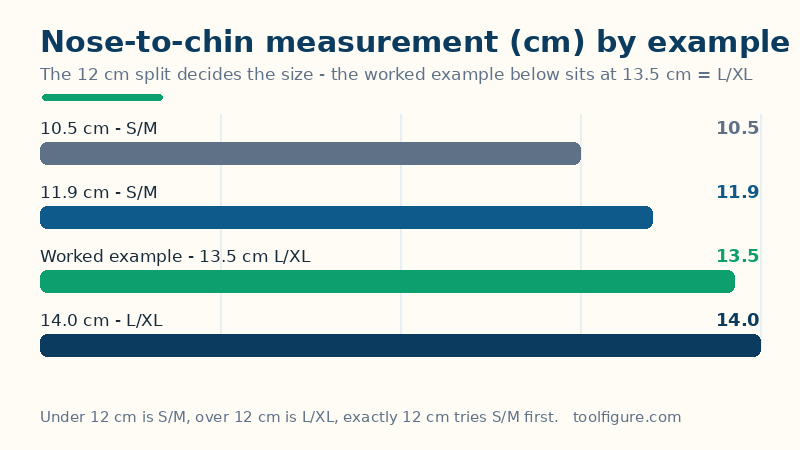
The boundary case deserves its own rule because the guides state the two sides without stating the line itself: less than 12 cm takes S/M, more than 12 cm takes L/XL, and exactly 12 cm is left to the fit test. This page resolves it toward S/M, for a stated reason — straps stretch slightly once wet, so a mask that starts snug seals better than one that starts loose — and says plainly to size up if S/M pulls or will not seal. A size that hurts is not a size that fits, whatever the ruler said.
Worked example: 13.5 cm nose-to-chin
A snorkeller measuring 13.5 cm from nose bridge to chin needs a full-face mask in size L/XL. The working: 13.5 cm is over the 12 cm split, so the size is L/XL; in inches that is 13.5 ÷ 2.54 = 5.31 in, against the same split at 12 ÷ 2.54 = 4.72 in. The same arithmetic at other measurements shows the split in both units:
| Nose-to-chin | In the other unit | Size |
|---|---|---|
| 10.5 cm | 4.13 in — under 4.72 in | S/M |
| 11.9 cm | 4.69 in — under 4.72 in | S/M |
| 12.0 cm | 4.72 in — exactly on the split | Try S/M first |
| 12.5 cm | 4.92 in — over 4.72 in | L/XL |
| 14.0 cm | 5.51 in — over 4.72 in | L/XL |
| 4.5 in | 11.43 cm — under 12 cm | S/M |
| 5.0 in | 12.70 cm — over 12 cm | L/XL |
Notice how close the second and fourth rows sit to the split — 11.9 cm one way, 12.5 cm the other — which is why the measurement method matters more than the second decimal place: a tape run over the nose instead of straight can move a true 11.9 cm reading past 12 cm and flip the size. When a reading lands within a few millimetres of 12 cm, remeasure straight, and let the suction test below break the tie.
How to read your result, and its limits
Three checks before buying. First, the suction test overrules the ruler: press the mask to your face without using the strap, breathe in gently through your nose, and let go — a sealing mask stays on your face. If it drops at once, the skirt is not sealing on your face shape, and neither size of that model may fit — face shapes differ, and a size chart cannot see yours. Second, the strap position is part of the fit: the strap should sit high on the back of your head, not resting on your ears, where it turns painful; if you have to pull the straps tight to get a seal, or the mask leaves deep red marks when it comes off, it is too tight or the wrong size. Third, this page sizes full-face masks only: traditional two-lens masks are sized differently, by the skirt's fit to your face rather than by this 12 cm split, and the sizing system here does not transfer to them — and full-face masks are surface-snorkelling masks only, not for diving down on a single breath. Children need their own measurement, not an adult's size scaled down: measure the child the same way and apply the same split, and check the mask maker's own chart, since brands vary around it.
Common mistakes
- Measuring over the nose. The measurement is a straight line from bridge to chin; following the nose's curve inflates it and can flip the size from S/M to L/XL.
- Buying the larger size "to be safe". A loose full-face mask leaks, and leaks are the whole problem the size is meant to prevent — snug seals, loose does not.
- Skipping the suction test. Two faces with the same nose-to-chin measurement can seal differently; the test takes ten seconds and catches what the ruler cannot.
- Using a full-face mask to dive down. These masks are designed for the surface only — breath-hold diving in one risks the mask's air pocket and breathing path, and is not what the mask is for.
Related tools: Life Jacket Size Calculator — Your life jacket size: children by body weight, adults by chest measurement — plus the fit test that confirms it; Scuba Weight Calculator — Your starting scuba lead weight from body weight, wetsuit, water type and tank — with the buoyancy check that settles it; Wetsuit Size Calculator — The right wetsuit size from your height and weight, plus the suit thickness for your water temperature: one consolidated chart, honestly stated.
Frequently asked questions
What size full-face snorkel mask do I need?
Measure straight from the bridge of your nose to the bottom of your chin: under 12 cm is S/M, over 12 cm is L/XL, and exactly 12 cm means try S/M first. For example, 13.5 cm (5.31 in) is L/XL. Confirm with the suction test before you buy.
How do I measure my face for a snorkel mask?
In a mirror, measure the straight-line distance from the bridge of your nose (between your eyes) to the bottom of your chin — a straight line, not over the nose. Ask someone else to take it if you can, since your own reading tends to follow the curve of the nose and read long.
What if my measurement is exactly 12 cm?
Try S/M first: straps stretch slightly once wet, so a mask that starts snug seals better than one that starts loose. If S/M pulls uncomfortably or fails the suction test, size up to L/XL rather than forcing it.
How do I know if a snorkel mask fits?
Press the mask to your face without the strap, breathe in gently through your nose, and let go — it should stay sealed on your face. The strap should sit high on the back of your head, not on your ears, and you should not need to pull it tight to get a seal.
