Light falling on a surface, in two languages
Illuminance is the light that actually lands on a surface — not the light a bulb emits, but the light your desk, your reading chair or your workbench receives. The world measures it in two languages. The SI language is lux: one lux is one lumen spread over one square metre, and it is the language of lighting standards, building codes outside North America, and every light meter with a metric setting. The imperial language is the foot-candle: one lumen spread over one square foot, still the language of American lighting specifications, theatre plots and older photography books. They are the same physical quantity wearing different area units, and the bridge between them is exact: a square foot is 0.09290304 square metres, so one foot-candle is 10.76391041670972 lux, and one lux is 0.09290304 foot-candles. This page restates any level in all six units at once — lux, millilux, microlux, kilolux, foot-candle and phot — worked through lux with every factor defined, and tells you how many lumens a room at that level needs.
The formula
answer = lux ÷ (lux in one "to" unit)
Three terms, all visible on the page. value is the number you enter. lux in one "from" unit is the exact definition of the unit you are converting from — 1 for the lux itself, 0.001 for the millilux, 0.000001 for the microlux, 1,000 for the kilolux, 10.76391041670972 for the foot-candle, and 10,000 for the phot. answer is the result in the unit you asked for. The phot deserves a note: it is the old CGS unit, one lumen per square centimetre, which is why it is exactly 10,000 lux — a centimetre is a hundredth of a metre, and area squares the hundred into ten thousand.
Worked example
Convert 500 lx to foot-candles — the standard office lighting level — the way the tool does it.
Step 1 — get to lux. The input is already in lux, so 500 × 1 = 500 lx.
Step 2 — divide by the target factor. One foot-candle is 10.76391041670972 lx, so 500 ÷ 10.76391041670972 = 46.45152.
Step 3 — read the display. The page prints four decimals below 10 and two above, so the headline reads 46.45 fc, and the detail line shows the working: 500 lx = 46.45 fc — worked through lux: 500 lx ÷ the Foot-candle factor.
How many lumens? Lumens are illuminance times area: 500 lx × 20 m² = 10,000 lumens, which is the line the tool adds under the answer — the total light a perfectly even, lossless installation would need for a 20 m² office at 500 lx. Real rooms need more, because walls absorb light and no fitting spreads it perfectly evenly; treat 10,000 as the floor, not the shopping list.
Check it. Multiplying back, 46.45 × 10.76391041670972 ≈ 500 — the hundredth is display rounding, and the tool's own table restates the same 500 lx in all six units (500,000 mlx, 500,000,000 µlx, 0.5 klx, 46.45 fc, 0.05 ph), so the from/to choice only changes which row is the headline.
Conversions worth memorising
Every row below is the tool's own output, checked figure by figure:
| From | To | Result |
|---|---|---|
| 1 lx | foot-candles | 0.0929 fc |
| 10 fc | lux | 107.64 lx |
| 1 ph | lux | 10,000 lx |
| 100 lx | foot-candles | 9.2903 fc |
| 300 lx | foot-candles | 27.87 fc |
| 500 lx | foot-candles | 46.45 fc |
| 1,000 lx | foot-candles | 92.9 fc |
| 10,000 lx | kilolux | 10 klx |
| 100,000 lx | foot-candles | 9,290.3 fc |
| 0.25 lx | foot-candles | 0.0232 fc |
| 1 klx | lux | 1,000 lx |
| 50 fc | lux | 538.2 lx |
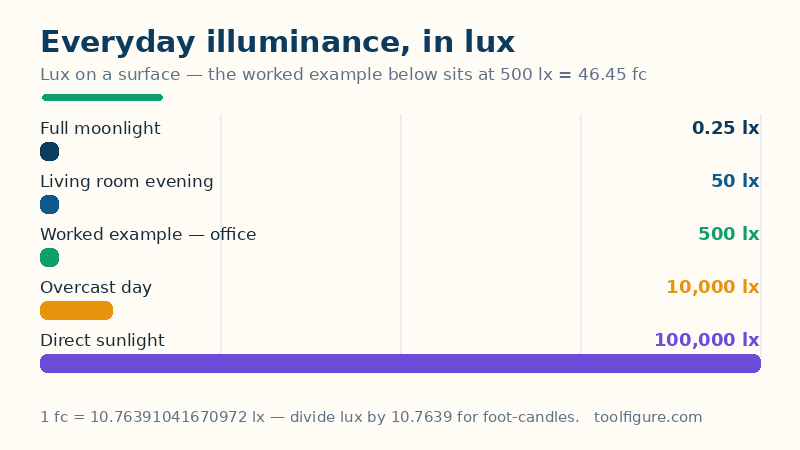
Three rows deserve a second look. The 500 lx row is the office standard — 46.45 fc — and it is the number American specs quote as "50 foot-candles" rounded, which is why a spec that says 50 fc and a meter that reads 500 lx are describing nearly the same room. The 0.25 lx row is full moonlight — 0.0232 fc — and its smallness is the point: moonlight is about two thousand times dimmer than office light, which is why night photography needs long exposures. And the 100,000 lx row is direct sunlight — 9,290.3 fc — the brightest level most people ever stand in, and the reason a sunlit room needs no lamps at all.
Three traps worth knowing
Lux is not lumens, and the area is the whole difference. A 1,000-lumen bulb over 1 m² gives 1,000 lx; the same bulb over 20 m² gives 50 lx. Bulb boxes quote lumens (total light out); lighting specs quote lux (light landing here). This page converts lux, and its lumens line multiplies by your area to cross between the two — never compare a lumen figure with a lux figure without the area.
Foot-candles and lux differ by about ten, not a hundred. The rough rule "divide lux by 10 for foot-candles" is close enough for a site visit (500 lx ≈ 50 fc against the true 46.45), but it is 7% off, which matters when a specification has a pass mark. Use the exact 10.76391041670972 for anything contractual, and the divide-by-ten rule only for a corridor estimate.
Phot is not a typo for foot-candle. The phot (ph) is 10,000 lux — the CGS cousin of the lux — while the foot-candle is 10.76 lux. They differ by a factor of about 929, and confusing them turns a reading room into a sunlit beach. If an old textbook gives a level in ph, divide by 929 to reach foot-candles, or let this page do it: 1 ph is 929.03 fc.
How to read your result, and the limits
Results show four decimal places below 10 and two above — more precision than any handheld meter justifies, so round to the meter for real use. Four limits belong with the page. Negative values are refused: −500 lx gets a clear error, because negative light falling on a surface has no meaning here. Empty input clears quietly; type and the table rebuilds, delete and the page waits. Anything past a trillion in any unit gets a clear error instead of a meaningless digit string. And this page converts levels, not rooms: it will restate any illuminance in any unit and work out the lumens an even spread would need, but it will not account for shadows, wall colours, fitting losses or daylight — for a real lighting design you need the room, not just the arithmetic.
Related tools: Unit Converter — Convert length, weight, temperature and volume — km to miles, kg to pounds, °C to °F, litres to gallons; Energy Converter — Joules to calories, kcal to kJ, kWh to joules and BTU — every answer in all ten units, through the exact definitions; Power Converter — Horsepower to kW, kW to hp, watts and tons of refrigeration — every answer in all eight units, through the exact definitions.
Frequently asked questions
How do I convert lux to foot-candles?
Divide lux by 10.76391041670972. So 500 lx becomes 46.45 fc, 100 lx becomes 9.2903 fc, and 1,000 lx becomes 92.9 fc. To go back, multiply foot-candles by 10.76391041670972: 10 fc is 107.64 lx and 50 fc is 538.2 lx. This page does both directions and restates every answer in all six units at once.
How many lumens do I need for a room?
Multiply the illuminance you want by the room's area: lumens = lux × square metres. An office at 500 lx over 20 m² needs 10,000 lumens before losses; a living room at 100 lx over 15 m² needs 1,500. Enter your area on this page and the tool works it out — then add margin for wall absorption and uneven spread, because no real fitting is perfectly even.
What is a good lux level for an office?
Around 500 lx on the working plane is the widely used office standard — about 46.45 fc. Reading and detailed work sit near 300–500 lx, corridors manage on 100 lx, and direct sunlight reaches 100,000 lx. These are planning guides, not legal requirements: your local building code and the task itself have the last word.
What is the difference between lux, lumens and foot-candles?
Lumens measure total light leaving a source; lux and foot-candles measure light landing on a surface — lux per square metre, foot-candles per square foot. So lumens ÷ area = illuminance, and 1 fc = 10.76391041670972 lx. A bulb box quotes lumens; a lighting spec quotes lux or foot-candles; this page converts the landing-light units and multiplies by your area to reach lumens.