The one number behind every phase
The moon returns to the same phase every synodic month: 29.530588853 days from one new moon to the next, measured against the sun. Pick a reference new moon whose instant is known — 6 January 2000 at 18:14 UTC, the reference most phase calculators share — count the days from it to your date, and divide by the synodic month. The whole number of cycles is history; the remainder is the moon's age, and the age names the phase. Illumination follows from the same age: the lit fraction is (1 − cos(2π × age ÷ 29.530588853)) ÷ 2, which is 0% at new moon, 50% at either quarter and 100% at full moon, because the phase angle runs twice as fast as the age fraction suggests.
age = (days since 6 Jan 2000, 18:14 UTC) mod 29.530588853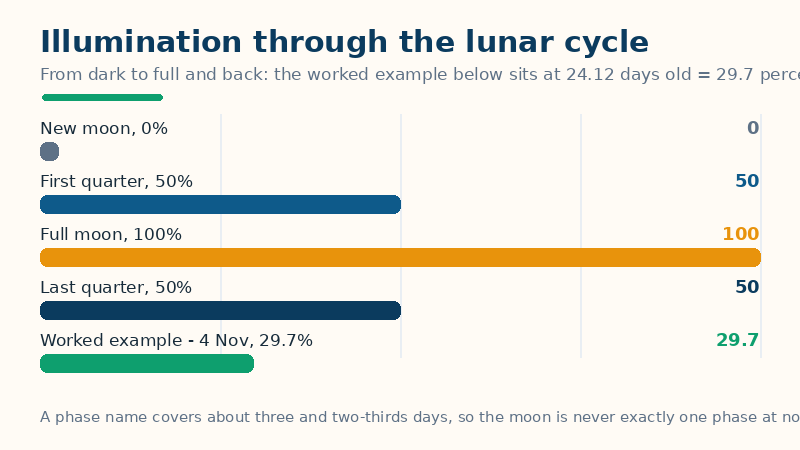
illumination = (1 − cos(2π × age ÷ 29.530588853)) ÷ 2The eight phases are the age cut into eight equal slices of 3.691 days, centred on the four principal events: new moon at age 0, first quarter at 7.38 days, full moon at 14.77 days and last quarter at 22.15 days. A phase name therefore covers a window of about three and two-thirds days, which is why the calculator's answer for a date near a boundary can differ from another tool's by one phase name — both are rounding the same continuous cycle at slightly different instants.
Worked example: 4 November 2026
From the reference new moon to noon UTC on 4 November 2026 is 9,798.74 days. Divide by 29.530588853: 331 complete lunations, with a remainder of 24.12 days — the moon's age. That age falls in the 23.99–27.68-day slice, so the phase is Waning Crescent, shrinking toward the next new moon. Illumination: (1 − cos(2π × 24.12 ÷ 29.530588853)) ÷ 2 = (1 − cos(5.131 radians)) ÷ 2 = (1 − 0.406) ÷ 2 = 29.7% lit. The next new moon is 29.530588853 − 24.12 = 5.42 days away, about 9 November, and the next full moon is (14.765294 − 24.12) mod 29.530588853 = 20.18 days away, about 24 November. The table on the calculator shows the whole cycle that follows: first quarter about 17 November, full moon about 24 November, last quarter about 2 December and the following new moon about 9 December. Two cross-checks confirm the model behaves: 9 November 2026 itself reads age 29.12 days, 0.2% lit, New Moon — the new moon the table is built on — and 24 November reads age 14.58 days, 100.0% lit, Full Moon. The famous 8 April 2024 eclipse day reads age 29.09 days, 0.2% lit, New Moon, as a solar eclipse must: the moon was between Earth and sun.
How to read your result, and its limits
Three cautions keep the answer honest. First, this is an average cycle, not an ephemeris: the real moon's orbit is elliptical, so true phase instants wander up to about 14 hours either side of the average — treat every date here as accurate to about a day, and never quote an exact full-moon hour from it. Second, the phase is computed for noon UTC, deliberately, so that the same date gives the same answer in every time zone; a phase that flips during your local night will show as the noon value, not the midnight one. Third, illumination is the fraction of the disc lit, not how bright the moon looks: a 50% quarter moon looks far less than half as bright as a full moon to the eye, because the full moon's brightness is boosted by the opposition surge. For the length of daylight on the same date, use the daylight hours calculator; for the direction of a night-sky target, the compass bearing calculator gives the bearing between any two points on Earth.
Common mistakes
- Expecting the full moon on the same date each month. The synodic month is 29.53 days, not a calendar month, so the full moon drifts about a day later each month and occasionally twice into one calendar month — the second is the "blue moon" of folklore, not a different kind of moon.
- Reading a phase name as an instant. "Full Moon" on this page means the date whose noon age falls in the full-moon slice (12.92–16.61 days), not the exact minute of opposition. Near a boundary, another tool can legitimately name the neighbouring phase.
- Confusing the synodic month with the sidereal month. The moon orbits Earth in 27.32 days (sidereal), but the sun has moved on in that time, so the moon needs 29.53 days to realign with it — and it is the 29.53-day cycle that sets the phases.
- Trusting a moon-age app to the hour. Any tool built on the average cycle, this one included, carries roughly a day of uncertainty on distant dates. For eclipse timing or photography planning to the minute, use a published ephemeris.
Related tools: Time Zone Converter — Convert a date and time between 20+ cities with real offsets — and see when the answer lands on another day.
Frequently asked questions
What is the moon phase today?
Enter today's date and the calculator names the phase, gives the moon's age in days and the illuminated percentage. The worked example, 4 November 2026, is a Waning Crescent, 24.12 days old and 29.7% lit, heading for a new moon around 9 November.
How is the moon phase calculated?
From the synodic month of 29.530588853 days, counted from the reference new moon of 6 January 2000 at 18:14 UTC. The moon's age is the remainder when the days since that reference are divided by 29.530588853, the phase name comes from which 3.691-day slice the age falls in, and illumination is (1 − cos(2π × age ÷ 29.530588853)) ÷ 2.
How accurate is this moon phase calculator?
To about a day. The real moon's elliptical orbit makes true phase instants wander up to about 14 hours either side of the average cycle, so dates here are right but exact hours are not claimed. For eclipse timing or photography to the minute, check a published ephemeris.
Why does the full moon fall on a different date each month?
Because the synodic month is 29.53 days while calendar months are 30 or 31 days (28 or 29 in February), so the full moon drifts about a day later each month. That drift is also why some calendar months contain two full moons — the second is traditionally called a blue moon.