Three prices, one month
Home care is priced by the hour, assisted living by the month and a nursing home by the day, so the first step is to put all three on the same footing — a month. Home care is the hourly rate times the hours a week times 52 weeks divided by 12 months; a nursing home is the daily rate times 365.25 days divided by 12; assisted living is already monthly. The crossover — the number of home-care hours a week at which assisted living becomes cheaper — is the assisted living monthly price times 12, divided by the hourly rate times 52. And the total over the years of care is not the annual cost times the years, because care prices rise: each year's cost is the first year's cost grown by the inflation rate, added year by year:
home care a month ($) = hourly rate × hours a week × 52 ÷ 12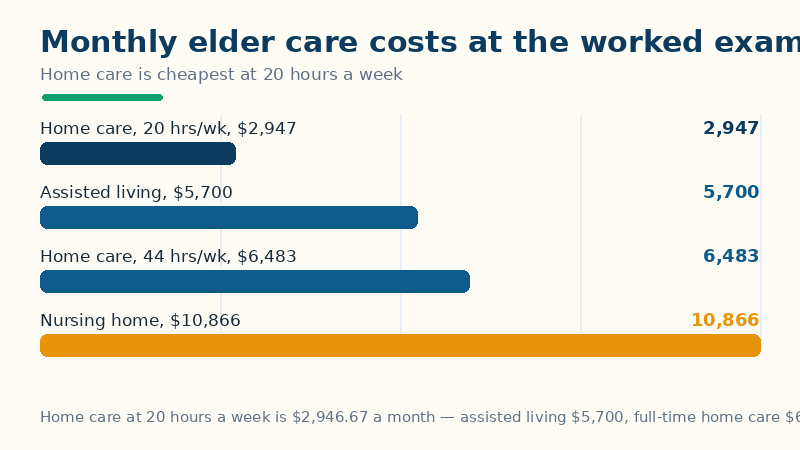
nursing home a month ($) = daily rate × 365.25 ÷ 12crossover hours a week = assisted living a month × 12 ÷ (hourly rate × 52)total over N years ($) = annual cost × (1 + inflation)0 + annual cost × (1 + inflation)1 + … + annual cost × (1 + inflation)N−1The table above shows the same maths for every option at the worked example's inputs. Home care at 20 hours a week is $2,946.67 a month and $35,360.00 a year; at 44 hours it is $6,482.67 a month and $77,792.00 a year — more than assisted living's $5,700 a month. A private nursing home room is $10,866.19 a month and $130,394.25 a year. Over 3 years at 4% a year those become $110,379.78, $242,835.51, $213,517.44 and $407,038.69: the inflation compounding adds $4,299.78 to the home-care total over the three years alone.
Worked example: 20 hours of home care a week
At $34 an hour for 20 hours a week, home care costs $34 × 20 × 52 ÷ 12 = $2,946.67 a month, or $35,360.00 a year. Assisted living at $5,700 a month is $68,400.00 a year, and a private nursing home room at $357 a day is $357 × 365.25 ÷ 12 = $10,866.19 a month, or $130,394.25 a year. The crossover is $5,700 × 12 ÷ ($34 × 52) = 38.7 hours a week: below about 39 hours of home care a week, home care is the cheaper option; above it, assisted living is. Over 3 years at 4% a year, the home-care total is $35,360.00 + $35,360.00 × 1.04 + $35,360.00 × 1.042 = $35,360.00 + $36,774.40 + $38,245.38 = $110,379.78. Against $2,500 a month of income and no insurance, home care leaves a gap of $2,946.67 − $2,500 = $446.67 a month, and $50,000 of savings covers that gap for $50,000 ÷ $446.67 = 111.9 months — about 9.3 years. Three published cross-checks reproduce exactly: OnlyCalculators' assisted living rate of $164 a day is $164 × 365.25 ÷ 12 = $4,991.75 a month — the $4,992 they publish — and their nursing home private rate of $357 a day is $10,866.19 a month and $130,394.25 a year, the same figures as here; The Modern Wallet's home aide at $33 an hour for 44 hours a week is $33 × 44 × 52 ÷ 12 = $6,292.00 a month, $75,504 a year, which they round to about $76,000; and A Place for Mom's 44 hours a week at $34 an hour is about $6,480 a month — $6,482.67 on this page. The spread between the sources is the point: the national medians cluster around $34 an hour, $5,700–$6,313 a month for assisted living and $357 a day for a nursing home, and the state you are in moves every one of them — Alaska runs about twice the national median and Mississippi about 0.7 times.
How to read your result, and its limits
Four cautions keep the number honest. First, the crossover is about hours, not about which care is better: below about 39 hours a week home care costs less, but it buys only those hours — the rest of the week the person is alone, while assisted living includes room, board, meals and 24-hour staffing. Second, Medicare does not cover this: standard Medicare pays for skilled nursing only after a qualifying 3-day hospital stay and only for up to 100 days; it never pays for assisted living or custodial home care. Third, inflation compounds: at 4% a year, a $35,360 annual cost is $38,245.38 by year three, and over a longer care period the later years dominate the total — a 3-year plan that ignores inflation understates the bill by thousands. Fourth, the medians are national: state medians run from about 0.7 times the national figure in Mississippi and Louisiana to about 2.2 times in Alaska, and a facility's level-of-care surcharge can add $0–$1,500 a month on top of the base rate — replace the defaults with local quotes where you have them. For the savings side of the same plan, the retirement calculator prices a pot the same way — a monthly contribution, a rate and a number of years — and the net worth calculator totals what is actually available to pay for it; for the housing side, the house affordability calculator prices what a home costs each month.
Common mistakes
- Comparing an hourly price with a monthly price without converting. $34 an hour sounds cheap next to $5,700 a month — but 20 hours a week is already $2,946.67 a month, and 44 hours is $6,482.67, more than the assisted living it was meant to undercut.
- Assuming Medicare will pay. Medicare does not cover assisted living, home aides or custodial nursing home care, ever — only short skilled-nursing stays after a hospital admission. Families that plan on Medicare discover the gap only when the bill arrives.
- Multiplying the first year's cost by the years. Care prices rise about 4% a year, so a 3-year home-care bill is $110,379.78, not 3 × $35,360.00 = $106,080.00 — the compounding adds $4,299.78, and over longer periods it adds far more.
- Budgeting the monthly cost and forgetting the gap. A $2,946.67 monthly cost against $2,500 of income is a $446.67 monthly gap — $5,360 a year — and $50,000 of savings lasts 111.9 months only because the gap is small; at the nursing home's $10,866.19 a month the same savings last 6.0 months.
- Treating the national median as a local quote. State medians run from about 0.7 times the national figure to about 2.2 times, and a level-of-care surcharge can add up to $1,500 a month — get the local facility's own rate before deciding.
Frequently asked questions
How much does home care cost per month?
At the worked example's inputs — $34 an hour for 20 hours a week — home care costs $2,946.67 a month, or $35,360 a year. At 44 hours a week, full-time weekday care, it is $6,482.67 a month, $77,792 a year. The 2026 national median is $34 an hour, and the monthly figure depends entirely on the hours: every extra hour a week adds about $147.33 a month.
When is assisted living cheaper than home care?
At the worked example's inputs, assisted living at $5,700 a month becomes cheaper than home care at 38.7 hours of home care a week — below about 39 hours, home care costs less; above it, the facility does. The crossover moves with the prices: a higher hourly rate or a cheaper facility lowers it, a lower rate or a dearer facility raises it. Remember the crossover is about money, not care: assisted living also includes room, board, meals and 24-hour staffing.
How much does a nursing home cost?
At the worked example's inputs a private nursing home room at $357 a day costs $10,866.19 a month, or $130,394.25 a year. A semi-private room at about $294 a day is about $8,949 a month. Over 3 years at 4% care-price inflation the private room totals $407,038.69. Costs vary by state from about 0.7 times the national median in Mississippi to about 2.2 times in Alaska.
Does Medicare cover elder care costs?
No. Standard Medicare does not cover assisted living, home health aides or custodial nursing home care. It pays for skilled nursing only after a qualifying 3-day hospital stay, and only for up to 100 days. Medicaid pays for nursing home care after a spend-down, and for assisted living and home care only in states with home and community-based services waivers.