The number on the plan and the number on the screen
There is a small, daily mystery in modern life: the plan says 100 Mbps, the download manager says 12.5 MB/s, and nobody stole your bandwidth. The answer is that networks count in bits and computers store in bytes, and there are 8 bits in every byte. ISPs, speed tests and router boxes quote megabits per second (Mbps); browsers, game launchers and file managers report megabytes per second (MB/s). 100 ÷ 8 = 12.5 — the two numbers were the same speed all along. This page restates any rate in all nine units at once — bits and bytes, kilo to tera, through bits per second on the exact SI definitions — and works out how long a file of your chosen size takes at the entered rate, so the plan's promise and the progress bar finally agree.
The illuminance converter translates light falling on a surface — lux to foot-candles, phot and more, 500 lx is 46.45 fc — with the lumens a room at that level actually needs, so a lighting spec and a bulb box finally speak the same language.
The electric current converter restates any current — amps to milliamps, microamps and the rest, 2.5 A is 2,500 mA — with the watts that current carries at the voltage you enter, so a charger rating and a circuit rating can be compared directly.
The luminous intensity converter converts lumens to candelas and back through the beam angle — 800 lm in a 60° beam is 950.36 cd — with the lux that intensity throws onto a surface at the distance you enter, so a bulb box and a spotlight datasheet can finally be compared.
The magnetic field converter restates any field — tesla to gauss, millitesla, microtesla and more, 0.5 T is 5,000 G — with the gauss-versus-oersted distinction stated rather than merged, so an MRI rating, a fridge magnet and the Earth’s field can all be read in one unit.
The viscosity converter restates how thick a fluid is — centipoise to pascal-seconds, poise, reyn and more, 100 cP is 0.1 Pa·s — with the dynamic-versus-kinematic distinction kept honest: the table converts dynamic viscosity only, and the kinematic figure appears only once you supply a density.
The electric charge converter translates the battery label into physics — 5,000 mAh is 18,000 C, 5 Ah, 0.1866 faradays — with the energy that charge holds at the voltage you enter, so a milliamp-hour rating and a watt-hour rating can finally be compared.
The flow rate converter restates how fast a fluid moves — litres per minute to US gallons per minute, cubic feet per minute, cubic metres per hour and more, 10 L/min is 2.6417 US gal/min — with the US-versus-imperial gallon distinction named in every row, so a pump figure can never be read in the wrong gallon.
The capacitance converter translates the capacitor label into every unit — 0.1 µF is 100 nF, 100,000 pF, code 104 — with the charge and energy that capacitance holds at the voltage you enter, so a schematic value, a parts-list value and the print on the part itself finally agree.
The inductance converter translates the inductor label into every unit — 100 µH is 0.1 mH, 100,000 nH, code-era values and all — with the energy that inductance stores at the current you enter, so a buck-converter value, a motor value and an RF value finally share one page.
The acceleration converter restates any acceleration in m/s², g-force, ft/s², knots per second and more — 9.80665 m/s² is exactly 1 g — with the speed that acceleration adds over a time you enter, so a physics figure, a pilot figure and a car-review figure finally agree.
The resistance converter translates the resistor label into every unit — 4.7 kΩ is 4,700 Ω, 4,700,000 mΩ, code 4k7 — with the current that resistance draws and the power it dissipates at the voltage you enter, so a schematic value, a parts-list value and a multimeter reading finally agree.
The magnetic flux converter restates any flux in webers, maxwells, milliwebers and more — 2.5 mWb is 250,000 Mx — with the voltage that flux induces when it changes over a time you enter, so a transformer figure, an old CGS table and a physics text finally share one page.
The conductance converter translates the resistor label into siemens — 2.5 mS is 2,500 µS, 0.0025 ℧, a 400 Ω resistor — with the current that conductance passes at the voltage you enter, so a meter reading, a datasheet value and a resistor value finally agree.
The luminance converter restates screen and cinema brightness in nits, foot-lamberts, lamberts and more — 48 cd/m² is 14.01 fL, the cinema standard — with the light a diffusing surface at that luminance gives off, so a TV spec, a cinema spec and a lighting table finally share one page.
The angular velocity converter translates a spin between the workshop and the physics lab — 1,800 RPM is 188.5 rad/s, 10,800 °/s and 30 Hz — with the rim speed at any radius you enter, so a motor plate, a servo datasheet and a turntable review finally share one page.
The radioactivity converter restates any activity in becquerels, curies and disintegrations per minute — 4 mCi is 148 MBq, 0.004 Ci and 8,880,000,000 dpm — with the decays counted over any time you enter, so a dose card, a datasheet and a counter printout finally agree.
The angular acceleration converter restates a spin-up between the workshop and the physics lab — 150 RPM/s is 15.71 rad/s², 900 °/s² and 9,000 rev/min² — with the tangential acceleration at any radius you enter, so a washing-machine manual, a servo datasheet and a flywheel table finally share one page.
The molar concentration converter restates a solution between the lab notebook and the clinical report — 0.25 mol/L is 250 mmol/L, 250 mol/m³ and 0.25 kmol/m³ — with the moles in any volume you enter, so a notebook, a report and a datasheet finally agree.
The mass flow rate converter restates a flow between the process datasheet and the US vendor manual — 2.5 kg/s is 9,000 kg/h, 19,841.6 lb/h and 9.9208 short tons per hour — with the total mass moved over any running time you enter, so a datasheet, a pump manual and a bulk-handling sheet finally share one page.
The electric field strength converter restates a field between the textbook and the high-voltage datasheet — 12,000 V/m is 12 kV/m, 120 V/cm and 0.4003 statV/cm — with the force on any test charge you enter, so a textbook, a lab note and an old CGS table finally agree.
The heat flux converter restates a flux between the solar datasheet and the US insulation manual — 5,000 W/m² is 1,584.99 Btu(IT)/h/ft², 399.41 kcal(IT)/h/ft² and 3.2258 W/in² — with the total heat through any area you enter, so a solar sheet, a furnace manual and a fire-safety table finally share one page.
The thermal conductivity converter restates a material property between the European datasheet and the US insulation sheet — 200 W/(m·K) is 115.56 Btu(IT)·ft/(h·ft²·°F), 0.4777 cal(IT)/(s·cm·°C) and 2 W/(cm·°C) — with the heat conducted at any temperature gradient you enter, so a materials sheet, an insulation manual and an old textbook finally agree.
The voltage converter restates a potential difference between the sensor datasheet and the transmission table — 230 V is 230,000 mV, 0.23 kV and 0.7672 statV — with the power at any current you enter, so a sensor sheet, a car manual and a power table finally share one page.
The luminous flux converter restates a light output between the bulb box and the lighting plan — 800 lm is 0.8 klm, 800 cd·sr and 1.1713 W at 555 nm — with the illuminance on any area you enter, so a bulb box, a lighting plan and a lab note finally agree.
The thermal resistance converter restates insulation between the European datasheet and the US insulation bag — 3.5 m²·K/W is R-19.87, 22.58 clo and 35 tog — with the U-value and the heat flux at any temperature difference you enter, so a datasheet, a bag label and a clothing tag finally share one page.
The heat transfer coefficient converter restates a U-value between the European window spec and the American wall table — 0.3 W/(m²·K) is 0.0528 Btu(IT)/(h·ft²·°F) and 3.3333 m²·K/W of resistance — with the heat passed through any area at any temperature difference you enter, so a window spec, a wall table and a heat-exchanger sheet finally agree.
The specific heat capacity converter restates how much heat a material soaks up between the European datasheet and the American table — 1 Btu(IT)/(lb·°F) is 4,186.8 J/(kg·K), 1 cal(IT)/(g·°C) and 1 CHU/(lb·°C) — with the heat for any mass and temperature rise you enter, so a datasheet, a chemistry table and a heating manual finally share one page.
The electrical resistivity converter restates a material between the copper datasheet and the grounding report — 1.68 μΩ·cm is 1.68e-08 Ω·m and 100 Ω·m is 10,000 Ω·cm — with the conductivity and the resistance of any wire you enter, so a datasheet, a textbook and a grounding report finally agree.
The heat capacity converter restates one particular object between the furnace manual and the calorimetry table — 1 Btu(IT)/°F is 1,899.1 J/K and 1 kcal(IT)/°C is 4,186.8 J/K — with the heat for any temperature rise and the specific heat for any mass you enter, so a manual, a datasheet and a calorimetry table finally share one page.
The thermal diffusivity converter restates how fast heat spreads between the materials table and the textbook — copper at 111 mm²/s is 1.11e-04 m²/s and 1 ft²/s is 0.0929 m²/s — with the diffusivity from any conductivity, density and specific heat you enter, so a materials table, a textbook and an American report finally agree.
The radiation dose converter restates a dose between the radiotherapy sheet and the dosimeter report — 2 Gy is 200 rad and 150 rem is 1.5 Sv — with each family converted exactly within itself and the weighting factor that connects absorbed dose to equivalent dose kept as its own visible step, so a sheet, a report and an old survey table finally share one page.
The specific volume converter restates how much room a kilogram takes up between the steam table and the American report — air at 0.8 m³/kg is 12.81 ft³/lbm and 1 m³/kg is 99.78 UK gal/lbm — with the density and the volume for any mass you enter, so a steam table, a materials sheet and a vendor manual finally agree.
The decibel converter restates a level between the amplifier sheet, the acoustics table and the radio datasheet — 60 dB is 6.9078 Np and 30 dBm is 1 W — with each family converted exactly within itself and the power ratio and amplitude ratio behind every figure kept visible, so a sheet, a table and a datasheet finally share one page.
The specific energy converter restates how much energy a kilogram holds between the fuel datasheet and the American table — gasoline at 44 MJ/kg is 18,916.6 Btu(IT)/lb and 12,222.22 Wh/kg — with the total energy for any mass you enter, so a datasheet, a fuel table and a battery sheet finally agree.
The kinematic viscosity converter restates how fast a fluid flows under its own weight between the lubricant datasheet and the physics paper — 32 cSt is 0.32 St and 3.20e-05 m²/s — with the dynamic viscosity for any density you enter, so a datasheet, a paper and a pump curve finally share one page.
The thermal expansion coefficient converter restates how much a material grows per degree between the European datasheet and the American supplier table — steel at 12 µm/(m·K) is 6.6667 ppm/°F — with the length change for any length and temperature rise you enter, so a datasheet, a supplier table and a bridge-joint drawing finally agree.
The formula
answer = bits per second ÷ (bits per second in one "to" unit)
download seconds = file gigabytes × 8,000,000,000 ÷ bits per second
Four terms, all visible on the page. value is the number you enter. bits per second in one "from" unit is the exact definition of the unit you are converting from — 1,000 for the kilobit, 1,000,000 for the megabit, 1,000,000,000 for the gigabit, 1,000,000,000,000 for the terabit, and 8 times each for the byte-per-second units (8,000,000 for the megabyte per second). answer is the result in the unit you asked for. download seconds treats a gigabyte as 8,000,000,000 bits — the same decimal scale — and divides by the rate: it is the best-case time, full speed the whole way, which the page says openly rather than implying your Wi-Fi will cooperate.
Worked example
Convert 100 Mbps to megabytes per second — the most-typed internet-speed question there is — the way the tool does it.
Step 1 — get to bits per second. One megabit per second is 1,000,000 bps, so 100 × 1,000,000 = 100,000,000 bps.
Step 2 — divide by the target factor. One megabyte per second is 8,000,000 bps, so 100,000,000 ÷ 8,000,000 = 12.5.
Step 3 — read the display. The page prints four decimals below 10 and two above, so the headline reads 12.5 MB/s, and the detail line shows the working: 100 Mbps = 12.5 MB/s — worked through bits per second: 100,000,000 bps ÷ the Megabytes per second factor.
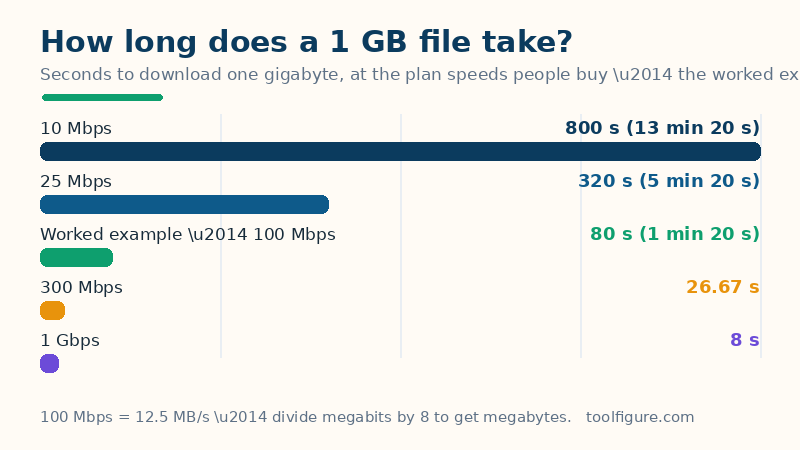
How long for a gigabyte? 1 GB is 8,000,000,000 bits; at 100,000,000 bps that takes 80 seconds — 1 min 20 s — which is the line the tool adds under the answer. A 50 GB game at the same rate needs 1 h 6 min 40 s best case, and the real world adds overhead on top.
Check it. Multiplying back, 12.5 × 8 = 100 exactly — bits and bytes close with nothing lost, because the 8 is exact by definition. The table underneath restates the same 100 Mbps in all nine units (100,000 Kbps, 0.1 Gbps, 12,500 KB/s, 0.0125 GB/s), so the from/to choice only changes which row is the headline.
Conversions worth memorising
Every row below is the tool's own output, checked figure by figure:
| From | To | Result |
|---|---|---|
| 1 Mbps | megabytes per second | 0.125 MB/s |
| 10 Mbps | megabytes per second | 1.25 MB/s |
| 25 Mbps | megabytes per second | 3.125 MB/s |
| 100 Mbps | megabytes per second | 12.5 MB/s |
| 300 Mbps | megabytes per second | 37.5 MB/s |
| 1 Gbps | megabytes per second | 125 MB/s |
| 50 MB/s | megabits per second | 400 Mbps |
| 1 GB/s | gigabits per second | 8 Gbps |
| 1,000 Kbps | megabits per second | 1 Mbps |
| 1 Mbps | kilobits per second | 1,000 Kbps |
| 10 Gbps | gigabytes per second | 1.25 GB/s |
| 1 GB/s | megabytes per second | 1,000 MB/s |
Three rows deserve a second look. The 25 Mbps row is the plan much of the world still buys — 3.125 MB/s — and it is why a "fine for streaming" connection still takes over five minutes for a gigabyte (320 seconds at best case, and the chart below draws exactly that). The 50 MB/s row runs the direction backwards — a download manager showing 50 MB/s means the line is carrying 400 Mbps — which is how you check whether your fibre is actually delivering. And the 1,000 Kbps row closes the prefix ladder: 1,000 kilobits is 1 megabit, the same decimal thousand as everywhere else on this page.
Three traps worth knowing
Mbps is not MB/s, and the capitalisation is the whole story. The small b is bits, the big B is bytes — Mbps and MB/s differ by exactly 8×. Marketing writes the small-b number because it looks bigger; your computer shows the big-B number because it counts stored bytes. This page converts both, honestly, through bits per second.
Your operating system may use a different thousand. This page uses the SI thousand (1,000) that ISPs, speed tests and router boxes quote. Some operating systems display file sizes in binary units (1 MiB = 1,024 KiB), so a download Windows calls 11.9 MiB/s is the same stream this page calls 12.5 MB/s — about 5% apart, and neither is wrong. If a number looks slightly off against your OS, that is the gap.
Advertised is not achieved. The download-time line is best case: full speed, no pauses, no overhead. Real downloads run 60–90% of the plan rate once protocol overhead, Wi-Fi losses, server limits and everyone else in the house are counted. If your 100 Mbps plan sustains 10 MB/s, that is the overhead, not a fault — but if it sustains 3 MB/s, something is actually wrong.
How to read your result, and the limits
Results show four decimal places below 10 and two above — more precision than any speed test justifies, so round to what the test actually measured for real use. Four limits belong with the page. Negative values are refused: −100 Mbps gets a clear error, because a negative transfer rate has no meaning here. Empty input clears quietly; type and the table rebuilds, delete and the page waits. Anything past a trillion in any unit gets a clear error instead of a meaningless digit string. And this page converts rates, not connections: it will translate any quoted speed into any dialect and time any file at it, but it will not measure your connection — for that you need a speed test, and this page will at least help you read its answer.
Related tools: Unit Converter — Convert length, weight, temperature and volume — km to miles, kg to pounds, °C to °F, litres to gallons; Data Storage Converter — Convert bits, bytes, KB–TB and KiB–TiB — every answer in all ten units, both systems explained; Frequency Converter — Hz to kHz, MHz, GHz, THz, RPM and rad/s — every answer in all seven units, through the exact definitions.
Frequently asked questions
How do I convert Mbps to MB/s?
Divide by 8. So 100 Mbps becomes 12.5 MB/s, 25 Mbps becomes 3.125 MB/s, and 1 Gbps becomes 125 MB/s. To go back, multiply megabytes per second by 8: 50 MB/s is 400 Mbps. The 8 is exact — one byte is eight bits — so this conversion closes perfectly in both directions.
Why is my download speed lower than my internet plan?
Two honest reasons before you suspect a fault. First, units: your plan is quoted in megabits (Mbps) while the download shows megabytes (MB/s), so 100 Mbps was always going to read about 12.5 MB/s. Second, overhead: protocol headers, Wi-Fi losses and server limits typically leave 60–90% of the plan rate in practice. If the gap is bigger than that after the unit conversion, then something is actually wrong.
Is 1 Mbps 1,000 or 1,024 Kbps?
On this page, 1,000 — the SI decimal thousand that ISPs, speed tests and router boxes use for network speeds. The 1,024-based units (KiB, MiB) belong to file sizes in some operating systems, which is a different convention and the reason a download can look about 5% smaller on screen than the same speed converts here. This page states its thousand openly and never mixes the two.
How long will my download take?
Enter your rate and a file size in gigabytes and the tool works it out: file gigabytes × 8,000,000,000 ÷ bits per second, as best case. A 1 GB file at 100 Mbps takes 80 seconds (1 min 20 s); a 50 GB game at the same rate needs 1 h 6 min 40 s before real-world overhead. The number is a floor, not a promise — your Wi-Fi, the server and everyone else in the house all take their cut.
