Three steps: watts, minutes, cooks a week
The whole calculation is three multiplications, and the minutes are the one people get wrong. Watts divided by 1,000 is kilowatts; kilowatts times the minutes divided by 60 is the energy of one cook; the energy per cook times the cooks a week times 52 weeks is the year's energy; the year's energy times the price is the year's money. The month is the year divided by 12, not the week times 4 — the two differ by a few cents, and the year-divided-by-12 figure is the one this page uses, so it agrees with the yearly total exactly:
energy per cook (kWh) = watts ÷ 1,000 × minutes ÷ 60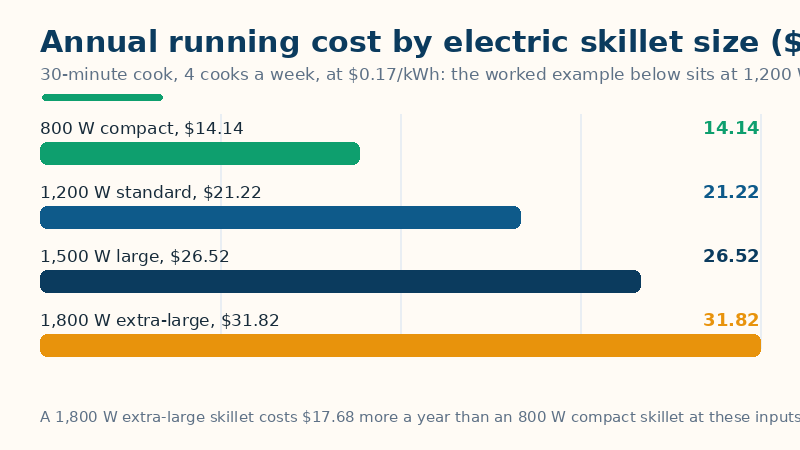
energy per week (kWh) = energy per cook × cooks a weekannual cost ($) = energy per week × 52 × electricity priceThe watts on the label are the heating element's maximum draw, and the element does not draw them for the whole cook. A compact skillet draws about 800 W, a standard skillet about 1,200 W, a large skillet about 1,500 W and an extra-large skillet up to 1,800 W — and a weeknight cook takes fifteen to sixty minutes including the preheat, so the whole cook is about half a kilowatt-hour. What matters is the cooks a week: one cook is 0.600 kWh, but four cooks is 2.400 kWh, and the skillet that runs every day will always cost more than the one that runs four times a week.
Worked example: 1,200 W, 30 minutes a cook, 4 cooks a week, $0.17/kWh
A 1,200 W electric skillet cooking for 30 minutes uses 1.2 × 30 ÷ 60 = 0.600 kWh, costing 10.2¢. A week is 0.600 × 4 = 2.400 kWh, costing $0.41. A month is 124.8 ÷ 12 = 10.4 kWh, costing $1.77. A year is 2.400 × 52 = 124.8 kWh, costing $21.22. The table above shows the same maths for the other electric skillet sizes at a 30-minute cook and 4 cooks a week: an 800 W compact skillet costs 6.8¢ a cook and $14.14 a year, a 1,500 W large skillet costs 12.8¢ a cook and $26.52 a year, and a 1,800 W extra-large skillet costs 15.3¢ a cook and $31.82 a year. One hour at full power uses 1.20 kWh and costs 20.4¢ at these settings, and ten years of skillet cooking at this pace costs $212.16. A 15-minute cook costs $10.61 a year and a 60-minute cook $42.43; cooking every day costs $37.13 a year, once a week $5.30. Four published cross-checks reproduce exactly: allfoodfaq's 1,200 W electric skillet for 2 hours uses 2.4 kWh and costs 28.8¢ a day at 12 cents — this page gives the same 2.400 kWh a cook and 28.8¢ at 120 minutes a cook, 7 cooks a week, $0.12 — and its wattage guide's 1,500 W skillet is 1.5 kWh an hour and its 800 W skillet 0.8 kWh an hour, both the same on this page's hour line. Costperkwh's table at the US average of 18.16¢ gives $0.09 an hour for 500 W, $0.18 for 1,000 W and $0.27 for 1,500 W — this page's hour line shows the same 9.1¢, 18.2¢ and 27.2¢ on the same watts × $0.1816 maths. And calclabhub's 1,500 W appliance for 3 hours a day uses 4.5 kWh and costs $1.26 a day at 28¢ — this page gives the same 4.500 kWh a cook and 126.0¢ ($1.26) at 180 minutes a cook, 7 cooks a week.
How to read your result, and its limits
Four cautions keep the number honest. First, the element cycles once the pan is hot: the full-power figure is the ceiling, because the thermostat switches the element off once the pan reaches temperature and back on to hold it — a skillet that is already hot draws less than its label watts, so the real cook may cost a little less than the figure here. Second, the minutes are the whole story: a 15-minute cook costs $10.61 a year and a 60-minute cook $42.43 at the worked example's inputs, and the preheat counts — a 10-minute preheat at 1,200 W is 0.20 kWh and 3.4¢ per cook, $7.07 a year at 4 cooks a week, before any food goes in the pan. Third, the cooks a week are the count, not the days: 4 cooks a week is 208 cooks a year, so the year is the week times 52 — 124.8 kWh and $21.22 — while multiplying one cook by 365 days would give $37.23, as if you cooked in the skillet every single day. Fourth, the electricity price is the all-in rate: the total on the bill divided by the kilowatt-hours on the bill, including delivery charges. For a bake in a full oven instead, the oven cost calculator prices the bake by watts and hours — a 2,400 W oven for an hour is 2.400 kWh and about 41¢, against this page's 0.600 kWh and 10.2¢ a cook; for a quick batch in hot air, the air fryer cost calculator prices the batch by watts and minutes — a 1,500 W air fryer for 15 minutes is 0.375 kWh and 6.4¢ a batch; and for the cost of running anything else in the house, the electricity cost calculator prices any appliance by watts and hours.
Common mistakes
- Pricing the label watts for a whole hour. A 1,200 W skillet for an hour is 1.2 kWh and 20.4¢, but a 30-minute cook is 0.600 kWh and 10.2¢ — the hour figure is two cooks, not one. Price the minutes, not the hour.
- Multiplying one cook by 365 days. Four cooks a week is 208 cooks a year, not 365: one cook costs $0.102, and $0.102 × 365 gives $37.23, while the real year is $21.22. Count the cooks a week, then multiply by 52.
- Comparing skillets on watts. An 800 W compact skillet and a 1,800 W extra-large skillet look far apart on watts, but the cook is 30 minutes either way: 0.400 kWh against 0.900 kWh, 6.8¢ against 15.3¢ — and the bigger skillet may preheat faster and finish the same food sooner, so the cost per cook can be closer still. Compare kilowatt-hours per cook, not watts.
- Forgetting the preheat. A 10-minute preheat at 1,200 W is 0.20 kWh and 3.4¢ per cook — $7.07 a year at 4 cooks a week — so enter the whole cook including the preheat, not just the minutes the food is in the pan.
- Adding the standing charge to every cook. The daily supply charge is payable whether the skillet runs or not. Only the per-kWh rate belongs in the per-cook maths — the fixed charge is a separate line on the bill.
Frequently asked questions
How much does an electric skillet cost to run?
A 1,200 W electric skillet costs 10.2¢ a cook for a 30-minute cook at $0.17 per kWh — 0.600 kWh a cook, $21.22 a year at 4 cooks a week. A 15-minute cook costs $10.61 a year and a 60-minute cook $42.43.
How many watts does an electric skillet use?
Most home electric skillets draw 800 to 1,800 W: a compact skillet about 800 W, a standard skillet about 1,200 W, a large skillet about 1,500 W and an extra-large skillet up to 1,800 W. The watts on the label are the heating element's maximum draw — the thermostat cycles it off once the pan is hot.
Does an electric skillet use a lot of electricity?
No: 4 cooks a week is 124.8 kWh a year and $21.22 at $0.17 per kWh — a little more than a 60 W bulb left on 5 hours a day, which costs $18.62 a year. Even cooking every day costs $37.13 a year. An electric skillet is one of the cheaper ways to cook a hot meal.
Is an electric skillet cheaper to run than an oven?
Yes, for one pan of food: a 1,200 W skillet for 30 minutes is 0.600 kWh and 10.2¢, while a 2,400 W oven for an hour is 2.400 kWh and 40.8¢ — four times the energy for a single dish. The oven wins only when it cooks several dishes at once.