The tank math, and why the appliance matters more than the tank
Propane runtime calculators agree on the shape of the answer even when they round the constant differently: total BTU = propane weight × about 21,500 BTU per pound, and burn hours = total BTU ÷ the appliance's BTU per hour. Published figures for the constant run from 21,500 to 21,600 BTU per pound — a spread of under half a percent, far smaller than the difference between cooking on high and cooking on medium, so this page uses 21,500 throughout and states it. The tank sizes are the ones campers actually buy: a disposable 1 lb canister holds 21,500 BTU, a 1 lb 14 oz cylinder holds 40,313 BTU, a 20 lb tank holds 430,000 BTU (about 4.7 gallons) and a 30 lb tank holds 645,000 BTU. Note what the "20 lb" means: it is the weight of the propane inside, not the tank — a 20 lb tank is filled to 80 percent of its water capacity for expansion room, and that 20 lb of propane is what the 430,000 BTU counts.
Total energy (BTU) = propane weight (lb) × 21,500 — Burn hours = total energy ÷ appliance BTU per hour — Days = burn hours ÷ hours used per day — Planning burn hours = burn hours × 0.9 — Planning days = days × 0.9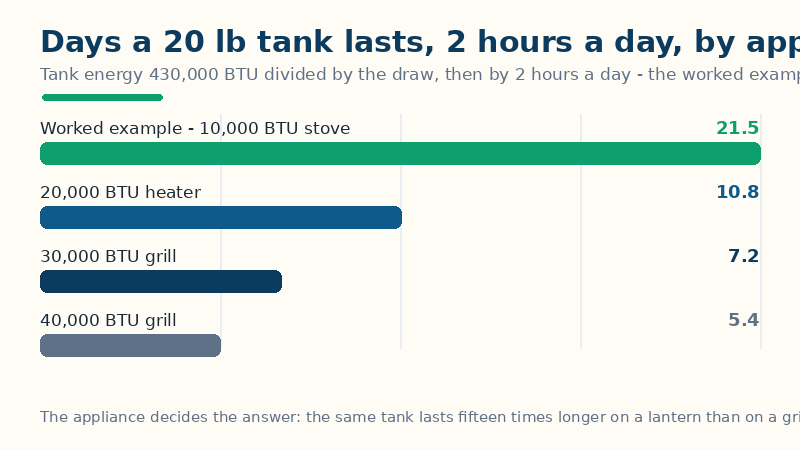
The planning figure is the honest part of this page. Guides that size from the headline figure report real-world runtimes 10 to 15 percent shorter, because burners run on high longer than planned, wind steals heat, and cold weather slows vaporisation in small canisters. This page takes 10 percent off for planning — a tank that reads 21.5 days on paper is a 19.4-day tank to pack by — and the gap between the two figures is the margin, not an error.
Worked example: a 20 lb tank on a 10,000 BTU camp stove, 2 hours a day
A 20 lb tank running a 10,000 BTU camp stove for 2 hours a day lasts 21.5 days — 43.0 hours of burn, with a planning figure of 38.7 hours and 19.4 days. The working: total energy = 20 × 21,500 = 430,000 BTU. Burn time = 430,000 ÷ 10,000 = 43.0 hours. Days = 43.0 ÷ 2 = 21.5. Planning burn = 43.0 × 0.9 = 38.7 hours, and planning days = 21.5 × 0.9 = 19.4 days. The same arithmetic on a 20 lb tank for other appliances, at the daily use stated:
| Appliance, daily use | Burn hours | Days |
|---|---|---|
| Lantern, 1,200 BTU/hr, 4 hours a day | 358.3 h | 89.6 |
| Camp stove, 10,000 BTU/hr, 2 hours a day (worked example) | 43.0 h | 21.5 |
| Heater, 18,000 BTU/hr, 4 hours a day | 23.9 h | 6.0 |
| Grill, 30,000 BTU/hr, 2 hours a day | 14.3 h | 7.2 |
| Grill, 40,000 BTU/hr, 2 hours a day | 10.8 h | 5.4 |
And the tank ladder at the worked stove rating of 10,000 BTU an hour: a 1 lb canister holds 21,500 BTU and burns 2.15 hours — 2 hours 9 minutes, one evening's cooking and no more; a 1 lb 14 oz cylinder holds 40,313 BTU and burns 4.03 hours; a 20 lb tank holds 430,000 BTU and burns 43.00 hours; a 30 lb tank holds 645,000 BTU and burns 64.50 hours. Check the lantern row by hand: 430,000 ÷ 1,200 = 358.33 hours, and 358.33 ÷ 4 = 89.58 days, shown as 89.6 — a lantern sips, a grill gulps, and the same tank lasts fifteen times longer on one than the other.
How to read your result, and its limits
Three checks before trusting the figure. First, the rating on the label is the HIGH setting: a burner on medium uses far less than its rated BTU an hour, so a stove used gently lasts well past the headline figure — the page's hours-per-day input is where that honesty lives, so set it to the hours the burner is actually lit, not the hours the trip lasts. Second, heaters and furnaces cycle: a thermostat-controlled heater rated 30,000 BTU an hour that burns only 30 to 50 percent of the time on a cold night draws an effective 9,000 to 15,000 BTU an hour, so for a heater, enter the rated figure times the fraction of the time it actually burns. Third, cold punishes small canisters: butane stops vaporising reliably below freezing, and even propane loses pressure in small canisters under high demand in the cold — a 1 lb canister that reads 2.15 hours on paper can sputter sooner on a freezing morning, which is one more reason the planning figure, not the headline, is the one to pack by.
Common mistakes
- Sizing from the tank instead of the appliance. A 20 lb tank is 43 hours on a stove and 14 hours on a grill — the appliance rating, not the tank, decides the answer.
- Counting trip hours instead of burner hours. A stove lit for 2 hours a day on a 7-day trip burns 14 hours, not 168 — enter the hours the burner is actually lit.
- Treating a heater's rating as continuous draw. A thermostat cycles: multiply the rating by the fraction of the time it burns before entering it.
- Packing to the headline figure. Real-world burn runs 10 to 15 percent faster — pack by the planning figure and carry the spare canister when the trip is longer than it.
Related tools: Camp Stove Fuel Calculator — Your camp stove fuel from group, days and stove type — grams and whole canisters for canister stoves, fluid ounces for white gas, cold and wind included; Camping Food Calculator — How much food to pack from trip days, group size and daily calories — total weight, per-person weight and per-day weight, with a safety buffer for delays; Cooler Ice Calculator — How much ice your cooler needs, from cooler size, days and heat — pounds of ice, 10 lb bags to buy, and the cooler space that ice fills.
Frequently asked questions
How long does a 20 lb propane tank last on a camp stove?
About 43 hours of burn on a 10,000 BTU stove, which is 21.5 days at 2 hours of cooking a day — or 19.4 days on the planning figure that allows for real-world burn running about 10 percent faster. On a 30,000 BTU grill the same tank lasts about 14.3 hours.
How many BTU are in a pound of propane?
About 21,500 BTU per pound (published figures run 21,500 to 21,600, a spread under half a percent). A 1 lb canister therefore holds about 21,500 BTU, a 20 lb tank about 430,000 BTU and a 30 lb tank about 645,000 BTU.
Does a 20 lb propane tank hold 20 lb of propane?
Yes — the 20 lb is the weight of the propane inside, not the tank. The tank is filled to 80 percent of its water capacity to leave room for expansion, and that 20 lb of propane is what the 430,000 BTU counts.
Why does my propane run out faster in cold weather?
Cold slows vaporisation, especially in small canisters under high demand, and heating appliances run longer and harder. Butane stops vaporising reliably below freezing, which is why propane, not butane, is the cold-weather choice — and why the planning figure, not the headline, is the one to pack by.
