The two rules behind the schedule
Two published rules generate every schedule on this page, and both are about the altitude you sleep at, not the altitude you walk to. The first is the daily cap: once above about 3,000 metres, the Wilderness Medical Society guidance summarised in the CDC Yellow Book says sleeping altitude should rise by no more than about 500 metres (1,640 ft) per night. The second is the rest rule: plan an additional acclimatization night for every 1,000 metres of sleeping-altitude gain. A rest day here means a day with no increase in sleeping altitude — you may still walk higher during the day and come back down to sleep, which is the "climb high, sleep low" pattern the guides recommend. This page applies the daily cap to the whole climb rather than only above 3,000 metres, which makes its schedules conservative on the lower stretch too, and it inserts a rest day whenever at least 1,000 metres has been gained since the last rest day and more climbing remains — so a trip that ends exactly on a 1,000-metre boundary does not finish with a pointless rest day.
Daily sleeping gain ≤ chosen cap (500 m by default) — Rest day inserted after each full 1,000 m gained since the last rest day, whenever more climbing remains — Total days = climbing days + rest days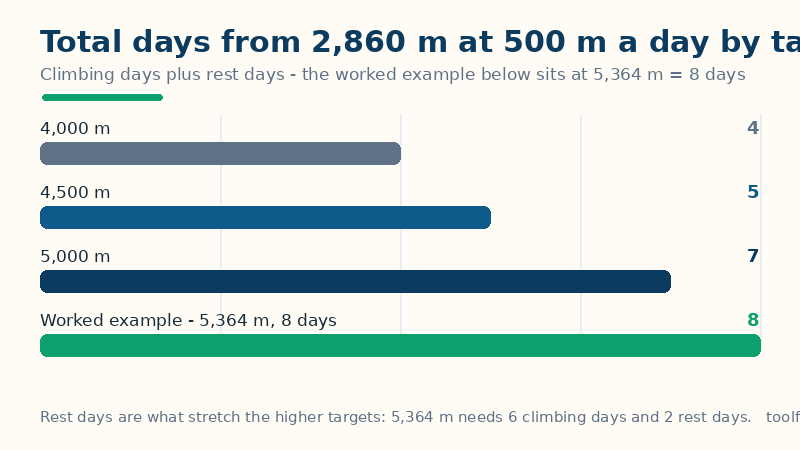
Every variable in that box is an input on this page. The cap is a ceiling, not a target: a 300-metre cap produces a longer, gentler schedule, and the table below shows the difference a slower cap makes on the same trip. Nothing in the arithmetic knows your body — fitness does not buy immunity from altitude illness, and previous good trips at altitude do not guarantee the next one — so the schedule is a planning floor, not a promise, and the response to symptoms is always to stop ascending and, if they worsen, to descend.
Worked example: Lukla (2,860 m) to Everest Base Camp sleeping altitude (5,364 m), 500 m a day
The classic Everest Base Camp trek starts its sleeping-altitude climb at Lukla, 2,860 metres (9,383 ft), and ends at 5,364 metres (17,598 ft) — a total gain of 2,504 metres (8,215 ft). At 500 metres a climbing day, the schedule this page prints is 8 days: 6 climbing days and 2 rest days. The working, day by day:
| Day | What happens | Sleeping altitude | Gain |
|---|---|---|---|
| Day 1 — climbing day | Climb from Lukla | 3,360 m (11,024 ft) | +500 m |
| Day 2 — climbing day | Second 500-metre gain | 3,860 m (12,664 ft) | +500 m |
| Day 3 — rest day | No increase in sleeping altitude | 3,860 m (12,664 ft) | No gain |
| Day 4 — climbing day | Climb resumes | 4,360 m (14,304 ft) | +500 m |
| Day 5 — climbing day | Second 500-metre gain since the rest day | 4,860 m (15,945 ft) | +500 m |
| Day 6 — rest day | No increase in sleeping altitude | 4,860 m (15,945 ft) | No gain |
| Day 7 — climbing day | Climb resumes | 5,360 m (17,585 ft) | +500 m |
| Day 8 — climbing day | Final short gain to the target | 5,364 m (17,598 ft) | +4 m |
Check the arithmetic: the six climbing gains are 500 + 500 + 500 + 500 + 500 + 4 = 2,504 metres, exactly the gap between 2,860 and 5,364. The rest days fall where the rule puts them — after the second climbing day, when 1,000 metres has been gained since the start, and after the fifth climbing day, when another 1,000 metres has been gained since the first rest day — and the final 4-metre day is not padded into a full day or rounded away: it is the honest remainder of the target. The same rules at other targets, from 3,000 metres at 500 metres a day, give 4,000 metres in 2 days with no rest day, 4,500 metres in 4 days (3 climbing, 1 rest), 5,000 metres in 5 days (4 climbing, 1 rest) and 6,000 metres in 8 days (6 climbing, 2 rest). A slower cap stretches the same trip: 3,500 to 4,500 metres at 300 metres a day takes 4 climbing days (300 + 300 + 300 + 100) with no rest day, because the 1,000-metre rest threshold is never crossed before the target — while 2,800 to 4,800 metres at 400 metres a day takes 6 days (5 climbing, 1 rest), the rest day falling after the third climb, when 1,200 metres has been gained since the start.
How to read your result, and its limits
Three limits decide whether a passing schedule is enough. First, this is sleeping altitude only: a day that crosses a high pass and sleeps low again is not a violation of the cap, and a night spent high after a low day is exactly what the cap counts — judge the itinerary by its nights, not its summits. Second, the first night matters most: the guidance warns against going directly from low altitude to a sleeping altitude of 2,750 metres or higher in a single day, so a schedule that starts high because the flight lands high deserves its first 48 hours treated conservatively, whatever the later days say. Third, the schedule cannot see you: age, fitness, previous altitude experience, illness and dehydration all move individual susceptibility, and no calculator can clear a person for altitude — if headache, nausea, dizziness or breathlessness appears, the correct action is to stop ascending and descend if symptoms worsen, not to re-run the numbers.
Common mistakes
- Counting the summit instead of the sleep. A day that tops out at 5,000 metres and sleeps at 4,300 metres has gained to 4,300 metres by the rule's measure — and a night at 5,000 metres after a 4,300-metre sleep is a 700-metre gain, over the cap, even though the day's walking felt easy.
- Treating rest days as optional. Cutting the rest day to save a day on the itinerary is the commonest way a sound schedule becomes an unsound one: the rest day is when the adaptation catches up, and skipping it does not save time if the trip ends early.
- Assuming fitness protects you. Strong, fit climbers get altitude sickness too — the guidance is explicit that fitness does not remove susceptibility, and the fastest person in the group is not the safest person at altitude.
- Rounding the cap up. A 500-metre cap means 500, not "about 600": the extra 100 metres a day, repeated over a week, is a whole extra day of gain the body never got to adapt to.
Related tools: Trekking Pole Size Calculator — Your trekking pole length from height: flat, uphill and downhill settings in one page; Hiking Time Calculator — Your trail time from distance and ascent by Naismith's Rule — walking time, breaks and arrival time, in metric or imperial units; Hiking Water Calculator — Your hiking water from hours, heat and effort — litres to carry, 1-litre bottles and the pack weight, with a delay hour and camp water included.
Frequently asked questions
Why is the daily gain capped at 500 metres?
Because that is the Wilderness Medical Society guidance summarised in the CDC Yellow Book: once above about 3,000 metres, sleeping altitude should rise by no more than about 500 metres per night. Above that rate, the risk of acute mountain sickness rises sharply, and the extra day saved is rarely worth the trip it can end.
Why does the schedule insert rest days every 1,000 metres?
Because the same guidance adds an acclimatization night for every 1,000 metres of sleeping-altitude gain. A rest day means no increase in sleeping altitude — you can still walk higher during the day and sleep low again, which is the climb-high-sleep-low pattern that makes rest days useful rather than idle.
Can a fit climber ascend faster than the schedule?
Fitness does not buy immunity: the guidance is explicit that strong, young, aerobically fit people are still susceptible to altitude illness, and a previous good trip at altitude does not guarantee the next one. A faster schedule is a personal risk decision, not something a calculator can clear.
What should I do if I feel ill at altitude?
Stop ascending. Headache, nausea, dizziness or unusual breathlessness are the early warnings, and the treatment for worsening symptoms is descent, not rest at the same altitude and not pushing on. This page is a planning aid, not medical advice — take proper mountain-medicine advice before a high trip.
