From the energy you want to the bank you must buy
Battery sizing runs backwards. Start with the energy you want available — daily use times the days the bank must last without recharge — then undo the two losses that sit between the nameplate and your sockets: depth of discharge, the share of the bank you are allowed to draw before recharging, and inverter efficiency, the share that survives conversion back to household current:
autonomy energy (kWh) = daily energy × days of autonomy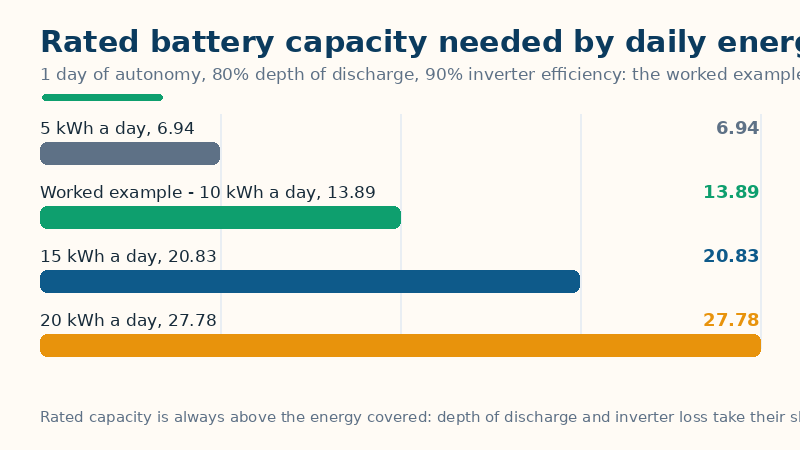
rated capacity (kWh) = autonomy energy ÷ (depth of discharge × inverter efficiency)amp-hours = rated capacity (Wh) ÷ system voltage (V)units = amp-hours ÷ one unit's amp-hours, rounded upDepth of discharge is the number that most changes the answer. A lithium bank is typically drawn to 80% — deeper cycling shortens its life — while a lead-acid bank is typically drawn to only 50%, because deep discharges damage lead-acid cells far faster. That single difference makes a lead-acid bank nearly twice the rated size of a lithium bank for the same usable energy, which is why lead-acid looks cheaper per kilowatt-hour on the spec sheet and dearer once sized properly. Inverter efficiency, typically about 90%, is the smaller but non-negotiable second factor: the bank stores direct current and the house runs on alternating current, and conversion loses roughly a tenth. System voltage — 48 V for whole-home systems, 12 V or 24 V for smaller setups — does not change the kilowatt-hours at all; it only changes how the same energy is expressed in amp-hours, because amp-hours times volts equals watt-hours.
Worked example: 10 kWh a day, 1 day, 80% depth of discharge, 90% efficiency
Autonomy energy = 10 × 1 = 10.0 kWh. Rated capacity = 10.0 ÷ (0.80 × 0.90) = 10.0 ÷ 0.72 = 13.89 kWh. Amp-hours at 48 V = 13,889 ÷ 48 = 289.4 Ah. Units of 100 Ah = 289.4 ÷ 100 = 2.89, rounded up to 3 units = 300 Ah = 14.4 kWh installed. Usable from the installed bank = 14.4 × 0.80 × 0.90 = 10.37 kWh — just above the 10.0 kWh asked for, which is the rounding-up margin doing its job. The calculator's table shows the same method at other daily uses (1 day, 80% depth of discharge, 90% efficiency, 48 V, 100 Ah units): 5 kWh a day → 6.94 kWh rated, 144.7 Ah, 2 units (9.6 kWh); 15 kWh → 20.83 kWh, 434.0 Ah, 5 units (24.0 kWh); 20 kWh → 27.78 kWh, 578.7 Ah, 6 units (28.8 kWh). Two sensitivities show where the answer moves: the same 10 kWh a day on lead-acid at 50% depth of discharge needs 10 ÷ (0.50 × 0.90) = 22.22 kWh rated, or 463.0 Ah at 48 V; and asking for 2 days of autonomy at the lithium settings needs 20 ÷ 0.72 = 27.78 kWh rated — doubling the autonomy doubles the bank, which is why most grid-tied homes size for one overnight, not for a cloudy week.
How to read your result, and its limits
Four cautions keep the number honest. First, daily energy here is the energy you want the battery to cover, not your whole bill: for a grid-tied solar home that is typically the overnight use — often roughly half the daily total — while an off-grid home must cover the whole day plus its autonomy days, a much larger bank. Sizing from the whole bill for a grid-tied home oversizes the battery by roughly double. Second, power rating is a separate limit: this page sizes energy (kWh), but a battery also has a maximum output power (kW), and a bank with enough energy can still fail to start a large motor or run a whole home at once — check the kW rating against your biggest simultaneous loads. Third, usable capacity fades: a bank rated 13.89 kWh today holds less after years of cycling, so installers commonly add a margin for degradation rather than sizing exactly to today's requirement. Fourth, this is a sizing estimate, not an installation design: wiring, fusing, inverter choice, local codes and the solar array that must refill the bank all change the final system — the solar panel calculator sizes the array side, and a licensed installer should confirm the battery design before purchase. For what the stored energy is worth in emissions avoided, the carbon footprint calculator totals a household's CO2.
Common mistakes
- Buying the nameplate number as the usable number. A 10 kWh battery at 80% depth of discharge and 90% inverter efficiency delivers only 7.20 kWh to the house. Sizing by the nameplate alone undersizes the bank by nearly a third at these settings.
- Sizing a grid-tied battery from the whole daily bill. The battery only needs to cover what the sun cannot — typically the overnight use. Using the full daily total roughly doubles the bank and its cost for energy the panels already cover directly.
- Ignoring chemistry in the depth of discharge. Lead-acid at 50% needs nearly twice the rated capacity of lithium at 80% for the same usable energy. Comparing the two on nameplate price alone reverses the real cost order.
- Rounding units down. Battery units are whole objects: 2.89 units must become 3, not 2, or the bank falls short of the energy it was sized to cover. The rounding-up margin is a feature, not waste.
Related tools: Electricity Cost Calculator — What any appliance costs to run — per day, per month and per year — from watts, hours and your rate.
Frequently asked questions
How many kWh of battery storage do I need?
Divide the energy you want covered by depth of discharge times inverter efficiency. Covering 10 kWh a day for one day at 80% depth of discharge and 90% efficiency needs 10 ÷ 0.72 = 13.89 kWh rated — 3 units of 100 Ah at 48 V, or 14.4 kWh installed.
What is depth of discharge?
The share of a battery's rated capacity you draw before recharging. Lithium banks are typically drawn to about 80%, lead-acid to about 50% — drawing lead-acid deeper shortens its life far faster, which is why a lead-acid bank needs nearly twice the rated size for the same usable energy.
How do I convert kWh to amp-hours?
Divide watt-hours by system voltage: amp-hours = rated kWh × 1,000 ÷ volts. The worked example's 13.89 kWh bank is 289.4 Ah at 48 V, but would be 578.7 Ah at 24 V — the same energy, expressed differently.
Why is the installed bank bigger than the calculated size?
Because battery units are whole objects: 289.4 Ah of requirement at 100 Ah per unit must round up to 3 units (300 Ah, 14.4 kWh). Rounding down would leave the bank short of the energy it was sized to cover, so the installed figure always lands slightly above the exact requirement.