Three steps: watts, minutes, cleans a week
The whole calculation is two multiplications. Watts divided by 1,000 is kilowatts; kilowatts times the clean time in hours is the energy of one session; the sessions a week times the energy per session is the week's energy; the week's energy times 52 weeks is the year's energy; the year's energy times the price is the year's money. The month is the year divided by 12, not the week times 4 — the two differ by a few cents, and the year-divided-by-12 figure is the one this page uses, so it agrees with the yearly total exactly:
energy per session (kWh) = watts ÷ 1,000 × minutes ÷ 60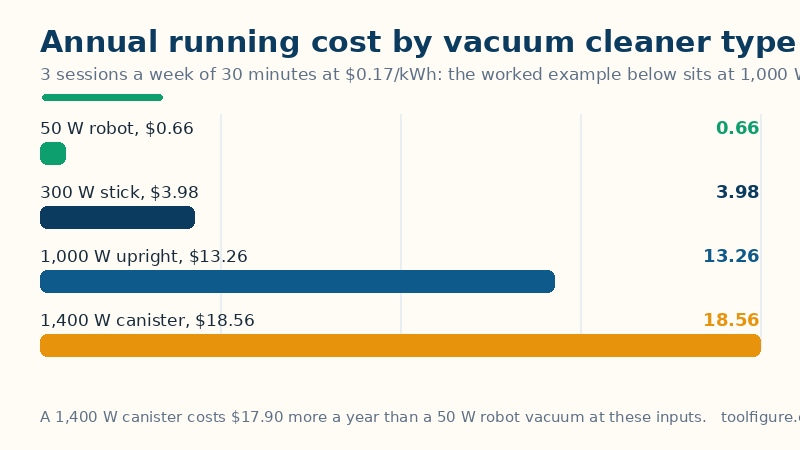
energy per week (kWh) = energy per session × sessions a weekannual cost ($) = energy per week × 52 × electricity priceThe watts on the label are the most the motor ever draws, and the motor does not draw them all clean. A robot vacuum draws about 20 to 50 W, a cordless stick about 100 to 500 W, a corded upright or cylinder about 500 to 1,200 W, and a shop or commercial vacuum up to 2,000 W or more — and the suction setting, the floor type and the carpet-boost mode all move the real draw around. What matters is the session: thirty minutes at 1,000 W is 0.5 kWh, and a vacuum that runs for minutes a few times a week will never be a large line on the bill, whatever the watts on the box suggest.
Worked example: 1,000 W, 30 minutes, 3 sessions a week, $0.17/kWh
A 1,000 W vacuum cleaner running for 30 minutes uses 1.0 × 30 ÷ 60 = 0.500 kWh a session, costing 8.5¢. A week is 0.5 × 3 = 1.5 kWh, costing $0.26. A month is 78.0 ÷ 12 = 6.5 kWh, costing $1.11. A year is 1.5 × 52 = 78.0 kWh, costing $13.26. The table above shows the same maths for the other vacuum types at 3 sessions a week of 30 minutes: a 50 W robot vacuum costs 0.4¢ a session and $0.66 a year, a 300 W cordless stick costs 2.6¢ a session and $3.98 a year, and a 1,400 W canister costs 11.9¢ a session and $18.56 a year. One hour of cleaning costs $0.17 at these settings, and ten years of vacuuming at this pace costs $132.60. Once a week the same vacuum costs $4.42 a year, every day it costs $30.94; a 60-minute session costs $26.52 a year at 3 sessions a week, and a 15-minute session costs $6.63. Four published cross-checks reproduce exactly: wattcostcalc's 1,000 W vacuum at half an hour a day and 17.5 cents costs $0.088 a day — this page gives the same 0.5 kWh a session and 8.8¢, shown as $0.09; its $31.94 a year is the day times 365, while this page's year is the week times 52, $31.85 — a 9-cent convention difference — and its $2.63 a month is the day times 30, while this page's year-divided-by-12 month is $2.65; Anker's 700 W vacuum for 30 minutes uses 0.35 kWh and costs about 9p at Ofgem's 26.11p per kWh — this page gives the same 0.35 kWh a session and 9.1p; Jackery's 1,200 W vacuum for one hour uses 1.2 kWh and costs $0.20 at 17 cents — this page gives the same 1.2 kWh and 20.4¢ — and its 1,500 W vacuum at one hour a day uses 1.5 kWh a day and 45 kWh a month, the day times 30, while this page's year-divided-by-12 month is 45.5 kWh; and bestvacuuminsider's 1,200 W vacuum for one hour at 15 cents costs $0.18 — this page gives the same 1.2 kWh and 18.0¢.
How to read your result, and its limits
Four cautions keep the number honest. First, the year is the week times 52: 78.0 kWh a year is 6.5 kWh a month and $1.11, while the week times 4 would give 6.0 kWh and $1.02 — a nine-cent difference that is only a convention, and the year-divided-by-12 figure is the one that adds up to the yearly total. Second, the watts are a peak, not a constant: a vacuum on low suction or a hard floor draws less than its label, a robot vacuum on a carpet boost draws more, and only a plug-in meter on your own machine measures it exactly. Third, watts are not suction: suction is measured in air watts, a different figure, and Consumer Reports notes that motor wattage alone is not a reliable indicator of cleaning ability — a modern 700 W vacuum can out-clean an older 1,400 W one. Fourth, the electricity price is the all-in rate: the total on the bill divided by the kilowatt-hours on the bill, including delivery charges. For the fan that runs while you clean, the ceiling fan cost calculator prices the breeze by watts and hours with the speed setting kept honest; for the cooling that follows the cleaning, the air conditioner cost calculator prices it watt by watt from its BTU rating and SEER; and for the cost of running anything else in the house, the electricity cost calculator prices any appliance by watts and hours.
Common mistakes
- Pricing the rated watts for a whole day. A 1,000 W vacuum for 30 minutes is 0.5 kWh and 8.5¢, not 24 kWh and $4.08 — the session is minutes, and the minutes are the whole story.
- Putting minutes in as hours. Thirty minutes is 0.5 hours, not 30 — entering 30 as the hours would price sixty sessions. Divide the minutes by 60 first: 30 ÷ 60 = 0.5.
- Multiplying the weekly cost by 4 for the month. Four weeks is not a twelfth of a year: the week times 4 gives $1.02 a month at the worked example's inputs, while the year divided by 12 gives $1.11. Use the year-divided-by-12 figure, which is the one that adds up.
- Comparing vacuums on watts. A 1,400 W canister and a 300 W stick look far apart on watts, but the session is 30 minutes either way: 0.7 kWh against 0.15 kWh, 11.9¢ against 2.6¢. Compare kilowatt-hours per session, not watts — and remember watts are not suction anyway.
- Adding the standing charge to every session. The daily supply charge is payable whether the vacuum runs or not. Only the per-kWh rate belongs in the per-session maths — the fixed charge is a separate line on the bill.
Frequently asked questions
How much does it cost to run a vacuum cleaner per hour?
A 1,000 W vacuum cleaner costs $0.17 an hour at $0.17 per kWh at its rated watts, and a 1,200 W vacuum costs $0.20 — Jackery's figure. For the usual 500 to 1,800 W range that is roughly $0.08 to $0.30 an hour at 17 cents, but the per-hour figure is the wrong one to budget on: a clean lasts minutes, so a 30-minute session at 1,000 W is 8.5¢, not 17¢.
How much does a vacuum cleaner cost per use?
A 1,000 W vacuum running for 30 minutes uses 0.5 kWh a session and costs 8.5¢ at $0.17 per kWh. A 700 W vacuum for the same 30 minutes uses 0.35 kWh and costs about 9p at Ofgem's 26.11p per kWh — Anker's figure — and a 50 W robot vacuum for 30 minutes uses 0.025 kWh and costs 0.4¢.
Do robot vacuums cost much to run?
Almost nothing: a 50 W robot vacuum running 90 minutes a day uses 0.075 kWh a run, costing 1.3¢, and 27.3 kWh a year, costing $4.64 at $0.17 per kWh. Even running every day it stays under $5 a year — the charging dock's standby draw is the only other line, and it is smaller still.
Does a higher-wattage vacuum always clean better?
No: watts measure how much electricity the motor draws, while suction is measured in air watts — a different figure. Consumer Reports notes that motor wattage alone is not a reliable indicator of cleaning ability, and a modern 700 W vacuum can out-clean an older 1,400 W one. Buy on airflow and design, and use this page only for what the watts cost.