Three steps: watts, hours a day, days a week
The whole calculation is three multiplications, and the thermostat duty is the one people get wrong. Watts divided by 1,000 is kilowatts; kilowatts times the hours a day times the thermostat duty divided by 100 is the energy of one day; the day's energy times the days a week times 52 weeks is the year's energy; the year's energy times the price is the year's money. The month is the year divided by 12, not the day times 30 — the two differ by about half a dollar on a radiator, and the year-divided-by-12 figure is the one this page uses, so it agrees with the yearly total exactly:
energy per day (kWh) = watts ÷ 1,000 × hours a day × duty ÷ 100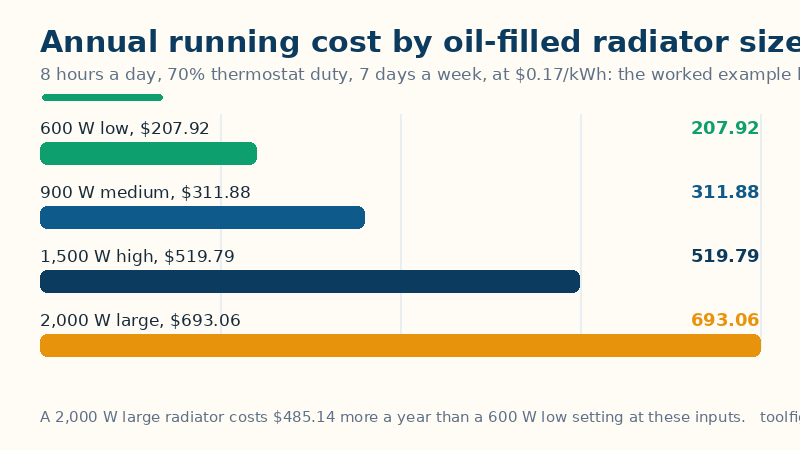
energy per year (kWh) = energy per day × days a week × 52annual cost ($) = energy per year × electricity priceThe watts on the label are the radiator's maximum draw, and the radiator does not draw them all day. Most plug-in oil-filled radiators sold in the US top out at 1,500 W, with lower settings of 900 W and 600 W, while larger UK models run to 2,000 W and 2,500 W. What matters is the thermostat duty: the oil stores the heat, so once it is hot the element switches off and the radiator keeps warming the room — Jackery's guide puts typical cycling at 50 to 75% of the time at full power. The days a week matter just as much: a radiator in a home office runs five days, not seven, and a radiator is a seasonal appliance — the yearly figure assumes all 52 weeks, so a radiator used for the five cold months costs about five twelfths of it.
Worked example: 1,500 W, 8 hours a day, 70% thermostat duty, 7 days a week, $0.17/kWh
A 1,500 W oil-filled radiator at 8 hours a day and 70% thermostat duty draws 1.5 × 0.7 = 1.05 kW on average and uses 1.05 × 8 = 8.400 kWh a day, costing $1.43. A week is 8.400 × 7 = 58.8 kWh, costing $10.00. A month is 3,057.6 ÷ 12 = 254.8 kWh, costing $43.32. A year is 8.400 × 7 × 52 = 3,057.6 kWh, costing $519.79. The table above shows the same maths for the other radiator sizes at 8 hours a day: a 600 W low setting costs 7.1¢ an hour and $207.92 a year, a 900 W medium setting costs 10.7¢ an hour and $311.88 a year, and a 2,000 W large radiator costs 23.8¢ an hour and $693.06 a year. One hour at these settings uses 1.05 kWh and costs 17.9¢, and at full power without cycling it costs 25.5¢ an hour. Running 4 hours a day costs $259.90 a year and 12 hours a day $779.69; with the thermostat cycling at 50% it costs $371.28 a year, and a five-month winter at this pace costs $216.58. Ten years of heating at this pace costs $5,197.92. Six published cross-checks reproduce exactly: wattcostcalc's 1,500 W oil-filled radiator at 8 hours a day and 17.5 cents costs $0.263 an hour, $2.10 a day, $63.00 a month and $766.50 a year — this page gives the same 12 kWh a day and $2.10 a day, while its $63.00 a month is the day times 30 and this page's year-divided-by-12 month is $63.70, and its $766.50 a year is the day times 365 against this page's week-times-52 year of $764.40; and its 1-hour row of $7.88 a month and $95.81 a year is the same day-times-30 and day-times-365 maths against this page's $7.96 and $95.55. The WattCost guide's 1,500 W radiator at 8 hours a day and 18.16 cents costs $0.27 an hour, $2.18 a day and $65.38 a month — this page gives the same $2.18 a day, while its $0.27 an hour is the whole-cent rounding of this page's 27.2¢ and its $65.38 a month is the day times 30 against this page's $66.10; and its 900 W radiator costs $39.23 a month and its 600 W $26.15, against this page's $39.66 and $26.44. Jackery's 1,500 W radiator at 8 hours a day and 18.34 cents costs $2.20 a day flat out, $1.10 at 50% duty and $1.65 at 75% — this page gives the same three day figures exactly — while its $66.02 a month continuous and $49.52 at 75% duty are the day times 30 against this page's $66.76 and $50.07. EPC Cost's 2,000 W radiator at 70% duty costs 37p an hour at the Ofgem price-cap rate of 26.32p — this page gives the same 1.40 kWh an hour, 36.8p at that rate — and its 4-hour day of £1.47 is this page's 5.6 kWh a day at the same rate. HeaterGuides' 1,500 W radiator at 8 hours a day and 17 cents costs 26 cents an hour, $2.04 a day and $61.20 a month — this page gives the same $2.04 a day, while its 26 cents an hour is the whole-cent rounding of this page's 25.5¢ and its $61.20 a month is the day times 30 against this page's $61.88. And BugSolutionHub's 600, 900 and 1,500 W radiators cost $0.11, $0.17 and $0.29 an hour at 19 cents — this page gives the same figures as the whole-cent roundings of 11.4¢, 17.1¢ and 28.5¢ — while its $27.74, $41.61 and $69.35 a month are the day-times-365 year divided by 12 against this page's $27.66, $41.50 and $69.16 on the week-times-52 year.
How to read your result, and its limits
Four cautions keep the number honest. First, the duty is the average: the oil holds the heat, so a radiator that cycles at 50% costs half the full-power figure — the same 1,500 W radiator at 8 hours a day costs $371.28 a year at 50% duty against $742.56 at full power — and in a draughty room the element may run at 80 to 90% duty, so enter the duty you actually see, not the duty you hope for. Second, the days a week and the season: the yearly figure assumes the radiator runs every week of all 52 weeks, but a radiator used three days a week costs $222.77 a year, not $519.79, and a five-month winter at this pace costs $216.58 — count the days you actually run it. Third, every electric heater costs the same per watt: ceramic, oil-filled and infrared all turn about 95 to 100% of their electricity into heat — the US Department of Energy's figure — so a 1,500 W heater of any type costs 25.5¢ an hour flat out at $0.17. The oil changes the comfort — slow, steady, silent heat — not the cost; compare watts and duty, not the marketing name. For the fan and ceramic heaters that share the same maths, the space heater cost calculator prices them hour by hour. Fourth, the electricity price is the all-in rate: the total on the bill divided by the kilowatt-hours on the bill, including delivery charges. For the heat pump that replaces the radiator, the heat pump savings calculator prices the saving against resistance heat; and for the cost of running anything else in the house, the electricity cost calculator prices any appliance by watts and hours.
Common mistakes
- Pricing the label watts as if the element never cycled. A 1,500 W radiator at 70% duty uses 8.4 kWh in 8 hours, not 12 — $1.43 a day, not $2.04. Enter the duty, not just the watts.
- Multiplying the daily cost by 30 for the month. Thirty days is not a twelfth of a year: the day times 30 gives $42.84 a month at the worked example's inputs, while the year divided by 12 gives $43.32. Use the year-divided-by-12 figure, which is the one that adds up.
- Pricing the year for a seasonal heater. Eight hours a day for a five-month winter is $216.58, not $519.79 — the yearly figure assumes the radiator runs all year. Use the winter line for a seasonal heater.
- Comparing radiators on type instead of watts and duty. A 1,500 W oil-filled radiator and a 1,500 W fan heater both use 1.5 kWh an hour flat out — the oil-filled one just spreads the heat differently. Compare watts and duty, not the marketing name.
- Adding the standing charge to every hour. The daily supply charge is payable whether the radiator runs or not. Only the per-kWh rate belongs in the per-hour maths — the fixed charge is a separate line on the bill.
Frequently asked questions
How much does it cost to run an oil-filled radiator per hour?
A 1,500 W oil-filled radiator costs 17.9¢ an hour at $0.17 per kWh when the thermostat cycles at 70% — $1.43 a day at 8 hours a day and $519.79 a year. At full power without cycling it costs 25.5¢ an hour, $2.04 a day and $742.56 a year. The duty, not just the watts, decides the bill.
How much does it cost to run an oil-filled radiator per month?
At the worked example's inputs — 1,500 W, 8 hours a day, 70% duty, 7 days a week — the radiator uses 254.8 kWh a month and costs $43.32 at $0.17 per kWh. At 100% duty the same month costs $61.88, and a five-month winter at this pace costs $216.58.
Do oil-filled radiators save electricity?
No, not per watt: every electric resistance heater turns about 95 to 100% of its electricity into heat, so a 1,500 W oil-filled radiator and a 1,500 W fan heater both use 1.5 kWh an hour flat out. What the oil does is store heat, so the element switches off and the radiator keeps warming the room — the saving comes from the thermostat cycling at 50 to 75%, not from the oil itself.
What thermostat duty should I enter?
About 70% for a radiator in a room that holds its temperature — the figure this page uses by default — and 50% for a well-insulated room, where Jackery's guide puts typical cycling at 50 to 75%. In a draughty room the element may run at 80 to 90% duty, so watch the duty, not the dial.