Why the belt is two inches bigger than the waist
A belt has to do more than circle your waist: it passes over the trousers, through the belt loops, and still has to reach the hole you actually fasten, which should be the middle hole so the belt can be tightened or loosened by a hole either way. That is why the trade rule is belt size = trouser waist + 2 inches, with the answer rounded up to the next even inch, because belt sizes are sold in even inches. A 34-inch trouser waist therefore takes a 36-inch belt, not a 34-inch one — a 34-inch belt fastened on its last hole would leave no adjustment and a tip that barely reaches the first loop. The EU column on this page is that belt length in centimetres: 36 inches × 2.54 = 91.44 cm, rounded to 91 cm. United States and United Kingdom belt sizes are the same number, which is one fewer trap than clothing sizes carry.
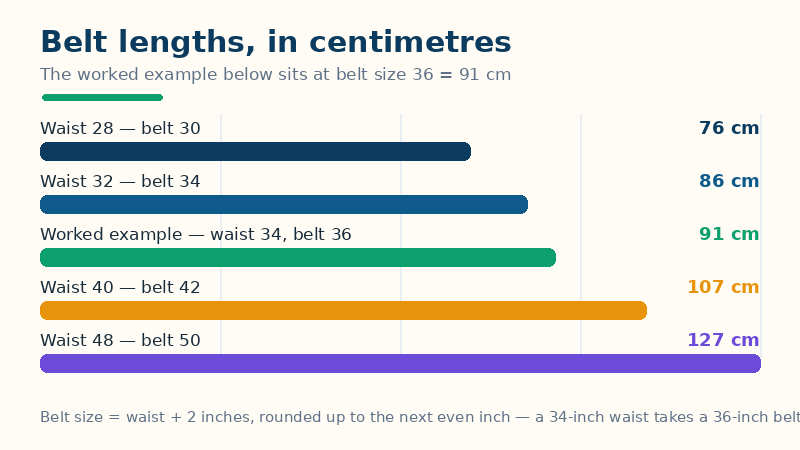
Worked example: a 34-inch trouser waist
Take a trouser waist of 34 inches. The rule gives 34 + 2 = 36, already even, so the answer is a belt size 36 inches, EU 91 cm, letter M. The waist itself is 34 × 2.54 = 86.36 cm, shown as 86.4 cm, and the belt length to the middle hole is the EU figure, 91 cm. Two more rows prove the rule holds across the table rather than on one lucky row: a 32-inch waist takes a 34-inch belt, EU 86 cm, S (waist 81.3 cm), and a 28-inch waist takes a 30-inch belt, EU 76 cm, XS (waist 71.1 cm). The odd-waist trap is worth stating plainly: a 33-inch waist gives 33 + 2 = 35, which is not sold, so it rounds up to a 36-inch belt — the same belt as a 34-inch waist — rather than down to a 34 that would fasten on its last hole.
Belt size table
| Trouser waist (in) | Waist (cm) | Belt US/UK (in) | Belt EU (cm) | Letter |
|---|---|---|---|---|
| 28 | 71.1 | 30 | 76 | XS |
| 30 | 76.2 | 32 | 81 | S |
| 32 | 81.3 | 34 | 86 | S |
| 34 | 86.4 | 36 | 91 | M |
| 36 | 91.4 | 38 | 97 | M |
| 38 | 96.5 | 40 | 102 | L |
| 40 | 101.6 | 42 | 107 | L |
| 42 | 106.7 | 44 | 112 | XL |
| 44 | 111.8 | 46 | 117 | XL |
| 46 | 116.8 | 48 | 122 | XXL |
| 48 | 121.9 | 50 | 127 | XXL |
How to read your result, and its limits
Three checks before ordering. First, measure the waist you will wear the belt over, not your natural waist: measure around the trousers at the height the belt will sit, with the trousers on, snug but not tight — low-rise jeans sit lower and measure larger than a natural waist, and a measurement taken over a tucked-in sweater is the honest one if that is how the belt will be worn. Second, watch for the other EU convention: some European brands label a belt by the waist it fits rather than by its length, so an EU 85 on such a brand means a waist of about 85 cm (a US 36 belt under the waist-plus-two rule on this page would be EU 91) — if the brand's EU number equals your waist in centimetres, trust the brand's chart over this table's EU column. Third, an old belt is the best measuring tool of all: lay it flat and measure from the buckle end to the hole you actually use; divide by 2.54 and round to the nearest even inch, and that is your belt size — a measurement that already includes how you wear it, which no waist measurement can promise.
Related tools: Pants Size Converter — Men's and women's pants sizes — US, UK and EU, with inseam; Clothing Size Converter — Men's and women's clothing sizes between US, UK and EU — with the measurements behind them; Shoe Size Converter — US, UK, EU and Japan shoe sizes — every system at once, men and women.
Frequently asked questions
Is my belt size the same as my trouser waist size?
No — it is two inches larger. Belt size = trouser waist + 2 inches, rounded up to the next even inch, because the belt passes over the trousers and should fasten on its middle hole. A 34-inch trouser waist takes a 36-inch belt.
Are US and UK belt sizes the same?
Yes. Unlike clothing sizes, where the US and UK systems diverge, a US 36 belt and a UK 36 belt are both 36 inches long. The EU figure differs because it is the same length in centimetres: 36 inches is 91 cm.
What if my trouser waist is an odd number?
Add two and round up to the next even inch. A 33-inch waist gives 35, which is not sold, so it rounds up to a 36-inch belt. Rounding down would leave the belt fastening on its last hole with no adjustment left.
What does the EU belt number mean?
On this page it is the belt's length in centimetres: belt inches × 2.54, rounded to the nearest centimetre, so a 36-inch belt is EU 91. Some European brands instead label by waist, so if a brand's EU number equals your waist in centimetres, use that brand's own chart.
