Base weight is the comparison, total weight is what you carry
Backpackers quote two different weights, and confusing them is the most common weight mistake on the trail. Base weight is everything in and on the pack except food, water and fuel: the pack itself, shelter, sleep system, clothing, cooking system and other gear. It does not change with trip length, which is exactly why it is the honest measure of a kit — a three-day trip and a ten-day trip with the same gear have the same base weight. Total pack weight is base weight plus consumables — food, water and fuel — and it is what your knees feel on day one, falling each day as you eat and drink. Worn items, the boots and clothes you walk in, are counted in neither figure here. The bands hikers use for base weight are commonly cited as under 10 lb (4.5 kg) ultralight, 10–20 lb (4.5–9.1 kg) lightweight, and over 20 lb (9.1 kg) traditional, and the load guideline most often quoted is a total pack weight under about 20% of body weight.
Base weight = pack + shelter + sleep system + clothing + cooking + other gear — Consumables = food + water (1 litre = 1 kg) + fuel — Total pack weight = base weight + consumables — Load ratio = total pack weight ÷ body weight × 100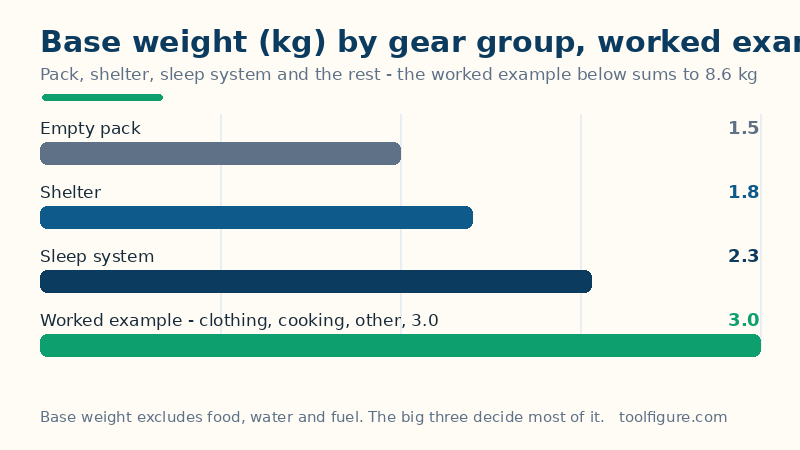
Water is the heaviest consumable and the easiest to misjudge: one litre weighs one kilogram (2.2 lb), so two litres already add 2 kg before food is counted, which is why carrying to the next refill beats carrying the whole route's water. Food runs about 0.7–0.9 kg (1.5–2 lb) a day for most three-season trips.
Worked example: a lightweight kit for an 80 kg hiker
An 80 kg hiker with a 1.5 kg pack, 1.8 kg shelter, 2.3 kg sleep system, 1.0 kg of clothing, 0.8 kg of cooking gear and 1.2 kg of other gear, carrying 3.0 kg of food, 2 litres of water and 0.5 kg of fuel, has a base weight of 8.6 kg (19.0 lb) — Lightweight — and a total pack weight of 14.1 kg (31.1 lb), which is 17.6% of body weight. The working: base weight = 1.5 + 1.8 + 2.3 + 1.0 + 0.8 + 1.2 = 8.6 kg. Consumables = 3.0 + 2.0 + 0.5 = 5.5 kg. Total = 8.6 + 5.5 = 14.1 kg. Load ratio = 14.1 ÷ 80 × 100 = 17.6%. Base weight as a share of body weight alone is 8.6 ÷ 80 × 100 = 10.8%. The 20% guideline for an 80 kg hiker is 16.0 kg, so 14.1 kg sits within it. The same arithmetic on other kits:
| Kit | Base weight | Consumables | Total and load ratio |
|---|---|---|---|
| Ultralight weekend, 70 kg hiker | 4.0 kg (Ultralight) | 2.0 food + 2.0 water + 0.3 fuel = 4.3 kg | 8.3 kg, 11.9% of body weight |
| Worked example, 80 kg hiker | 8.6 kg (Lightweight) | 3.0 food + 2.0 water + 0.5 fuel = 5.5 kg | 14.1 kg, 17.6% of body weight |
| Traditional multi-day, 80 kg hiker | 12.0 kg (Traditional) | 4.0 food + 3.0 water + 1.0 fuel = 8.0 kg | 20.0 kg, 25.0% of body weight |
| Winter multi-day, 85 kg hiker | 18.0 kg (Traditional) | 6.0 food + 2.0 water + 1.5 fuel = 9.5 kg | 27.5 kg, 32.4% of body weight |
Check the ultralight row by hand: 4.0 + 4.3 = 8.3 kg, and 8.3 ÷ 70 × 100 = 11.9%. Check the traditional row: 12.0 + 8.0 = 20.0 kg, and 20.0 ÷ 80 × 100 = 25.0% — above the 20% guideline, which is the point of the flag: a traditional base weight plus a multi-day food load is routinely over 20% on day one, and it only falls as the food is eaten.
How to read your result, and its limits
Three checks before trusting the figure. First, compare base weights, not totals: a total that includes five days of food will always beat a total that includes two, whatever the gear — base weight is the only like-for-like comparison between kits. Second, the 20% guideline is a guideline, not a limit: fit, experienced walkers carry 25% or more, beginners should aim lower, and winter, group-leading or waterless stretches legitimately push the total higher — the flag marks the guideline, it does not declare the load wrong. Third, weigh the real gear, not the catalogue: catalogue weights omit stuff sacks, stakes and the things added at packing, so a kitchen scale beats a spreadsheet — weigh the packed bag itself as the final check, because that is the weight you actually carry.
Common mistakes
- Comparing a total against a base weight. Food, water and fuel are consumables and belong outside base weight; mixing them makes every comparison meaningless.
- Counting worn items in the pack. Boots and walking clothes are not pack weight — including them inflates the base weight and breaks the band comparison.
- Forgetting water's weight. One litre is one kilogram: two litres are 2 kg before food is counted, and a waterless stretch can add more weight than any gear upgrade saves.
- Chasing the band instead of the trip. An ultralight base weight that leaves out shelter or warmth for the conditions is not a lighter trip, it is an unprepared one — the band serves the trip, not the other way round.
Related tools: Backpack Size Calculator — Your backpack size in two parts: frame size from torso length, and litres from trip length, packing style and season; Tent Size Calculator — Your tent size from sleepers and comfort — the floor area you need and the rating that covers it — with the packs-inside allowance; Hiking Water Calculator — Your hiking water from hours, heat and effort — litres to carry, 1-litre bottles and the pack weight, with a delay hour and camp water included.
Frequently asked questions
What is base weight?
Base weight is everything in and on the pack except food, water and fuel: the pack, shelter, sleep system, clothing, cooking system and other gear. It does not change with trip length, which is why hikers compare base weights rather than totals.
What is a good base weight?
Under 10 lb (4.5 kg) is commonly called ultralight, 10–20 lb (4.5–9.1 kg) lightweight, and over 20 lb (9.1 kg) traditional. The worked example's 8.6 kg (19.0 lb) is lightweight — a realistic three-season figure, not an extreme one.
How much should my backpack weigh compared to my body weight?
The commonly cited guideline is a total pack weight under about 20% of body weight — 16.0 kg for an 80 kg hiker. Fit, experienced walkers carry 25% or more; beginners should aim lower, and winter or waterless trips legitimately run higher.
Does water count in base weight?
No — water is a consumable, like food and fuel, and sits outside base weight. It still counts in total pack weight, at 1 kg per litre, which is why the total on day one is always the heaviest figure and falls as you eat and drink.
