Four steps: watts, day, season, comparison
The whole calculation is one division followed by multiplications. SEER — the Seasonal Energy Efficiency Ratio — is the cooling delivered over a season divided by the electricity used, so dividing the capacity by the SEER gives the watts the unit draws. Watts times hours gives the day's energy, days give the season, and the electricity price turns energy into money. The comparison runs the same chain for the old unit's SEER and subtracts:
power (W) = capacity (BTU per hour) ÷ SEER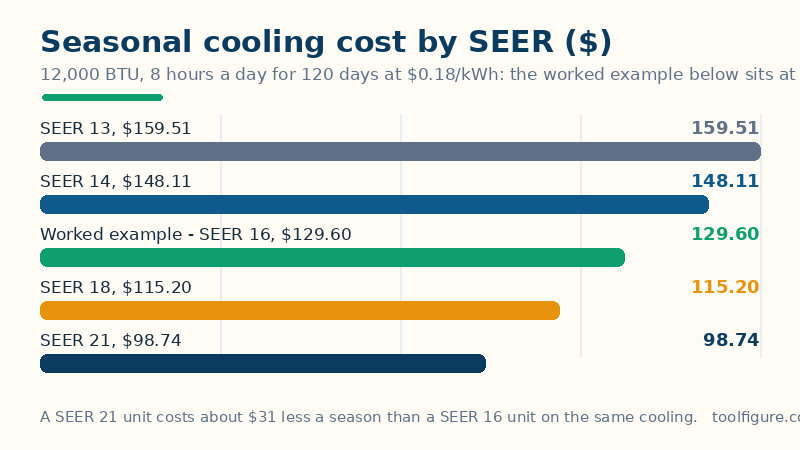
daily energy (kWh) = power ÷ 1,000 × hours a dayseasonal energy (kWh) = daily energy × days in the seasonseasonal cost ($) = seasonal energy × electricity pricesaving vs old unit ($) = old seasonal cost − new seasonal costTwo conversions sit behind the numbers. One ton of cooling is 12,000 BTU per hour, so a 12,000 BTU unit is a one-ton unit and a 24,000 BTU unit is two tons — the tonnage is the capacity, not the weight of anything. And SEER is a seasonal average, not a single-condition rating: the EER is the same ratio measured at one fixed outdoor temperature, so a unit's EER is usually a point or two below its SEER, and the two should never be compared directly. The hours are the subtle input: this page prices full-load hours, so if the thermostat is set for twelve hours but the compressor only runs for eight of them, eight is the number to enter.
Worked example: 12,000 BTU, SEER 16, 8 hours a day, 120 days
A one-ton window unit rated at 12,000 BTU per hour with a SEER of 16 draws 12,000 ÷ 16 = 750 W. Running eight hours a day it uses 750 ÷ 1,000 × 8 = 6 kWh a day, costing 6 × $0.18 = $1.08 a day. Over a 30-day month that is 180 kWh and $32.40, and over a 120-day season it is 720 kWh and $129.60. The old SEER 10 unit it replaces draws 12,000 ÷ 10 = 1,200 W, uses 1,152 kWh a season and costs $207.36 — so the new unit saves $77.76 a season, 37.5%. The table above shows the same cooling at other ratings: SEER 13 costs $159.51 a season, SEER 14 costs $148.11, SEER 18 costs $115.20 and SEER 21 costs $98.74. The step from 16 to 21 saves $30.86 a season, which is the honest scale of the upgrade decision: divide the price premium of the better unit by the yearly saving and you have its payback in years, and for most homes that payback is longer than the unit's life unless the old unit is already being replaced.
How to read your result, and its limits
Four cautions keep the number honest. First, full-load hours are a judgement, not a meter reading: an inverter unit ramps down instead of cycling, so its average draw is below its rated watts for much of the day — enter the hours at full load, or the cost is overstated. Second, SEER assumes a proper installation: an oversized unit short-cycles, a leaky duct loses a fifth of the cooling before it reaches the room, and a dirty filter raises the draw — none of which a rating can see, and all of which cost real money. Third, the electricity price is the all-in rate: the total on the bill divided by the kilowatt-hours on the bill, including delivery — and if your tariff has time-of-use pricing, the afternoon hours when the air conditioner works hardest are usually the dearest, so a single average understates the cost. Fourth, the comparison is running cost only: it excludes the purchase price, installation, refrigerant and maintenance, so a higher-SEER unit is not automatically the better buy — it is the better buy only when its price premium pays back inside its service life. For the heating side of the same house, the heat pump savings calculator compares heat pumps against gas, oil and electric heat; for the size of the load itself, the BTU calculator works out how much cooling a room needs; and for any other appliance, the electricity cost calculator prices watts and hours the same way.
Common mistakes
- Reading the BTU rating as the running cost. Two 12,000 BTU units can draw 750 W or 1,200 W depending on their SEER. The BTU rating is the cooling delivered; the SEER is what turns it into watts, and watts are what the meter sees.
- Comparing SEER with EER. SEER is a seasonal average and EER is a single-condition rating. A unit with a SEER of 16 and an EER of 13 is the same machine described two ways — comparing one unit's SEER against another's EER is comparing a season against an afternoon.
- Entering thermostat hours instead of running hours. A unit set for twelve hours that cycles for eight costs eight hours' worth of electricity. Entering twelve overstates the season by half — and makes every upgrade look better than it is.
- Buying SEER for its own sake. The step from SEER 16 to SEER 21 saves $30.86 a season on the worked example's unit. If the better unit costs $400 more, that is a thirteen-year payback — longer than the unit will last. Buy the SEER that pays back inside the life of the machine you are already replacing.
Frequently asked questions
How much does it cost to run an air conditioner?
Divide the BTU rating by the SEER to get watts, then multiply by hours and your electricity price. In the worked example — 12,000 BTU, SEER 16, 8 hours a day, $0.18/kWh — the unit draws 750 W and costs $1.08 a day, $32.40 a month and $129.60 over a 120-day season.
What does SEER mean, and what SEER should I buy?
SEER is the Seasonal Energy Efficiency Ratio: the cooling delivered over a whole season divided by the electricity used. A higher SEER means the same cooling for fewer watts — a SEER 16 unit draws 750 W where a SEER 10 unit draws 1,200 W for the same 12,000 BTU. Under the older SEER scale the US minimum was 13 in the north and 14 in the south; the current SEER2 scale sets the minimum at 14.3, and 16 is a good value on either scale, with the savings per extra point shrinking fast above 18.
How many watts does a 12,000 BTU air conditioner use?
It depends on the SEER: 12,000 ÷ SEER. At SEER 16 it is 750 W, at SEER 13 it is 923 W, at SEER 21 it is 571 W and at the old SEER 10 it is 1,200 W. The BTU rating alone cannot answer the question — the SEER is the other half of it.
Is a higher SEER air conditioner worth the extra cost?
Divide the price premium by the yearly saving. On the worked example's unit, SEER 21 saves $30.86 a season over SEER 16, so a $400 premium takes about thirteen years to pay back — longer than the unit's life. The upgrade pays when the old unit is already being replaced, or where the cooling season is long and electricity is dear.