What luminous flux is
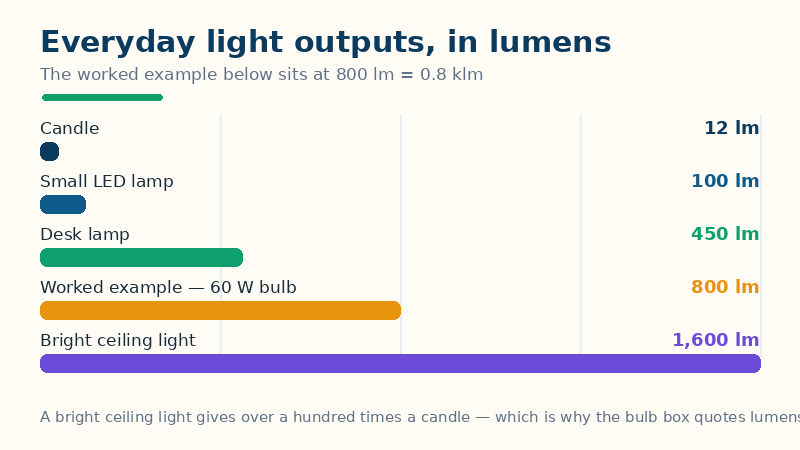
Luminous flux is the total amount of visible light a source emits, in all directions — the whole "brightness budget" of a lamp, before any of it is aimed, spread or dimmed by distance. It is the number on every bulb box: a candle gives about 12 lumens, an old 40 W bulb about 450, a 60 W bulb about 800, and a 100 W bulb about 1,600. The SI unit is the lumen, but lighting plans quote kilolumens, lab notes quote candela steradians, and photometry papers quote the equivalent watts at the eye's sensitivity peaks, so the same lamp arrives under half a dozen labels. This page restates any luminous flux in all ten units at once, worked through lumens with every factor defined, and answers the question the conversion alone cannot: spread over an area you enter, how brightly lit is that surface?
The formula
answer = lumens ÷ (lumens in one "to" unit)
illuminance = lumens ÷ area
Three terms, all visible on the page. value is the number you enter. lumens in one "from" unit is the definition of the unit you are converting from: 0.000001 for the microlumen, 0.001 for the millilumen, 1 for the lumen itself and for the candela steradian, 1,000 for the kilolumen and for the kilocandela steradian, 1,000,000 for the megalumen, 1,000,000,000 for the gigalumen, 683 for the watt at 555 nm, and 1,700 for the watt at 507 nm. answer is the result in the unit you asked for. area is the area you enter in square metres, and the illuminance line divides the flux by it, because illuminance = flux ÷ area, in lux, so the light falling on a real desk, room or stage falls out of the flux on the bulb box.
Worked example
Convert 800 lumens to kilolumens — a 60 W bulb's output, restated for a lighting plan — the way the tool does it.
Step 1 — get to lumens. The input is already in lumens, so the base value is 800 lm itself.
Step 2 — divide by the target factor. One kilolumen is 1,000 lm, so 800 ÷ 1,000 = 0.8.
Step 3 — read the display. The headline reads 0.8 klm, and the detail line shows the working: 800 lm = 0.8 klm — worked through lumens: 800 lm ÷ the Kilolumen factor. The full table for this example reads: 800,000,000 µlm, 800,000 mlm, 800 lm, 0.8 klm, 8.00e-04 Mlm, 8.00e-07 Glm, 800 cd·sr, 0.8 kcd·sr, 1.1713 W @ 555 nm and 0.4706 W @ 507 nm. The illuminance line, at the default area of 20 m², reads 40 lux: 800 ÷ 20 = 40 lux.
Check it. Multiplying back, 0.8 klm × 1,000 = 800 lm exactly, and 1.1713 W @ 555 nm × 683 = 800 lm to the displayed rounding — the exact value multiplies back to 800 exactly, because the 683 figure is exact by the SI definition of the candela. The illuminance line checks the same way: 40 lux × 20 m² = 800 lm, the flux we started from.
Conversion table
The conversions bulb boxes, lighting plans and lab notes reach for most, each one the same two steps as the example:
| From | To |
|---|---|
| 1 lm | 1,000 mlm |
| 1 lm | 0.001 klm |
| 1 lm | 1 cd·sr |
| 100 lm | 0.1 klm |
| 100 lm | 0.1464 W @ 555 nm |
| 800 lm | 0.8 klm |
| 1,600 lm | 1.6 klm |
| 1,600 lm | 2.3426 W @ 555 nm |
| 1,600 lm | 0.9412 W @ 507 nm |
Three everyday cross-checks for the scale, each one the same two steps: a candle at about 12 lm is 0.012 klm; a desk lamp at 450 lm is 0.45 klm and 0.6589 W @ 555 nm (450 ÷ 683 = 0.6589); and a 100 W bulb at about 1,600 lm is 1.6 klm. A beam cross-check, from the flux = intensity × solid angle definition rather than from this converter's units: a 500 cd spotlight in a 60° beam covers 0.8418 steradians (2π × (1 − cos 30°)), so it emits 500 × 0.8418 = 420.89 lm — and a 1,000 cd source radiating equally in all directions, over the full sphere of 12.5664 steradians, emits 12,566.37 lm.
Reading the result, and its limits
Four distinctions keep this page honest. First, flux is not intensity: lumens measure all the light emitted, while candelas measure light in one direction, and the two meet only through a solid angle — flux = intensity × steradians, as the beam cross-check above shows. Second, flux is not illuminance: lumens measure what leaves the lamp and lux measures what lands on a surface, and the two meet only through an area — illuminance = flux ÷ area, as the illuminance line shows. Third, the watt equivalents depend on wavelength: 683 lm/W holds only at 555 nm, the peak of daylight vision, and 1,700 lm/W only at 507 nm, the peak of night vision, so a watt of red light and a watt of green light are very different numbers of lumens and neither converts a real lamp's electrical watts — a 60 W bulb draws 60 electrical watts and emits only about 800 lumens. Fourth, the illuminance line assumes the flux spreads evenly over the area: a real room has walls, fittings and a beam pattern that concentrate light in some places and starve others, so 40 lux is the average over 20 m², not the brightness at any one desk.
Related tools: Luminous Intensity Converter — Lumens to candela and back through the beam angle — plus the lux at your distance; Illuminance Converter — Lux to foot-candles, phot and more — every answer in all six units, plus the lumens your room needs; Luminance Converter — Nits to foot-lamberts, lamberts, stilbs and more — every answer in all eight units.
Frequently asked questions
How do I convert lumens to kilolumens?
Divide by 1,000. A bulb at 800 lm is 800 ÷ 1,000 = 0.8 klm, the worked example on this page. To go the other way, multiply kilolumens by 1,000 to get lumens.
What is the difference between lumens, candelas and lux?
Lumens measure total light output, candelas measure light in one direction, and lux measures light landing on a surface. They meet through geometry: flux = intensity × solid angle, and illuminance = flux ÷ area. A 500 cd spotlight in a 60° beam emits 420.89 lm, and 800 lm spread over 20 m² gives 40 lux.
How many lumens is one watt of light?
It depends on the wavelength. At 555 nm, the peak of daylight vision, one watt is exactly 683 lumens by the SI definition. At 507 nm, the peak of night vision, one watt is about 1,700 lumens. Neither figure converts a lamp's electrical watts — a 60 W bulb draws 60 electrical watts and emits only about 800 lumens.
How do I find the illuminance from lumens?
Divide the flux by the area in square metres. In this page's units, 800 lm over 20 m² is 800 ÷ 20 = 40 lux. Enter any area and the illuminance line does that division for you — it is the average over the whole area, not the brightness at one point.
