The formula: height gives the length, age gives the drop
Two tables, both stated in full so the answer can be checked by hand. Step 1, length from height: find the height band and read off the bat length — a 60 in player takes 30 in, a 70 in player takes 33 in. Step 2, drop from age: 7 and under -12, ages 8-9 -11, ages 10-12 -10, ages 13-14 -7, 15 and over -3. Step 3, weight: bat weight in ounces is length plus drop, because drop is defined as length minus weight, written negative.
Bat length = height band length; Drop = age group drop; Bat weight (oz) = length + drop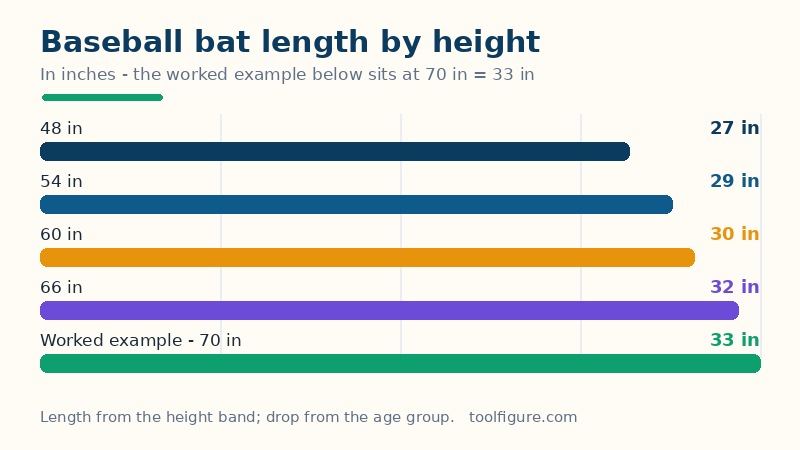
| Player height | Bat length |
|---|---|
| 36–44 in | 26 in |
| 45–48 in | 27 in |
| 49–52 in | 28 in |
| 53–56 in | 29 in |
| 57–60 in | 30 in |
| 61–64 in | 31 in |
| 65–68 in | 32 in |
| 69–72 in | 33 in |
| 73 in and over | 34 in |
| Age group | Drop |
|---|---|
| 7 and under | -12 |
| 8–9 | -11 |
| 10–12 | -10 |
| 13–14 | -7 |
| 15 and over | -3 |
Worked example: 178 cm, age 16
Take a 16-year-old who is 178 cm tall. Convert the height: 178 ÷ 2.54 = 70.1 in, which falls in the 69–72 in band, so the bat is 33 in (33 × 2.54 = 83.8 cm). Age 16 is in the 15-and-over group, so the drop is -3, and the bat weighs 33 + (-3) = 30 oz (30 × 28.3495 = 850.485 g, rounded to 850 g). A second check, a 10-year-old at 152 cm: 152 ÷ 2.54 = 59.8 in, in the 57–60 in band, so a 30 in bat; age 10 is in the 10–12 group, drop -10, weight 30 + (-10) = 20 oz (567 g).
How to read your result, and its limits
Three checks before buying. First, weight and strength move the pick by about an inch: a strong player can handle an inch longer, a lighter one should drop an inch and keep bat speed — the hold test in the result decides. Second, guides differ by an inch: this page's table is one consistent reading of the published height charts, not a league rule, so a neighbouring guide may say 32 in where this page says 33 in. Third, the stamp matters more than the brand: youth leagues require USA Baseball, USSSA or BBCOR stamps depending on age and league, and the wrong stamp means an illegal bat whatever the length.
Common mistakes
- Buying the longest bat for power alone. A bat that is too long slows the swing and drags the barrel — control beats length at every age.
- Shopping on length and ignoring drop. Two 30 in bats at -10 and -3 weigh 20 oz and 27 oz; the weight is half the decision.
- Measuring height without the shoes they bat in. Measure in cleats, back against a wall, heels flat — barefoot height undersizes the bat.
- Buying before checking the league stamp. The wrong certification is an illegal bat on game day, however right the length is.
Related tools: Baseball Glove Size Calculator — The right baseball glove size from age group and position: the published chart, looked up openly, with the catcher's circumference exception stated; Cricket Bat Size Calculator — The right cricket bat size from your height, with bat length, typical age group and a next-size-up warning near a boundary; Golf Club Length Calculator — Recommended driver, wood, iron and putter lengths from your height and wrist-to-floor measurement, with the full height table.
Frequently asked questions
What size baseball bat do I need for a 5-foot player?
A 5 ft (60 in) player takes the 57–60 in band, so a 30 in bat. The drop comes from age: a 10- to 12-year-old takes -10, so a 20 oz bat, while a high-school player takes -3, so a 27 oz bat.
What does drop weight mean on a baseball bat?
Drop is bat length in inches minus bat weight in ounces, written as a negative number. A 30 in bat that weighs 20 oz is a -10: 30 - 20 = 10, shown as -10. The bigger the number, the lighter the bat for its length.
Should I size up if my child is between bat sizes?
No — take the shorter bat. Bat speed and control matter more than length at every age, and a bat that is too long slows the swing and drags the barrel. Confirm with the hold test: hold the bat out one-handed for ten seconds; if the barrel dips, go lighter.
What drop weight do high school players use?
-3. High-school and college play under BBCOR rules, which require a -3 drop, and this calculator gives -3 for every player aged 15 and over. Younger leagues allow lighter drops: -10 for ages 10–12 and -7 for ages 13–14 on this page's table.
