One rate, a discount on the second child, and the weeks actually paid for
The whole calculation is one multiplication per child and two divisions of the annual total, and the only thing that needs care is which children the discount applies to. The first child pays the full monthly rate; every child after the first pays the rate less the sibling discount. The monthly total times twelve, scaled by the weeks of care actually paid for, plus the extra annual fees, is the annual cost — and the monthly average, the weekly figure and the cost per child are that same annual total divided by 12, by 52 and by the children:
monthly total ($) = rate + (children − 1) × rate × (1 − sibling discount %)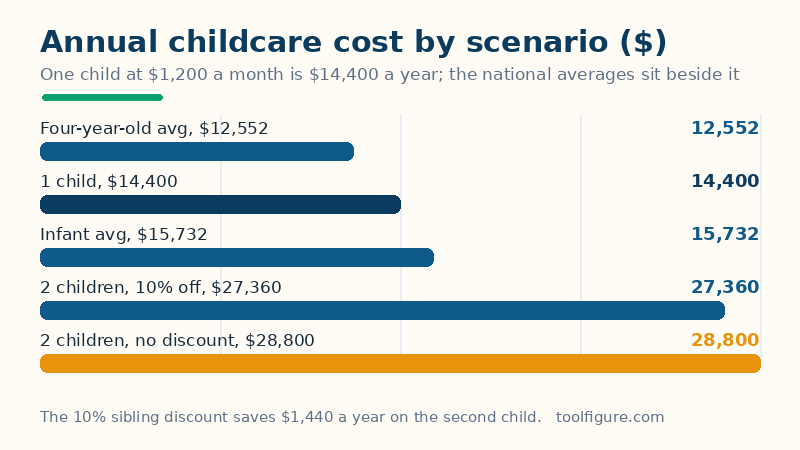
annual cost ($) = monthly total × 12 × weeks ÷ 52 + extra annual feesweekly cost ($) = annual cost ÷ 52 · income share (%) = annual cost ÷ household income × 100The table above shows the same maths at five points: one child at $1,200 a month is $14,400 a year ($1,200.00 a month, $276.92 a week); two children with a 10% sibling discount are $27,360 a year ($2,280.00 a month, $526.15 a week, $13,680.00 per child); the same two children with no discount are $28,800 a year ($2,400.00 a month, $553.85 a week); an infant at the national average of $1,311 a month is $15,732 a year ($302.54 a week); and a four-year-old at the national average of $1,046 a month is $12,552 a year ($241.38 a week). The discount saves $1,440 a year on the second child — $120 a month — and the infant-to-four-year-old step saves $3,180 a year at the national averages, which is why the rate that matters is the rate for your child's age, not the centre's headline rate.
Worked example: one child at $1,200 a month is $14,400 a year
One child at $1,200 a month, 52 weeks a year and no extra fees: the monthly total is $1,200.00, the annual cost is $1,200 × 12 = $14,400, the weekly cost is $14,400 ÷ 52 = $276.92, and the cost per child is $14,400. Against a $120,000 household income that is $14,400 ÷ $120,000 × 100 = 12.0% of income — tight against the 7% affordability yardstick, which reads affordable at 7% or under, tight above 7% up to 12%, and a heavy burden above 12%. Two children at the same rate with a 10% sibling discount are $1,200 + $1,080 = $2,280.00 a month, $27,360 a year, $526.15 a week — 22.8% of the same income, a heavy burden — and without the discount $28,800 a year, so the discount is worth $1,440 a year. Over five years at today's rate, two children cost $27,360 × 5 = $136,800. Three published cross-checks reproduce. CalculatorZilo's Cost of Daycare Calculator prices $60 a day, 5 days a week, 50 weeks a year, for 2 children at $30,000 a year — $2,500 a month and $577 a week, 25.0% of a $120,000 income — and the same arithmetic on this page's formula gives the same figures: $60 × 5 × 50 × 2 = $30,000, $30,000 ÷ 12 = $2,500.00 a month, $30,000 ÷ 52 = $576.92 a week, which rounds to their $577, and the daily rate is worth $1,250 a month per child ($60 × 5 × 50 ÷ 12). Child Care Aware of America puts the 2024 national average price of child care at $13,128 a year — about $1,094 a month across ages and care types — against this page's worked example of $14,400, which is a little above the average, as a $1,200-a-month full-time rate should be. And the baby cost page's own childcare line is the same $1,200 a month, $14,400 a year, inside its $24,820 first year — the same number, two pages, one rate.
How to read your result, and its limits
Four cautions keep the number honest. First, the rate is the estimate: at $14,400 a year it is the whole result, and it varies more than every other input combined — by city, by age room, by centre or nanny, and by full-time or part-time. Get one real local quote before trusting any total. Second, this is the bill before tax help: a dependent-care FSA lets you pay up to $7,500 a year (2026 limit, raised from $5,000) from pre-tax pay, escaping income tax and payroll tax together, and the child and dependent care tax credit then applies to what is left — the creditable expense is capped at $3,000 for one child and $6,000 for two or more, at a rate that phases down with income from 50% to 20% — so the net cost can be thousands below the bill on this page, and the exact saving depends on your income and your FSA election. Third, the rate changes as the child moves rooms: infant care at $1,311 a month nationally and four-year-old care at $1,046 is a $3,180-a-year step down, so a five-year total built on today's infant rate overstates the later years — price each age separately for a multi-year figure. Fourth, the 7% yardstick is a planning band, not a rule: the federal affordability benchmark says child care should cost no more than 7% of household income, and most families pay far more — 12.0% at the worked example's inputs, 25.0% at the CalculatorZilo cross-check — so read the verdict as a measure of the strain, not as a pass or fail. For the rest of the first year the cost sits in, the baby cost calculator prices the delivery, the gear and the other monthly lines around it; for the monthly side of the same household budget, the salary converter turns an annual salary into the monthly figure the childcare budget is built from and the rent calculator prices what a home costs each month.
Common mistakes
- Multiplying one monthly rate by twelve and calling it the year. Two children at $1,200 a month are not $28,800 a year when the second child carries a 10% discount — they are $27,360, and a centre that closes for two weeks charges for 50 weeks, not 52, which takes another $553.85 off the year at the worked example's rate.
- Applying the sibling discount to the first child. The discount lands on every child but the most expensive one — the first child pays the full $1,200 and the second pays $1,080. Discounting the first child instead understates the year by $1,440.
- Leaving the extra fees out. Registration, supplies, meals and activities are charged once a year and are not in the monthly rate. A $500 registration fee is $500 on the annual total, and it is the line people discover on the first invoice.
- Reading the monthly average as the monthly bill. The $1,200.00 monthly average at 52 weeks is the annual total divided by 12. At 50 weeks the annual total is $13,846.15 and the monthly average is $1,153.85 — the centre's monthly invoice is $1,200 in the months it charges, and the average is lower because two weeks are not charged at all.
- Comparing totals across sources that include different things. A $14,400 bill before tax help and a $10,000 net cost after an FSA and a credit can both be right: one is the invoice, the other is what the family actually pays. Compare bill to bill, and net to net.
Frequently asked questions
How much does childcare cost on average?
Child Care Aware of America puts the 2024 national average at $13,128 a year, about $1,094 a month, across ages and care types — $1,311 a month for centre-based infant care ($15,732 a year) and $1,046 for a four-year-old ($12,552 a year), with the state spread running from under $7,000 a year to over $28,000.
How much does childcare cost per month?
The monthly rate times the children, less the sibling discount: one child at $1,200 a month is $1,200.00 a month and $14,400 a year; two children with a 10% sibling discount are $2,280.00 a month and $27,360 a year. The rate for your child's age and your city is the number that matters — get one real local quote.
What is the 7% rule for childcare costs?
The federal affordability benchmark says child care should cost no more than 7% of household income. This page reads 7% or under as affordable, above 7% up to 12% as tight, and above 12% as a heavy burden — most families pay far more than 7%, so read it as a measure of the strain, not a pass or fail.
How does a sibling discount work for childcare?
The discount applies to every child after the first, not the first child: at a 10% discount the first child pays the full $1,200 a month and the second pays $1,080, so two children cost $27,360 a year instead of $28,800 — a saving of $1,440 a year, $120 a month.