Five pieces, kept apart: rate, premium, holiday, mileage, tip
A babysitter's pay is a piecewise hourly bill, not a single hourly rate. Time is billed from arrival to departure and rounded up to a quarter hour, because a sitter cannot sell the leftover eleven minutes to anyone else. The hourly rate is quoted for one child, with a fixed dollar surcharge per hour for each additional child rather than a doubling — with three children at $18 base and a $2 surcharge, you are paying $22 an hour, not $54. The late-night premium applies only to the hours after the cutoff, the holiday multiplier applies to the labour only, mileage reimburses a cost actually incurred, and the tip is calculated on the labour only:
effective rate ($/hour) = base rate + (children − 1) × surcharge per extra child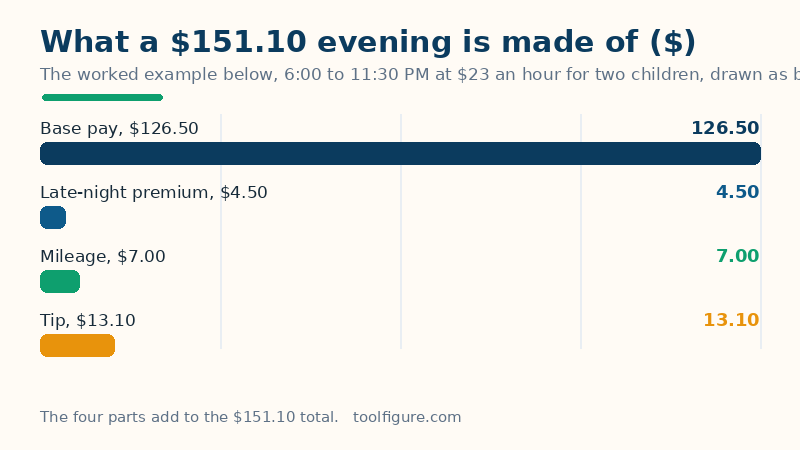
hours billed = longest of (time worked rounded up to 15 minutes, minimum sitting)base pay ($) = hours billed × effective ratelabour ($) = (base pay + late-night hours × premium) × holiday multipliertotal owed ($) = labour + tip (a % of labour) + mileage + bonusThe same formula is behind the table above, so every row can be rebuilt by hand. The worked example is a 6:00 PM to 11:30 PM sitting at $23 an hour for two children with no surcharge: 5 hours 30 minutes on the clock, billed as 5.50 hours, so the base pay is 5.50 × $23.00 = $126.50; the late-night premium is 1.50 hours after the 10:00 PM cutoff × $3.00 = $4.50, for a labour of $131.00; mileage is 10 miles × $0.70 = $7.00; the tip is 10% of the $131.00 labour = $13.10; and the total is $151.10 — $27.47 an hour across the evening, $13.74 an hour per child, $155.00 rounded up to the next $5.
Worked example, checked against the published calculators
Two published babysitter pay calculators reproduce the worked example exactly: 4calculators' Babysitter Pay Calculator gives the same evening — 5.50 hours at $23 an hour, $126.50 of base pay, $4.50 of late-night premium, $7.00 of mileage and a 10% tip of $13.10 — as a $151.10 total, with the same $27.47 effective hourly rate and $13.74 per child per hour, and its formula is the same one this page uses, including the tip on labour only and the quarter-hour rounding. The date-night row is SitterRate's published example — 6:15 PM to 11:40 PM at $22 an hour for one child — where the two pages differ honestly and only by the rounding rule: SitterRate bills the exact 325 minutes at $119.17, while this page rounds up to 5.50 hours, so the same evening is $121.00 of base pay before the $2.25 late-night premium (45 minutes after the 11:00 PM cutoff, rounded up) and the 10% tip of $12.33, a $135.58 total. The past-midnight row is SitterRate's second example — 7:00 PM to 1:00 AM at $24 an hour plus $2 an hour for the second child, 15% tip — which is 6 hours at a $26 effective rate, $156.00 of base pay, $6.00 of late-night premium, $162.00 of labour, a $24.30 tip and a $186.30 total, $31.05 an hour across the evening; on a holiday at ×1.5 the labour is $243.00, the tip $36.45 and the total $279.45. The short-pickup row is the minimum in action: 3:20 PM to 5:05 PM is 1 hour 45 minutes, billed as 3 hours under the 3-hour minimum, so $20 an hour is $60.00.
How to read your result, and its limits
Four cautions keep the number honest. First, the rate is the estimate: published 2026 US figures for one child run from about $20 to $26 an hour — Care.com's posted starting rate is $19.81, Sittercity's typical rate about $23, UrbanSitter's booked average $26.24 — and major metros run higher still, with San Francisco at $29.63 for one child; get the going rate where you live before trusting any total. Second, the surcharge is per child, not per sitting: published guidance is $2 to $5 an hour per additional child, and UrbanSitter's 2026 booking data has families paying $26.24 an hour for one child, $29.87 for two and $32.33 for three — a sitter who quotes one flat rate for any number of children is pricing the extra children at $0. Third, the tip belongs on the labour, not on the mileage or the bonus: mileage reimburses fuel the sitter already paid for, and a flat overnight bonus is a gift, not an hourly rate — tipping on either pays for the same thing twice. Fourth, an overnight flat bonus is not in the hourly maths: published guidance puts it at $50 to $100 for staying past midnight, and it goes in the bonus line rather than in the rate, so the effective hourly rate stays comparable. For the same household's longer-term care, the nanny cost calculator prices a regular weekly nanny with overtime and employer payroll tax, and the childcare cost calculator prices centre-based care the same way — one child at $1,200 a month is $14,400 a year.
Common mistakes
- Paying the exact minutes when the agreement was quarter-hour rounding. 5 hours 25 minutes at $22 an hour is $119.17 by the minute and $121.00 rounded up to 5.50 hours. Agree the rule before the evening, not after it.
- Comparing base rates instead of effective hourly rates. A $23-an-hour sitter with a $3 surcharge for a second child costs $26 an hour for two children; a $25-an-hour sitter with no surcharge costs $25. The effective rate is the only figure that survives contact with a different pricing structure.
- Tipping on the mileage. The tip is a percentage of the labour. A $7.00 mileage reimbursement is not labour, and tipping on it pays the sitter twice for the same fuel.
- Forgetting the late-night premium exists. An evening that runs past the cutoff costs more than the same hours in the afternoon — 1.50 hours after 10:00 PM at a $3.00 premium is $4.50 on the worked example, and 2 hours is $6.00 on the past-midnight row.
- Using a national average as a local rate. The 2026 national figures span $19.81 to $26.24 an hour for one child before any premium, and city rates run from $13 to $27 — your city's going rate beats any national average.
Related tools: Baby Cost Calculator — What does a baby cost in the first year? Price the delivery, the gear and the monthly lines — and see which line dominates.
Frequently asked questions
How much should I pay a babysitter?
Published 2026 US figures for one child run from about $20 to $26 an hour: Care.com's posted starting rate is $19.81, Sittercity's typical rate about $23, and UrbanSitter's booked average $26.24. Add $2 to $5 an hour for each additional child — UrbanSitter's 2026 booking data has $29.87 for two children and $32.33 for three — and more for late nights, holidays and major metros.
How is the babysitter's pay worked out?
Time is billed from arrival to departure, rounded up to the quarter hour. The hourly rate is the base rate plus a surcharge for each child after the first; hours after the late-night cutoff earn a premium; a holiday multiplies the labour; mileage is reimbursed separately; and the tip is a percentage of the labour only. On the worked example — 5.50 hours at $23 an hour, $4.50 of late-night premium, $7.00 of mileage and a 10% tip — the total is $151.10.
Why is the time rounded up to 15 minutes?
It is the convention sitters and families most often agree on: a sitter cannot sell the leftover eleven minutes to anyone else. The same rule applies to the late-night hours. SitterRate instead bills exact minutes — its 6:15 PM to 11:40 PM example is $119.17 by the minute against this page's $121.00 rounded up — so agree the rule before the evening.
Do I tip the babysitter, and on what?
Tipping is optional; 10% to 20% of the labour is the generous range. Tip on the labour only — the base pay plus the late-night premium, after any holiday multiplier — never on mileage, which reimburses fuel the sitter already paid for, and never on a flat overnight bonus. On the worked example the tip is 10% of the $131.00 labour, $13.10.