One twist, many dialects
Torque — the twist that tightens a bolt, turns a shaft or stalls an engine, τ = r × F — is measured in dialects that grew up in different workshops. The SI unit is the newton-metre: one newton of force applied one metre from the pivot. American car manuals, torque wrenches and engine spec sheets speak pound-force-foot (ft·lb) and its smaller sibling the pound-force-inch (in·lb), with the ounce-force-inch for delicate mechanisms. Older metric manuals quote kilogram-force-metre. And old physics texts carry the dyne-centimetre from the centimetre-gram-second system. They are all the same twist wearing different costumes, and this page undresses it: any torque restated in all nine units at once, worked through the newton-metre with every factor defined.
The formula
answer = newton-metres ÷ (newton-metres in one "to" unit)
Three terms, all visible on the page. value is the number you enter. newton-metres in one "from" unit is the exact definition of the unit you are converting from — 1.3558179483314004 for the pound-force-foot, 9.80665 for the kilogram-force-metre, 0.01 for the newton-centimetre. answer is the result in the unit you asked for. The pound-force-foot factor is exact: 0.3048 m × 4.4482216152605 N = 1.3558179483314004 N·m, the pound-force-inch is exactly one twelfth of that — 0.1129848250276167 N·m — and the kilogram-force-metre is exactly 9.80665 N·m. There is no lookup table of approximations here; every conversion is the same two multiplications through the newton-metre.
Worked example
Convert 100 N·m to pound-force-foot, the way the tool does it.
Step 1 — get to newton-metres. 100 N·m is already in newton-metres, so this step is 100 × 1 = 100 N·m.
Step 2 — divide by the target factor. One pound-force-foot is 1.3558179483314004 N·m, so 100 ÷ 1.3558179483314004 = 73.75621…
Step 3 — read the display. The page prints four decimals below 10 and two above, so the headline reads 73.76 ft·lb, and the detail line shows the working: 100 N·m = 73.76 ft·lb — worked through newton-metres: 100 N·m ÷ the Pound-force-foot factor.
Check it. Multiplying back, 73.76 × 1.3558179483314004 = 100.005…, which reads 100.01 — the hundredth is the display's rounding, not an error in the factor. The table underneath restates the same 100 N·m in all nine units, so the from/to choice only changes which row is the headline.
Conversions worth memorising
Every row below is the tool's own output, checked figure by figure:
| From | To | Result |
|---|---|---|
| 1 N·m | pound-force-foot | 0.7376 ft·lb |
| 60 N·m | pound-force-foot | 44.25 ft·lb |
| 200 N·m | pound-force-foot | 147.51 ft·lb |
| 25 ft·lb | newton-metres | 33.9 N·m |
| 150 ft·lb | newton-metres | 203.37 N·m |
| 10 N·m | pound-force-inch | 88.51 in·lb |
| 300 N·m | pound-force-inch | 2,655.22 in·lb |
| 1 ft·lb | newton-metres | 1.3558 N·m |
| 1 kgf·m | pound-force-foot | 7.233 ft·lb |
| 50 kgf·m | newton-metres | 490.33 N·m |
| 110 N·m | pound-force-foot | 81.13 ft·lb |
| 30 N·m | pound-force-foot | 22.13 ft·lb |
| 1 kN·m | pound-force-foot | 737.56 ft·lb |
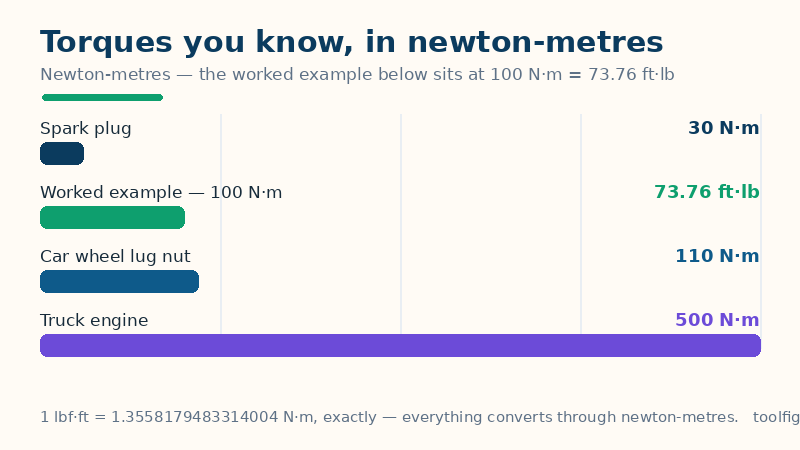
Three rows deserve a second look. The 110 N·m row is a car wheel's lug nuts — 81.13 ft·lb — and the 30 N·m row is a typical spark plug — 22.13 ft·lb — the two torque figures a home mechanic meets most, now in whichever dialect the wrench or the manual uses. The 25 ft·lb row round-trips exactly — 33.9 N·m back through the page gives 25 ft·lb — which is how you know the factor is exact rather than approximate.
Three traps worth knowing
Torque is not energy. A newton-metre of torque and a joule of energy share their dimensions, but a torque is a twist and energy is work done — 100 N·m on a bolt that never turns does zero work. Converting between torque units is honest arithmetic; converting a torque into an energy as if the units were interchangeable is a category error.
ft-lb and lb-ft are the same torque. Strictly, lb-ft — force times distance — is the preferred form, and it is what SAE and most US car manuals print; ft-lb is what most torque wrenches and most people say. This page treats them as one unit. Do not mix either with the foot-pound of energy found in old texts — same words, different quantity.
The manual's number wins. The typical values in the table are orientation, not specifications: spark plugs, lug nuts, cylinder heads and suspension bolts each have their own figure, and it varies by car. An under-torqued wheel and an over-torqued spark plug both fail expensively, so always use the manufacturer's figure and a calibrated wrench — this page only translates the dialect it is written in.
How to read your result, and the limits
Results show four decimal places below 10 and two above — more precision than most torque wrenches justify, so round to the wrench's own markings for real use. Four limits belong with the page. Negative values are allowed: −100 N·m converts to −73.76 ft·lb — the sign is clockwise versus counterclockwise, so the page converts it as given rather than refusing it. Empty input clears quietly; type and the table rebuilds, delete and the page waits. Anything past a trillion newton-metres gets a clear error instead of a meaningless digit string. And this page converts units, not specifications: it will translate any torque figure into any dialect, but it will not tell you the right torque for your car — for that you need the manufacturer's manual and a calibrated wrench.
Related tools: Unit Converter — Convert length, weight, temperature and volume — km to miles, kg to pounds, °C to °F, litres to gallons; Force Converter — Newtons to pound-force, kgf, kips and more — every answer in all ten units, through the exact definitions; Energy Converter — Joules to calories, kcal to kJ, kWh to joules and BTU — every answer in all ten units, through the exact definitions.
Frequently asked questions
How do I convert newton-metres to foot-pounds?
Divide by 1.355818 — or, the same thing, multiply by 0.737562. So 100 N·m becomes 73.76 ft·lb, 60 N·m becomes 44.25 ft·lb, and 1 N·m is 0.7376 ft·lb. To go back, multiply foot-pounds by 1.3558: 25 ft·lb is 33.9 N·m. This page does both directions and restates every answer in all nine units at once.
Is ft-lb the same as lb-ft?
For torque, yes — the same amount of twist. Strictly, lb-ft (force times distance) is the preferred form and the one SAE and most US car manuals print, while ft-lb is what most torque wrenches and people say; this page treats them as one unit. Neither should be confused with the foot-pound of energy in old texts.
Is torque the same as energy?
No, though they share dimensions: a newton-metre of torque and a joule of energy are dimensionally identical, but torque is a twist applied at a distance while energy is work actually done. A 100 N·m torque on a bolt that never turns does zero work. Convert torque units freely; do not convert a torque into an energy.
Why does this page allow negative torque?
Because torque has a direction — clockwise versus counterclockwise — and the sign carries it. −100 N·m converts to −73.76 ft·lb with the same arithmetic and the sign kept, rather than the page pretending one rotation direction does not exist.
