One quantity, many dialects
Density — mass packed into volume, ρ = m/V — is measured in dialects that grew up in different trades. Laboratories and food labels use grams per cubic centimetre and grams per millilitre. Engineers quote kilograms per cubic metre and tonnes per cubic metre. Workshops and materials datasheets speak pounds per cubic foot and pounds per cubic inch, and liquid handlers quote pounds per gallon. They are all the same quantity wearing different costumes, and this page undresses it: any density restated in all nine units at once, worked through the kilogram per cubic metre with every factor defined.
How the conversion works, with every factor defined
kg/m³ = value × the from-unit's factor · Converted value = kg/m³ ÷ the to-unit's factorGram per cubic centimetre 1,000 · Kilogram per litre 1,000 · Tonne per cubic metre 1,000 · Pound per cubic foot 16.01846337396014 · Pound per cubic inch 27,679.904710203125 · Ounce per cubic inch 1,729.9940443876953 · Pound per US gallon 119.82642731689663 · Pound per UK gallon 99.77637266310171 g/cm³ = 1 g/mL = 1 kg/L = 1,000 kg/m³ · 1 t/m³ = 1,000 kg/m³ · 1 lb/gal (US) = 119.83 kg/m³ · 1 lb/gal (UK) = 99.78 kg/m³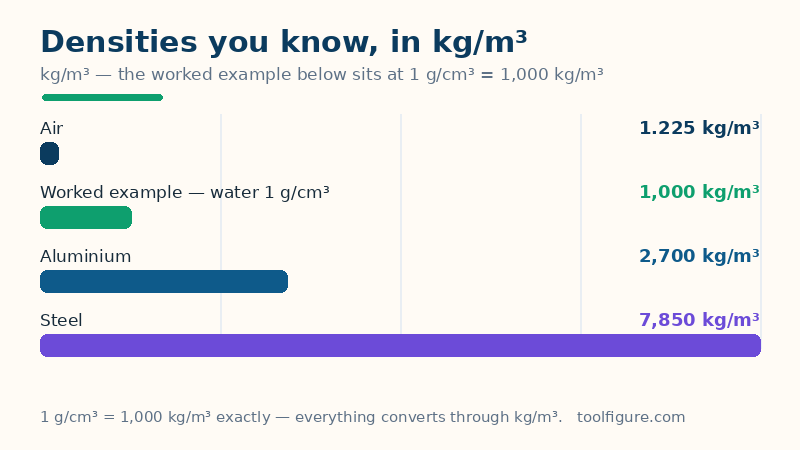
These factors are definitions, not measurements. Each one is really a mass conversion divided by a volume conversion: a pound is exactly 0.45359237 kg, a cubic foot exactly 0.028316846592 m³, so one pound per cubic foot is 0.45359237 ÷ 0.028316846592 = 16.01846337396014 kg/m³. The two gallon units differ because the gallons differ — the US gallon is 3.785411784 litres, the UK gallon 4.54609 — which is why a pound per US gallon (119.83 kg/m³) and a pound per UK gallon (99.78 kg/m³) are honestly separate units on this page rather than one merged row. Three equalities do the daily work: one gram per cubic centimetre is exactly one gram per millilitre, exactly one kilogram per litre, exactly 1,000 kilograms per cubic metre — so a food label's g/mL drops straight into the g/cm³ box.
Worked example: water, 1 g/cm³
The defaults above convert 1 gram per cubic centimetre — the density of water, the natural reference point of the whole subject. Through the base unit: 1 × 1,000 = 1,000 kg/m³. Dividing by each unit's factor: 1 kg/L, 1 t/m³, 62.43 lb/ft³, 0.0361 lb/in³, 0.578 oz/in³, 8.3454 lb/gal (US) and 10.02 lb/gal (UK). Two habits follow from the method. First, learn water's fingerprints: 1,000 kg/m³, 62.43 lb/ft³, 8.3454 lb per US gallon — any material within a few percent of those numbers floats or sinks only marginally in water, which is how specific gravity earns its keep. Second, always convert before you compare datasheets: a polymer quoted at 1.05 g/cm³ and a resin quoted at 65.5 lb/ft³ are 1,050 and 1,049 kg/m³ — the same material, not two grades.
The conversions people actually ask for
| Conversion | Answer | How it is worked |
|---|---|---|
| Water: 1 g/cm³ in every unit (worked example) | 1,000 kg/m³ | 1 × 1,000 — worked in full above |
| 1 kg/m³ to lb/ft³ | 0.0624 lb/ft³ | 1 ÷ 16.01846337396014 |
| 1 kg/m³ to lb/gal (US) | 0.0083 lb/gal (US) | 1 ÷ 119.82642731689663 |
| Steel: 7,850 kg/m³ to lb/ft³ | 490.06 lb/ft³ | 7,850 ÷ 16.01846337396014 |
| Steel: 7,850 kg/m³ to lb/in³ | 0.2836 lb/in³ | 7,850 ÷ 27,679.904710203125 |
| Aluminium: 2,700 kg/m³ to lb/ft³ | 168.56 lb/ft³ | 2,700 ÷ 16.01846337396014 |
| Air: 1.225 kg/m³ to lb/ft³ | 0.0765 lb/ft³ | 1.225 ÷ 16.01846337396014 |
| Mercury: 13,534 kg/m³ to g/cm³ | 13.53 g/cm³ | 13,534 ÷ 1,000 |
| Mercury: 13,534 kg/m³ to lb/ft³ | 844.9 lb/ft³ | 13,534 ÷ 16.01846337396014 |
| 1 lb/ft³ to kg/m³ | 16.02 kg/m³ | The definition, 0.45359237 ÷ 0.028316846592 |
| 1 lb/in³ to kg/m³ | 27,679.9 kg/m³ | The definition, 0.45359237 ÷ 0.000016387064 |
| 1 oz/in³ to g/cm³ | 1.73 g/cm³ | 1,729.9940443876953 ÷ 1,000 |
| 1 t/m³ to kg/m³ | 1,000 kg/m³ | The definition, exactly |
Three rows deserve a second look. The steel row is why the honest page keeps lb/ft³ and lb/in³ apart: mild steel is 7,850 kg/m³, which is a comfortable 490.06 lb/ft³ but a fiddly 0.2836 lb/in³ — the inch unit is for small precision parts, not for girders, and converting a girder's density into lb/in³ and back should return 7,850, which it does. The mercury row shows density's range: 13,534 kg/m³ is nearly fourteen times water, so a litre of mercury weighs 13.53 kg — the number that makes barometers and old thermometers work. And the air row is the quiet one: 1.225 kg/m³ (0.0765 lb/ft³) is why a balloon of hot air rises, and the density figure underneath every lift and drag calculation.
How to read your result, and the limits
Results show four decimal places below 10 and two above — more precision than most material data deserves, so round to the precision of the datasheet for real use. Four limits belong with the page. Temperature moves density: water is 1,000 kg/m³ at 4 °C and slightly less at room temperature — this page converts the number you enter, not the conditions it was measured in, so state the temperature when the figure matters. The two gallon units are not interchangeable: check which gallon your liquid's datasheet uses before converting, because the US/UK gap is 20%. Specific gravity is a division, not a unit: relative density is the density divided by water's 1,000 kg/m³ — a unitless number, so a material of 1,050 kg/m³ has a specific gravity of 1.05. And slugs per cubic foot are not offered: the unit exists in old imperial fluid dynamics and this page does not carry it — stated, rather than silently approximated. Finally, this page converts the ratio only: density alone cannot recover a mass or a volume — multiply by the volume you have for the mass it holds.
Related tools: Unit Converter — Convert length, weight, temperature and volume — km to miles, kg to pounds, °C to °F, litres to gallons; Volume Converter — Convert US cups, gallons, litres, millilitres and spoons — every answer in all ten units, through the exact US customary definitions; Weight Converter — Kilograms to pounds, pounds to kg, ounces, stone and tonnes — every answer in all eight units, through the exact definitions.
Frequently asked questions
How do I convert kg/m³ to lb/ft³?
Divide by 16.02 (multiply by 0.0624). Water at 1,000 kg/m³ is 62.43 lb/ft³; steel at 7,850 kg/m³ is 490.06 lb/ft³. The factor is exact — a pound is 0.45359237 kg and a cubic foot 0.028316846592 m³ — and this page's table restates every conversion in all nine units at once.
Is 1 g/cm³ the same as 1 g/mL?
Numerically identical: 1 g/cm³ = 1 g/mL = 1 kg/L = 1,000 kg/m³, exactly. Food labels tend to use g/mL and materials datasheets g/cm³; enter either in this page's gram-per-cubic-centimetre box and the answer is the same.
What is the difference between lb/gal (US) and lb/gal (UK)?
The gallons differ: the US gallon is 3.785411784 litres, the UK gallon 4.54609 litres — so 1 pound per US gallon is 119.83 kg/m³ while 1 pound per UK gallon is only 99.78 kg/m³. This page keeps them as separate units; check which gallon your liquid's datasheet uses before converting.
Why does density change with temperature?
Density is mass over volume, and the mass stays put while the volume expands as things warm. Water is 1,000 kg/m³ at 4 °C and slightly less at room temperature; gases shift far more. This tool converts the number you enter — when the figure matters, state the temperature it was measured at.
