The formula: shoe size first, style second, height for length
Deck width is decided by shoe size, deck length by height, and the two never trade against each other. The unadjusted width comes from the US men's shoe size: 3 and under → 6.75 in, 4–5 → 7.00 in, 6–7 → 7.50 in, 8–9 → 8.00 in, 10–11 → 8.25 in, 12–13 → 8.50 in, 14 and over → 8.75 in. A half size uses the next band up, so a US 7.5 reads from the 8–9 band at 8.00 in. The style adjustment then moves that width: Street −0.25 in, Park 0 in, Vert / Cruiser +0.25 in, and the final width is clamped to the 6.50–9.00 in range that decks are actually sold in. Width in centimetres is inches × 2.54, to one decimal place. Deck length comes from height alone: under 140 cm → 28.0 in (71.1 cm), 140–159 cm → 30.0 in (76.2 cm), 160 cm and over → 31.5 in (80.0 cm). The width and length rules below are ToolFigure's own consolidation of the published deck-size guides, not any single brand's chart — brands vary slightly around them, so check the brand's own chart before ordering.
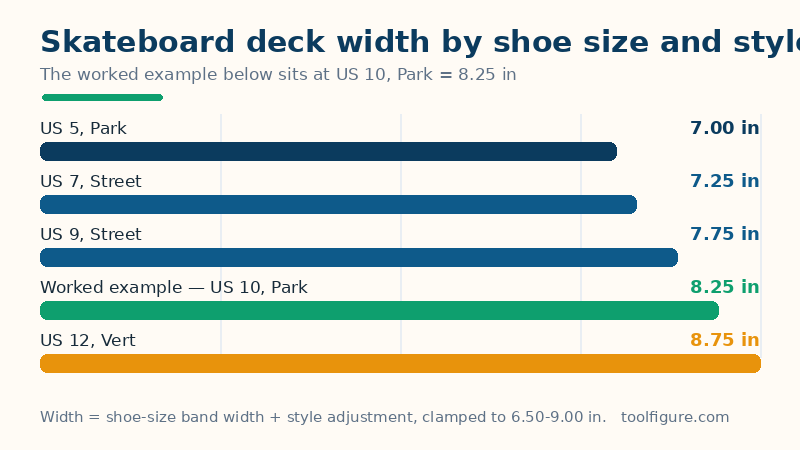
Worked example: 178 cm, US shoe size 10, Park
Take a rider who is 178 cm tall, wears US shoe size 10 and rides Park. The 10–11 band gives an unadjusted width of 8.25 in; Park riding leaves it unchanged, so the recommended width is 8.25 in (21.0 cm); height 178 cm is 160 cm and over, so the deck length is 31.5 in (80.0 cm). The same width arithmetic at other shoe sizes and styles reads:
| Shoe size | Style | Unadjusted width | Recommended width |
|---|---|---|---|
| US 7 | Street | 7.50 in | 7.25 in (18.4 cm) |
| US 12 | Vert / Cruiser | 8.50 in | 8.75 in (22.2 cm) |
| US 5 | Park | 7.00 in | 7.00 in (17.8 cm) |
| US 9 | Street | 8.00 in | 7.75 in (19.7 cm) |
| US 13 | Street | 8.50 in | 8.25 in (21.0 cm) |
And length follows height alone: a rider 150 cm tall reads a 30.0 in (76.2 cm) deck, and a rider 130 cm tall reads a 28.0 in (71.1 cm) deck, whatever their shoe size.
How to read your result, and its limits
Three checks before buying. First, width is preference as much as fit: the quarter-inch style adjustment is the direction most riders lean — street narrower for flip tricks, vert wider for stability — but plenty of street skaters ride wide and plenty of vert riders ride narrow, so treat a quarter inch either way as taste, not an error. Second, length is a starting point, wheelbase matters too: two decks of the same length can have different wheelbases, and wheelbase is what actually sets how the board turns, so check it on the specific deck before ordering. Third, kids are a different chart: the height bands here bottom out at a 28.0 in deck for riders under 140 cm, but small children ride shorter mini decks that this page does not size — a shop's kids chart is the right source under about 120 cm. For the rest of the kit, the bike frame size calculator sizes a frame from an inseam, and the snowboard size calculator sizes a board from height, ability and style.
Related tools: Ski Size Calculator — A recommended ski length range from your height, ability level and skiing style, with the full ability table.
Frequently asked questions
What size skateboard do I need?
Width comes from your shoe size and style, length from your height: 178 cm, US 10, Park is 8.25 in (21.0 cm) wide and 31.5 in (80.0 cm) long. Enter your own figures above and the calculator reads the same tables.
Does shoe size or height matter more for skateboard size?
Both, for different dimensions: shoe size sets the deck width, because your feet have to fit on it, and height sets the deck length. A tall rider with small feet gets a long, narrow deck; a shorter rider with large feet gets a shorter, wider one.
What is the difference between street, park and vert deck widths?
Street decks run a quarter inch narrower for flip tricks, vert and cruiser decks a quarter inch wider for stability, and park sits in the middle at the unadjusted shoe-size width. The adjustment is small on purpose — a quarter inch either way is taste, not a different size class.
I am between sizes — should I go wider or narrower?
Follow the style: street leans narrower, vert leans wider, park takes either. If you are still deciding, the unadjusted shoe-size width is the safe middle, and demo decks at a shop settle a quarter inch faster than any chart.
