What specific energy is
Specific energy says how much energy one unit of mass of a substance holds: a kilogram of gasoline holds about 44 megajoules, a kilogram of coal about 24 and a kilogram of hydrogen about 120 — and the same kilogram quoted in three different unit systems reads 44 MJ/kg, 18,916.6 Btu(IT)/lb and 12,222.22 Wh/kg. It is the number behind every fuel comparison, every battery rating and every explosives table, and it is simply total energy divided by mass, so a tonne of fuel holds a thousand times the energy of a kilogram of the same fuel at the same specific energy. Fuel datasheets quote megajoules per kilogram (MJ/kg); American tables quote Btu per pound (Btu/lb); and battery sheets quote watt-hours per kilogram (Wh/kg) — and all of them measure the same quantity, so gasoline at 44 MJ/kg in one datasheet is 18,916.6 Btu(IT)/lb in the report it arrived with. This page restates any specific energy in all ten units at once, worked through J/kg with every factor defined, and answers the question the conversion alone cannot: how much energy does a mass you enter actually hold?
The formula
J/kg = value × (J/kg in one "from" unit)
answer = J/kg ÷ (J/kg in one "to" unit)
total energy = specific energy × mass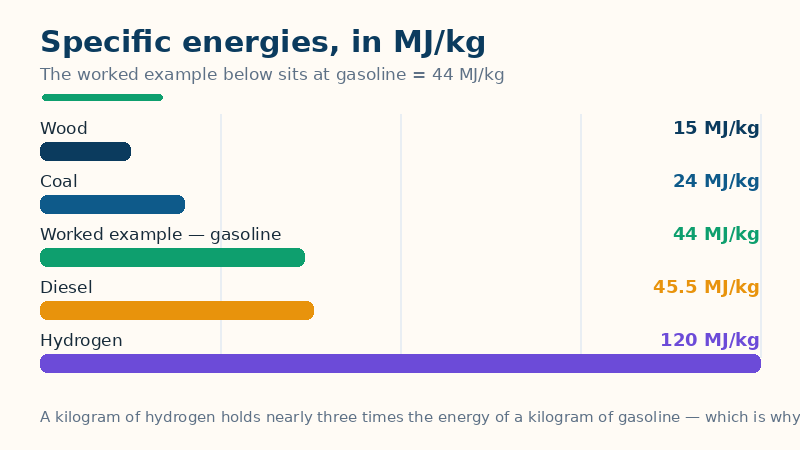
Three terms, all visible on the page. value is the number you enter. J/kg in one "from" unit is the definition of the unit you are converting from: 1 for the joule per kilogram itself, 1,000 for the kilojoule per kilogram, 1,000,000 for the megajoule per kilogram, 4,186.8 for the IT calorie per gram and for the IT kilocalorie per kilogram, exactly 2,326 for the IT Btu per pound, 2,324.4444 for the thermochemical Btu per pound, 3,600 for the watt-hour per kilogram, 3,600,000 for the kilowatt-hour per kilogram, and 2.98906692 for the foot-pound-force per pound. answer is the result in the unit you asked for. total energy is the specific energy times the mass you enter, shown in megajoules and in IT Btu, so the per-kilogram figure turns into the energy a real tank, battery or charge actually holds.
Worked example
Convert 44 MJ/kg (gasoline) to Btu(IT) per pound — the unit jump every American fuel table forces on a datasheet reader — the way the tool does it.
Step 1 — get to J/kg. One MJ/kg is 1,000,000 J/kg, so 44 × 1,000,000 = 44,000,000 J/kg.
Step 2 — read the display. The headline reads 18,916.6 Btu(IT)/lb, and the detail line shows the working: 44 MJ/kg = 18,916.6 Btu(IT)/lb — worked through J/kg: 44,000,000 J/kg ÷ the Btu (IT) per pound factor. The full table for this example reads: 44,000,000 J/kg, 44,000 kJ/kg, 44 MJ/kg, 10,509.22 cal(IT)/g, 10,509.22 kcal(IT)/kg, 18,916.6 Btu(IT)/lb, 18,929.25 Btu(th)/lb, 12,222.22 Wh/kg, 12.22 kWh/kg and 14,720,312.79 ft·lbf/lb. The extra line, at the default mass of 50 kg, reads: Total energy for 50 kg: 2,200 MJ (2,085,197.66 Btu(IT)) — specific energy × mass.
Check it. Multiplying back, 18,916.6 Btu(IT)/lb × 2,326 = 43,999,999.6 J/kg, the 44,000,000 we started from to the displayed rounding, and the total-energy line checks the same way: 44 MJ/kg × 50 kg = 2,200 MJ exactly.
Conversion table
The conversions fuel datasheets, American tables and battery sheets reach for most, each one the same two steps as the example:
| From | To |
|---|---|
| 1 kJ/kg | 0.4299 Btu(IT)/lb, 0.4302 Btu(th)/lb |
| 1 Btu(IT)/lb | 2,326 J/kg, 0.6461 Wh/kg |
| 1 cal(IT)/g | 4,186.8 J/kg, 1.8 Btu(IT)/lb |
| 1 Wh/kg | 1.5477 Btu(IT)/lb |
| TNT, 4.184 MJ/kg | 1,798.8 Btu(IT)/lb |
| Coal, 24 MJ/kg | 10,318.14 Btu(IT)/lb |
| Hydrogen, 120 MJ/kg | 51,590.71 Btu(IT)/lb |
Three everyday cross-checks for the scale, each one the same two steps: diesel at 45.5 MJ/kg is 19,561.48 Btu(IT)/lb, just above gasoline, which is why the two fuels sit side by side in fleet tables; wood at 15 MJ/kg is 6,448.84 Btu(IT)/lb, about a third of coal, which is why a wood stove eats three times the mass of a coal stove for the same heat; and one kilowatt-hour per kilogram is 3.6 MJ/kg, so a battery at 250 Wh/kg holds 0.9 MJ/kg — roughly a fiftieth of gasoline, which is the whole weight problem of electric flight in one division.
Reading the result, and its limits
Four distinctions keep this page honest. First, specific energy is not specific heat capacity: specific energy is joules per kilogram, while specific heat capacity is joules per kilogram per kelvin — the per-kelvin is the difference, and a 44 MJ/kg fuel figure must never be read as a heat-capacity figure. Second, the Btu rows need their Btu named: the IT Btu and the thermochemical Btu differ by less than a tenth of a percent, so this page carries both, separately, on every row — a fuel contract in the wrong Btu is a small error on every tonne. Third, calorie per gram and kilocalorie per kilogram always read the same number: 1 cal(IT)/g is 4,186.8 J/kg and 1 kcal(IT)/kg is the same 4,186.8 J/kg, so the two columns agree by definition, not by coincidence. Fourth, a specific energy is a property, not a promise: gasoline at 44 MJ/kg is the fuel's chemical energy, and no engine turns all of it into motion — the figure converts units, it does not rate an engine.
Related tools: Energy Converter — Joules to calories, kcal to kJ, kWh to joules and BTU — every answer in all ten units, through the exact definitions; Specific Heat Capacity Converter — Specific heat J/(kg·K) to Btu/(lb·°F), cal/(g·°C) and CHU — every answer in all ten units; Density Converter — kg/m³ to lb/ft³, g/cm³ to lb/in³, lb/gal and more — every answer in all nine units, through the exact definitions.
Frequently asked questions
How do I convert MJ/kg to Btu/lb?
Divide by 2,326 for the IT Btu. The worked example's 44 MJ/kg is 44,000,000 ÷ 2,326 = 18,916.6 Btu(IT)/lb. To go the other way, multiply by 2,326 — 1 Btu(IT)/lb is 2,326 J/kg.
What is the difference between specific energy and specific heat capacity?
Specific energy is energy per unit mass (J/kg) — how much energy a kilogram holds. Specific heat capacity is energy per unit mass per kelvin (J/(kg·K)) — how much energy warms a kilogram by one degree. The per-kelvin is the difference, and the two must never share a table.
What is the difference between Btu (IT) and Btu (th)?
The IT Btu is 1,055.05585262 J and the thermochemical Btu is 1,054.35026444 J, so per pound they are 2,326 and 2,324.4444 J/kg — less than a tenth of a percent apart, but a fuel contract in the wrong Btu misstates every tonne, so this page carries both.
Why are cal/g and kcal/kg the same number?
Because both scale by a thousand: a kilocalorie is 1,000 calories and a kilogram is 1,000 grams, so the two factors cancel. 1 cal(IT)/g is 4,186.8 J/kg and 1 kcal(IT)/kg is the same 4,186.8 J/kg.
