The formula: weight, times a skill ratio
Recommended volume = weight in kilograms × skill ratio, in litres. The ratios, in litres per kilogram, are beginner 0.70–1.00 (centre 0.85), intermediate 0.50–0.70 (centre 0.60), advanced 0.35–0.50 (centre 0.425). The shape of those numbers is the whole sport in one line: a beginner needs roughly twice the float per kilo of an advanced surfer, because paddling into a wave and standing up steadily take buoyancy, while an advanced surfer trades float for responsiveness and can surf a board that barely floats them at rest. The centre ratio is the midpoint of each band, so the centre volume always sits in the middle of its own range.
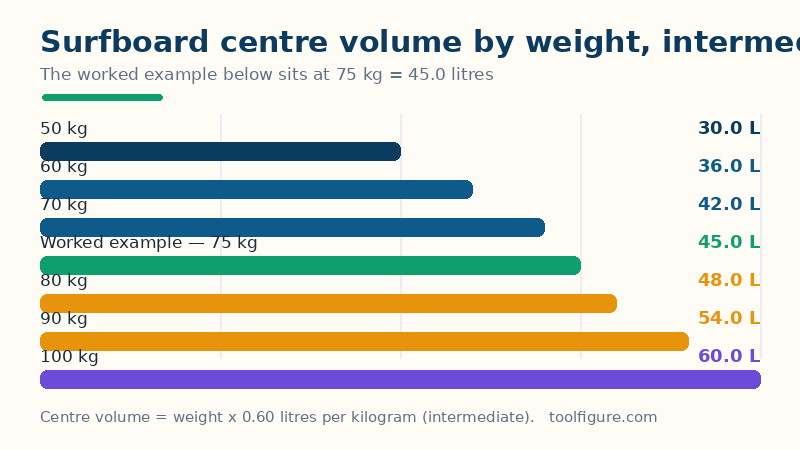
Worked example: 75 kg, intermediate
Take a surfer who weighs 75 kg and is an intermediate. The arithmetic is 75 × 0.60 = 45.0 litres, with a range of 75 × 0.50 = 37.5 litres to 75 × 0.70 = 52.5 litres — so the recommendation is 45.0 litres, range 37.5–52.5 litres. The same 75 kg rider at every skill level reads: beginner 63.8 litres (52.5–75.0 litres) — 75 × 0.85 = 63.75, shown as 63.8 — intermediate 45.0 litres (37.5–52.5 litres) and advanced 31.9 litres (26.3–37.5 litres) — 75 × 0.425 = 31.875, shown as 31.9, with the range 26.25–37.5 shown as 26.3–37.5. Notice the bands touch but do not confuse: the advanced top (37.5) is exactly the intermediate bottom (37.5), because the same board can be a stretch goal for one rider and a comfortable board for another.
More weights, intermediate
| Weight | Centre volume | Recommended range |
|---|---|---|
| 50 kg | 30.0 L | 25.0–35.0 L |
| 60 kg | 36.0 L | 30.0–42.0 L |
| 70 kg | 42.0 L | 35.0–49.0 L |
| 80 kg | 48.0 L | 40.0–56.0 L |
| 90 kg | 54.0 L | 45.0–63.0 L |
| 100 kg | 60.0 L | 50.0–70.0 L |
How to read your result, and its limits
Three checks before buying. First, check any board's printed volume against your range, not its length: a board's volume can be recovered from its own dimensions with volume ≈ length × width × thickness × 0.55, all in centimetres, divided by 1,000 — so a 188 cm × 50.8 cm × 6.35 cm board works out at about 33.4 litres, which sits inside the advanced range for a 75 kg rider and below the intermediate range, exactly as its shortboard shape suggests. Second, waves move you inside the range: small, weak waves and a still-developing paddle favour the top of the range, while powerful waves let an experienced surfer take the bottom, and a board bought for one break may sit wrong at another. Third, volume is not the whole board: two boards with the same litres can surf very differently — length, width, thickness distribution, outline and rocker all matter once the volume is roughly right — and a local shaper or shop, who knows your waves, gets the last word over any calculator. For the other half of the kit, the snowboard size calculator sizes the winter board from height instead of weight, and the weight converter restates a weight between kilograms and pounds before you enter it here.
Related tools: Ski Size Calculator — A recommended ski length range from your height, ability level and skiing style, with the full ability table.
Frequently asked questions
What surfboard volume do I need at 75 kg as an intermediate?
45.0 litres, range 37.5–52.5 litres: 75 × 0.60 = 45.0, with the intermediate band 0.50–0.70 litres per kilogram. The same rider as a beginner needs 63.8 litres and as an advanced surfer needs 31.9 litres.
How is surfboard volume calculated?
Volume in litres = weight in kilograms × a skill ratio: beginner 0.70–1.00, intermediate 0.50–0.70, advanced 0.35–0.50 litres per kilogram. A board's own volume can also be estimated from its dimensions: length × width × thickness × 0.55, all in centimetres, divided by 1,000.
Does a heavier surfer need a bigger surfboard?
Yes, in litres first and in size second: float has to carry the rider, so volume scales with weight at every skill level — a 100 kg intermediate needs 60.0 litres where a 50 kg intermediate needs 30.0. Length alone does not tell you this, which is why boards are sold by volume.
Is more volume always better for a beginner?
Up to a point, yes: extra float makes paddling easier and standing up steadier, which is why beginners take 0.70–1.00 litres per kilogram. Beyond the top of the range, though, a board becomes hard to turn and hard to duck-dive, so the range — not the maximum — is the recommendation.
