Why the rope must be twice the pitch
The rule climbers actually buy by is short: minimum rope length = 2 × longest pitch + allowance. The doubling is not caution, it is geometry. On a single-pitch climb the rope runs from the belayer on the ground, up to the anchor, and — when the climber is lowered or the party rappels — back down again, so a rope exactly as long as the pitch only reaches the top one way. The allowance, 5 metres by default here, is where tying in, the knots, the anchor setup and the ends trimmed over the rope's life all live. Guides state the same rule from the other side: you need double the length of the pitch to lower off it, which is why 60 metres became the standard outdoor rope — it covers the 25 to 27 metre pitches that dominate sport crags — and why gym walls of 10 to 15 metres get by on 30 to 40 metre ropes.
Minimum rope (m) = 2 × longest pitch (m) + allowance (m) — Rope to buy = the smallest standard length (30, 40, 50, 60, 70, 80, 100 m) at or above the minimum — Longest pitch a bought rope covers = (bought length − allowance) ÷ 2 — Feet = metres × 3.28084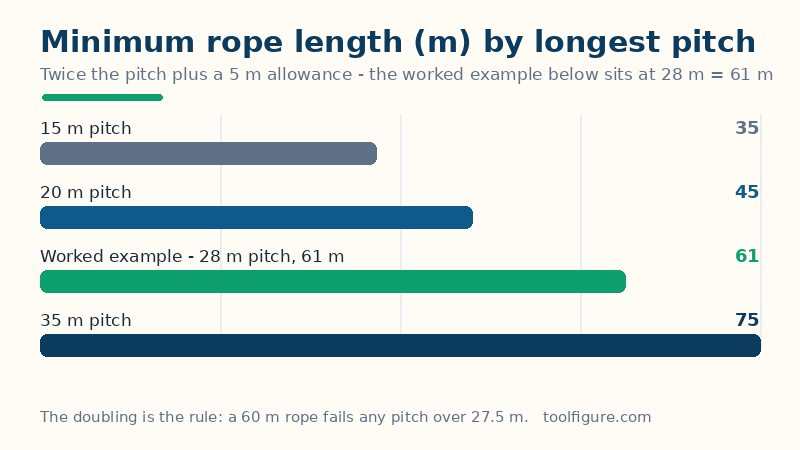
The standard lengths are not arbitrary either. Ropes are sold in steps, and the steps have gaps that matter: there is no standard 90 metre single rope on this ladder, so a pitch needing 85 metres jumps straight to a 100. That gap is worth knowing before shopping, because it is the difference between expecting a neat fit and finding a 15 metre spare — which, to be clear, is a good problem: spare rope is trimming stock, a safety knot and margin, not waste.
Worked example: a 28 metre pitch
A route whose longest pitch is 28 metres needs a minimum rope of 61 metres (200.1 ft), so the rope to buy is a 70 metre rope (229.7 ft), leaving 9 metres spare and covering a longest pitch of 32.5 metres. The working: minimum = 2 × 28 + 5 = 61 m. Feet = 61 × 3.28084 = 200.1 ft. The standard lengths go 30, 40, 50, 60, 70 — and 60 is 1 metre short of 61, so the smallest covering length is 70 m. Spare = 70 − 61 = 9 m. Longest pitch that 70 covers = (70 − 5) ÷ 2 = 32.5 m. Note the trap the worked example is built around: a 60 metre rope is the standard outdoor rope, and it fails this route by a single metre — which is exactly why the minimum is calculated rather than guessed from what is popular. The same arithmetic across the ladder, all at the default 5 metre allowance:
| Longest pitch | Minimum rope | Rope to buy | Spare |
|---|---|---|---|
| 12 m | 29 m (95.1 ft) | 30 m (98.4 ft) | 1 m |
| 15 m (gym wall) | 35 m (114.8 ft) | 40 m (131.2 ft) | 5 m |
| 20 m | 45 m (147.6 ft) | 50 m (164.0 ft) | 5 m |
| 25 m | 55 m (180.4 ft) | 60 m (196.9 ft) | 5 m |
| 28 m (worked example) | 61 m (200.1 ft) | 70 m (229.7 ft) | 9 m |
| 30 m | 65 m (213.3 ft) | 70 m (229.7 ft) | 5 m |
| 35 m | 75 m (246.1 ft) | 80 m (262.5 ft) | 5 m |
| 40 m | 85 m (278.9 ft) | 100 m (328.1 ft) | 15 m |
Check the gym row by hand: 2 × 15 + 5 = 35 m, and the smallest standard length at or above 35 is 40 m. And check the 40 metre row: 2 × 40 + 5 = 85 m, which passes 80 and lands on 100 — the gap in the standard ladder, stated rather than hidden.
How to read your result, and its limits
Three checks before trusting the figure. First, size by the longest pitch, not the route: on a multi-pitch route the rope only ever has to cover one pitch at a time, so the longest single pitch is the input, not the total height of the wall. Second, the allowance is yours to set, not a law: 5 metres covers tying in and knots for most single-pitch climbing, but a wandering route, a distant anchor or a rope you plan to trim hard all argue for more — raise it and watch the recommendation move. Third, this page sizes length only: diameter, weight, dry treatment and single versus twin or half ropes are separate decisions that depend on the climbing itself, and a correctly long rope of the wrong type is still the wrong rope.
Common mistakes
- Buying the route length. A rope as long as the pitch reaches the top and stops there — it cannot lower anyone back down. Double it first, then add the allowance.
- Forgetting the 60 metre trap. The standard rope fails any pitch over 27.5 metres at the default allowance — a 28 metre pitch already needs a 70. Check the pitch, not the popularity.
- Skipping the end knot because the rope “just reaches”. A rope with 1 metre spare has no margin for a knot, a stretch or a miscount — that is a reason to size up, not to skip the knot.
- Sizing a multi-pitch route as one pitch. A 300 metre wall does not need a 600 metre rope; it needs a rope that covers its longest pitch, used pitch by pitch.
Related tools: Climbing Harness Size Calculator — Your climbing harness size from waist and leg measurements — S, M, L or XL — with the fit checks that settle it; Climbing Shoe Size Calculator — Your climbing shoe size from foot length and fit: comfort, snug, performance or downsized; Trekking Pole Size Calculator — Your trekking pole length from height: flat, uphill and downhill settings in one page.
Frequently asked questions
How long should my climbing rope be?
Twice your longest pitch plus about 5 metres for tying in, knots and the anchor. A 28 metre pitch needs 61 metres minimum, so you buy a 70 metre rope. A 60 metre rope — the common outdoor standard — covers pitches up to 27.5 metres at that allowance.
Why does the rope need to be double the pitch?
Because it has to go up and come back down: from the belayer to the anchor and back to the ground when the climber is lowered or the party rappels. A rope exactly as long as the pitch only reaches the top one way.
What rope length do I need for a gym wall?
Gym walls are usually 10 to 15 metres, so 2 × 15 + 5 = 35 metres minimum, which means a 40 metre rope. Most gyms supply ropes, but if you bring your own, size it from the tallest wall the same way.
What if my route is longer than any standard rope?
Split it into pitches, or use twin or half ropes: the longest pitch a 100 metre rope covers is 47.5 metres at the default allowance. Anything longer is a multi-pitch route, and the rope only ever has to cover one pitch at a time.
